
Relying on datacenter IPs for high-stakes data extraction in 2026 is a recipe for instant blacklisting. You've likely hit the wall with Cloudflare's advanced bot detection or struggled to access mobile-only endpoints that simply don't respond to standard residential traffic. It's frustrating to watch your scraping success rates plummet because your infrastructure can't mimic the behavior of a real user on a cellular network. Managing IP rotation manually only adds layers of complexity that your development team doesn't have time to solve.
Integrating a mobile proxy api for scraping is the only way to leverage the inherent trust of Carrier Grade NAT (CGNAT) to bypass these sophisticated defenses. This guide shows you exactly how to programmatically integrate and rotate mobile IPs to ensure your workflows remain stable and undetected. We'll explore the mechanics of API-driven rotation, the technical requirements for scraping mobile-first ecosystems, and how to build automated systems that require zero manual oversight. You'll learn how to transform your data collection from a fragile process into a robust, enterprise-grade operation.
Key Takeaways
- Understand why CGNAT technology makes mobile IP addresses significantly more resistant to blacklisting than standard datacenter or residential proxies.
- Learn to programmatically integrate a mobile proxy api for scraping to automate rotation intervals and bypass sophisticated anti-bot challenges like Cloudflare.
- Discover the technical configuration steps for connecting high-trust mobile gateways to scraping frameworks such as Playwright, Selenium, and Scrapy.
- Master the alignment of browser fingerprints and User-Agent headers with carrier data to ensure your automated requests are indistinguishable from real mobile users.
- Explore how to scale complex data extraction by combining the mobile proxies of our partner proxied.com with the Anosim API (v1) for number rental and SMS activation.
Table of Contents
- Why Mobile Proxy APIs are Essential for 2026 Web Scraping
- Technical Architecture: How a Mobile Proxy API Works
- How to Integrate a Mobile Proxy API into Your Scraper
- Advanced Tactics: Mobile Fingerprinting and Header Management
- Scaling Extraction with High-Trust Mobile Proxy Infrastructure
Why Mobile Proxy APIs are Essential for 2026 Web Scraping
A mobile proxy API for scraping serves as a programmatic gateway that routes your data requests through 4G or 5G cellular towers rather than standard server farms. This infrastructure allows your automated scripts to adopt the identity of a genuine mobile device connected to a carrier network. In the current landscape, high-value platforms like social media networks and global retail sites have shifted to mobile-first architectures. These systems prioritize traffic originating from mobile devices, as it represents the vast majority of their legitimate user base. By using mobile IPs, your scraper operates within the trust parameters these platforms already expect.
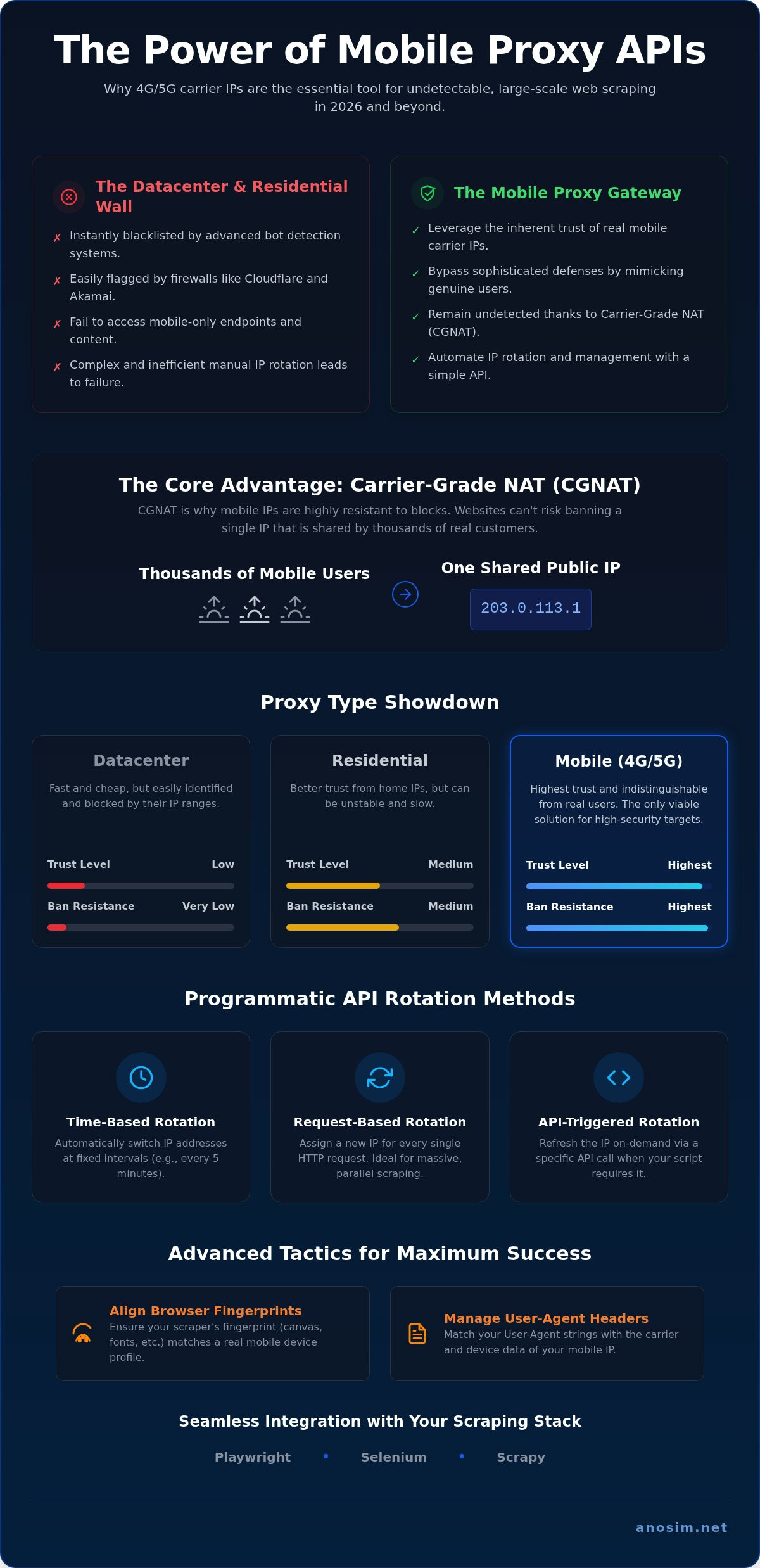
The primary technical advantage of this approach lies in Carrier-Grade NAT (CGNAT). Because mobile carriers assign the same public IP address to thousands of different users simultaneously, websites cannot easily blacklist these IPs. Blocking a single mobile IP could potentially lock out hundreds of real customers, a risk most platforms aren't willing to take. While the cost of mobile proxies is higher than other options, the investment is offset by significantly lower failure rates and reduced development time spent on troubleshooting bans. Understanding how proxy servers work at this level is vital for developers who need to maintain high-volume extraction without constant interruptions.
Datacenter vs. Residential vs. Mobile Proxies
Choosing the right proxy type depends on your target's security sophistication. Datacenter proxies are fast and inexpensive, but their IP ranges are easily identified and frequently blocked by major firewalls. Residential proxies offer better trust by using home internet connections; however, they often suffer from instability and slower speeds. Mobile proxies represent the premium tier of data extraction. They provide the highest trust levels because they utilize legitimate carrier-assigned IPs that are indistinguishable from real mobile users. If you're scraping platforms with aggressive anti-bot systems like Akamai or Cloudflare, mobile proxies are often the only viable solution.
The Role of APIs in Modern Data Extraction
Modern scraping requires moving beyond static proxy lists. Manually managing a list of IPs is inefficient and leads to rapid detection. A robust mobile proxy api for scraping automates the entire lifecycle of your connection. These APIs handle the heavy lifting of authentication, protocol management, and rotation logic. Instead of hardcoding rotation intervals, you can trigger a new IP address via a simple API call or let the gateway handle it based on your request volume. API-driven rotation is superior to manual list management because it allows for instantaneous, programmatic IP changes that align perfectly with your specific scraping velocity and target site requirements.
Technical Architecture: How a Mobile Proxy API Works
The core of a mobile proxy api for scraping is the back-connect proxy server. Instead of connecting your scraper directly to thousands of individual mobile devices, you interface with a single API gateway. This gateway acts as a load balancer and management layer, routing your outgoing requests to an available mobile IP within a carrier's pool. This architecture simplifies your code significantly; you only need to configure one endpoint in your scraping framework, while the API handles the complex logic of IP sourcing and connection stability in the background.
Efficiency in data extraction depends on your rotation logic. Most developers choose between three primary methods depending on their target site's sensitivity. Time-based rotation switches the IP at fixed intervals, such as every five or ten minutes. Request-based rotation assigns a new IP for every individual HTTP request, which is ideal for massive, parallelized scraping. For more granular control, API-triggered rotation allows your script to send a specific command to the gateway to refresh the IP only when a block is detected or a specific task is completed. If your workflow involves multi-step processes like logging into an account before extracting data, you'll need session persistence. This ensures you maintain the same mobile IP throughout the entire sequence to avoid triggering security alerts.
Understanding CGNAT and IP Reputation
Carrier-Grade NAT (CGNAT) is the primary reason mobile IPs carry such high reputation. Because IPv4 addresses are limited, mobile carriers assign a single public IP to thousands of different mobile users simultaneously. From a web server's perspective, traffic from a mobile IP is a mix of legitimate browsing, app usage, and background data. If a website blocks that IP, they risk alienating thousands of real customers. This "shared trust" model makes a mobile proxy api for scraping virtually immune to the site-wide blacklisting that plagues datacenter IP ranges. Using these "clean" IPs ensures your success rate remains high even on platforms with the most aggressive anti-bot measures.
API Endpoints and Authentication
Authentication is usually handled through two primary methods: IP whitelisting or username and password credentials. IP whitelisting is often preferred for server-side scraping as it reduces the overhead of sending credentials with every request. For more flexible or distributed setups, standard HTTP Basic authentication via the proxy gateway is the industry standard. Most providers offer standard GET or POST endpoints for managing your proxy settings programmatically. For developers building high-volume automation, reviewing the Anosim API documentation provides a clear path for implementing these architectural patterns into your custom scraping flows.
How to Integrate a Mobile Proxy API into Your Scraper
Integrating a mobile proxy api for scraping into your existing codebase requires a structured approach to ensure both reliability and anonymity. While the back-connect gateway simplifies the connection, your script must handle the logic of when and how to rotate identities. Following a disciplined integration path prevents common pitfalls like IP leakage or session desynchronization. You should begin by retrieving your API credentials and gateway address from your provider dashboard, as these details are the foundation of your configuration.
- Step 1: Access your provider dashboard to retrieve your API credentials and the back-connect gateway address. This gateway usually follows a standard hostname and port format.
- Step 2: Configure your scraping library. Whether you're using Playwright, Selenium, or Scrapy, you must point your proxy settings toward the back-connect gateway instead of a static IP list.
- Step 3: Build a rotation trigger. When your script detects a block, such as a 403 Forbidden status or a CAPTCHA, it should programmatically call the rotation API endpoint to request a new mobile IP.
- Step 4: Implement robust error handling. Mobile networks are prone to higher latency and occasional connection drops. Set your request timeouts to at least 30 or 60 seconds to accommodate cellular network jitter.
- Step 5: Validate the IP change. Use an external service like api.ipify.org within your script to verify the IP has rotated successfully before proceeding with the next data extraction task.
Python Example: Rotating Proxies with Requests
In Python, the requests library allows for simple proxy dictionary configuration. You define your proxies using the http and https keys, pointing them to your gateway URL. Leveraging a mobile proxy api for scraping allows you to use a simple requests.get() call to the rotation endpoint whenever a refresh is needed. It's critical to use a session object to maintain cookies while selectively triggering IP rotations only when necessary. Always include a timeout parameter to prevent your script from hanging indefinitely during carrier-side handovers.
import requests

proxies = {
"http": "http://user:[email protected]:port",
"https": "http://user:[email protected]:port"
}

# Call the API to rotate the IP
requests.get("https://provider-api.com/rotate?key=YOUR_API_KEY")

# Execute the scraping request
response = requests.get("https://target-site.com", proxies=proxies, timeout=30)
Node.js and Puppeteer Integration
Puppeteer requires passing the --proxy-server argument during the browser launch phase. If your proxy requires authentication, use the page.authenticate() method before navigating to your target URL. To optimize performance and reduce data costs, consider disabling images and CSS. This is particularly important with mobile proxies, where bandwidth is often a premium resource. For advanced automation flows, you can find detailed integration patterns in the Anosim API documentation, which covers programmatic control over your mobile infrastructure.
Advanced Tactics: Mobile Fingerprinting and Header Management
Using a mobile proxy api for scraping provides the necessary IP reputation, but it's only half of the equation. Sophisticated anti-bot systems analyze your request headers and browser fingerprint to ensure they align with the network type. If your connection originates from a cellular tower but your browser fingerprint indicates a Linux server or a desktop Chrome instance, you'll likely face immediate challenges. This discrepancy is a primary reason why simple IP rotation often fails on high-security targets. To maintain a high success rate, you must synchronize your User-Agent strings with the mobile carrier data associated with your proxy.
Beyond the User-Agent, managing TLS fingerprints is critical. Standard scraping libraries often have distinct TLS handshakes that differ from real mobile browsers. Tools like JA3 or JA4 fingerprinting allow servers to identify these non-human patterns before the first byte of data is even exchanged. If you don't adjust your TLS stack to mimic a mobile browser like Safari on iOS or Chrome on Android, your requests might be flagged regardless of the IP trust level. Managing cookies and local storage across rotated mobile sessions also requires care; you should isolate session data for each mobile identity to prevent cross-contamination that could lead to account linking.
Mobile-Specific HTTP Headers
Modern browsers have moved toward Client Hints, specifically the Sec-CH-UA headers, to provide hardware and platform information. You must ensure these headers are correctly populated to match your emulated device. Additionally, mimicking the natural latency and jitter of a cellular network can prevent behavioral detection systems from identifying your script as an automated bot. Mismatched headers trigger silent blocks even on high-trust IPs, where the server continues to accept requests but serves stale or throttled data without a clear error message.
Bypassing Mobile-Only App APIs
Many platforms now hide their most valuable data behind private APIs used exclusively by their iOS and Android apps. These endpoints often have stricter security requirements than web-based versions. Leveraging a mobile proxy api for scraping provides the essential infrastructure to access these app-level requests by providing the carrier-grade IP identity the API expects. For a deeper look at the technical evolution of these systems, check the Anosim Blog. If you're ready to upgrade your scraping stack, you can explore the high-trust mobile proxies from our partner proxied.com, designed for enterprise-level extraction.
Scaling Extraction with High-Trust Mobile Proxy Infrastructure
Scaling a data extraction project requires more than just high-trust IPs; it demands a unified infrastructure that manages the entire lifecycle of an automated session. The mobile proxy API for scraping comes from our partner proxied.com, while account verification runs through the Anosim API (v1). Together they let developers control rotation logic, session persistence and number supply programmatically. This level of control is essential for enterprise-level tasks where failure rates must be minimized to maintain a positive return on investment. By utilizing a global network of mobile IPs, you can bypass regional geo-blocks and access localized content with the same trust level as a domestic user. Our documentation is built specifically for high-volume automated workflows, ensuring your integration is both rapid and stable.
Solving the "Account Required" Scraping Hurdle
Many high-value targets require a verified account before displaying data. This creates a significant hurdle for scrapers that rely on guest access. You can solve this by combining mobile proxies with SMS activation or Anosim Number Rental to create and verify accounts at scale. To maintain account stability, it's vital to use a mobile proxy from the same geographic region where the account was created. This consistency prevents security triggers that often occur when an account suddenly appears on a different network type or location. Using SMS-Activate Standard API compatible services ensures that your existing automation tools can integrate these verification steps without extensive custom development.
Optimizing Performance and ROI
Efficiency in scaling isn't just about volume; it's about the precision of your resource usage. Monitoring proxy health and success rates in your proxied.com dashboard allows you to identify bottlenecks in your scraping logic. You can optimize your ROI by reducing unnecessary data consumption, such as blocking media files or using HEAD requests where full page loads aren't required. A well-configured mobile proxy api for scraping ensures that every request counts, reducing the overhead caused by retries and IP bans. This pragmatic approach to infrastructure allows your team to focus on data analysis rather than technical troubleshooting. When your operations grow, our system scales with you, providing the technical robustness needed for 2026 data environments.
Get started with the Mobile Proxy API of our partner proxied.com to build a resilient, high-trust extraction system today.
Future-Proof Your Data Extraction Strategy
Success in 2026 web scraping requires moving beyond simple IP rotation to a model that leverages the inherent trust of cellular networks. By implementing a mobile proxy api for scraping, you gain access to Carrier-Grade NAT (CGNAT) infrastructure that makes your automated traffic indistinguishable from real mobile users. We've explored how programmatic control, coupled with precise header management and fingerprint synchronization, allows you to bypass even the most aggressive anti-bot defenses without manual intervention.
Our partner proxied.com provides the high-trust 4G/5G infrastructure, and Anosim adds the developer-first tools needed to scale these operations efficiently. The Anosim API v1 automates number rental and SMS retrieval, while our platform remains compatible with SMS-Activate Standard API protocols for seamless account management. This combination of mobile identity and automated verification creates a robust environment for high-value data collection. Integrate the proxied.com Mobile Proxy API into Your Scraper Now to ensure your workflows remain stable and productive in an increasingly complex digital landscape. You're now equipped to build a scraping stack that's both resilient and highly effective.
Frequently Asked Questions
What is the difference between a mobile proxy and a residential proxy for scraping?
Mobile proxies route traffic through cellular towers, whereas residential proxies use home internet connections. The primary advantage of mobile infrastructure is the trust inherited from carrier networks. Because thousands of users share a single mobile IP via CGNAT, websites are less likely to block these addresses compared to residential IPs, which are tied to individual households. This makes mobile proxies the superior choice for scraping platforms that employ aggressive bot detection algorithms.
How often should I rotate my mobile IP via API to avoid detection?
Rotation frequency depends on the target site's security and your scraping volume. For high-security platforms, rotating every 5 to 10 minutes or after a set number of requests is common. If you're performing account-based actions, maintain the session until the task is complete to avoid triggering suspicious login alerts. A well-timed rotation strategy balances the need for fresh IPs with the requirement for session stability during multi-step extraction processes.
Can I use mobile proxy APIs with Python libraries like Scrapy or BeautifulSoup?
A mobile proxy api for scraping is fully compatible with Python frameworks like Scrapy, Selenium, and Requests. You simply configure the proxy settings in your script to point toward the API gateway address. This setup allows you to handle complex data parsing with BeautifulSoup while the API manages the underlying cellular network rotation and authentication. Using an API-driven approach ensures your Python scripts remain modular and easy to maintain as your project scales.
Why are mobile proxies more effective against CAPTCHAs?
Mobile proxies are effective because they carry the highest trust reputation of any IP type. Websites are hesitant to serve CAPTCHAs to mobile IPs because doing so would degrade the experience for thousands of legitimate cellular users sharing that same address. This inherent trust reduces the frequency of automated verification challenges. By mimicking real mobile device behavior, your scraper can navigate secure platforms with significantly fewer interruptions than datacenter-based tools.
Do mobile proxy APIs support 5G speeds for high-volume data extraction?
Premium providers like Anosim offer infrastructure that supports 5G speeds for high-volume extraction. While mobile networks generally have higher latency than datacenter connections, the increased bandwidth of 5G allows for faster data transfer once the connection is established. Integrating a mobile proxy api for scraping with 5G capabilities ensures your automated workflows can handle large data payloads without throughput bottlenecks. This high-speed access is essential for modern data projects that require real-time processing and massive scale.
Is it legal to use mobile proxy APIs for web scraping in 2026?
Scraping public data is generally legal in the United States as of June 2026 and doesn't violate the Computer Fraud and Abuse Act. However, in the EU and UK, the GDPR imposes strict rules on collecting personal data. You must have a legal basis for collection and comply with transparency requirements even when data is publicly accessible on the web. Always review the target site's terms to mitigate potential breach of contract claims.
What happens if a mobile IP is flagged by a target website?
If a mobile IP is flagged, the target website might serve a CAPTCHA or temporarily throttle requests. Because mobile IPs are shared via CGNAT, websites rarely issue permanent blocks. If you encounter a block, simply use the API to trigger an IP rotation and resume your scraping session with a fresh identity. This resilience is a key benefit of using mobile networks, as it prevents a single flagged IP from halting your entire operation.
How do I authenticate my scraper with the proxied.com Mobile Proxy API?
Authentication is handled through IP whitelisting or standard username and password credentials. Whitelisting your server's IP address in your proxied.com dashboard is the most efficient method for high-volume tasks as it reduces request overhead. Alternatively, you can pass your unique username and password through the proxy gateway for more granular control across multiple scraping nodes. Both methods provide secure, reliable access to the mobile proxy pool and can be configured programmatically via the API.