Your legacy automation setup is likely sitting on a ticking clock if you're still relying on outdated API endpoints. Most developers spent months perfecting their bots for the SMS-Activate protocol, only to face the massive service disruptions following that provider's shutdown in late 2025. You need a solution that keeps your scripts running without forcing a total code overhaul. Finding a provider that is sms-activate standard api compatible isn't just about convenience anymore; it's about operational survival in a market where technical stability is increasingly rare.
We understand that migration usually feels like a chore that risks downtime and lost revenue. That's why we've streamlined the process. You can switch to Anosim in under a minute by simply updating your host URL and API key. You'll get the same seamless integration you're used to, but with the added benefit of 100% physical SIM cards and significantly higher verification success rates. This guide will show you how to implement this plug-and-play replacement to secure zero-downtime automation. We'll also cover how to leverage integrated mobile proxies and long-term number rentals to bulletproof your account management strategy for 2026.
Key Takeaways
- Complete a 30-second migration by simply updating your endpoint and API key to maintain automation continuity without technical downtime.
- Learn why being sms-activate standard api compatible allows you to swap providers in your existing software without rewriting a single line of logic.
- Increase OTP success rates by transitioning from recycled numbers to high-trust physical SIM pools and mobile VoIP services.
- Scale your account management by integrating mobile proxies and long-term number rentals to prevent IP-based flagging and platform restrictions.
Table of Contents
- What is the SMS-Activate Standard API and Why Does It Matter?
- Core Functions Supported by the Anosim Compatible API
- Anosim vs. Legacy Providers: The Strategic Advantage
- Developer Template: 30-Second Integration Guide
- Scaling Your Automation with Anosim's Advanced Features
What is the SMS-Activate Standard API and Why Does It Matter?
The SMS-Activate Standard API is a specialized Application Programming Interface (API) protocol that has become the industry benchmark for virtual number management. It functions as a set of rules that allow your software to communicate directly with a provider's server to request numbers, receive SMS codes, and manage rental durations. Because so many automation tools were originally built to interact with this specific structure, it has evolved into a "standard" that other high-tier providers now support to ensure user flexibility.
When a service is sms-activate standard api compatible, it means you can swap your backend provider without touching your core application logic. This portability is vital for developers who value uptime. If your primary provider experiences technical issues, price hikes, or service shutdowns, you simply point your bot to a new endpoint. Anosim maintains 100% compatibility with this protocol, providing a stable infrastructure that respects your existing technical investments while offering superior number quality and reliability.
The Architecture of a Standard API Request
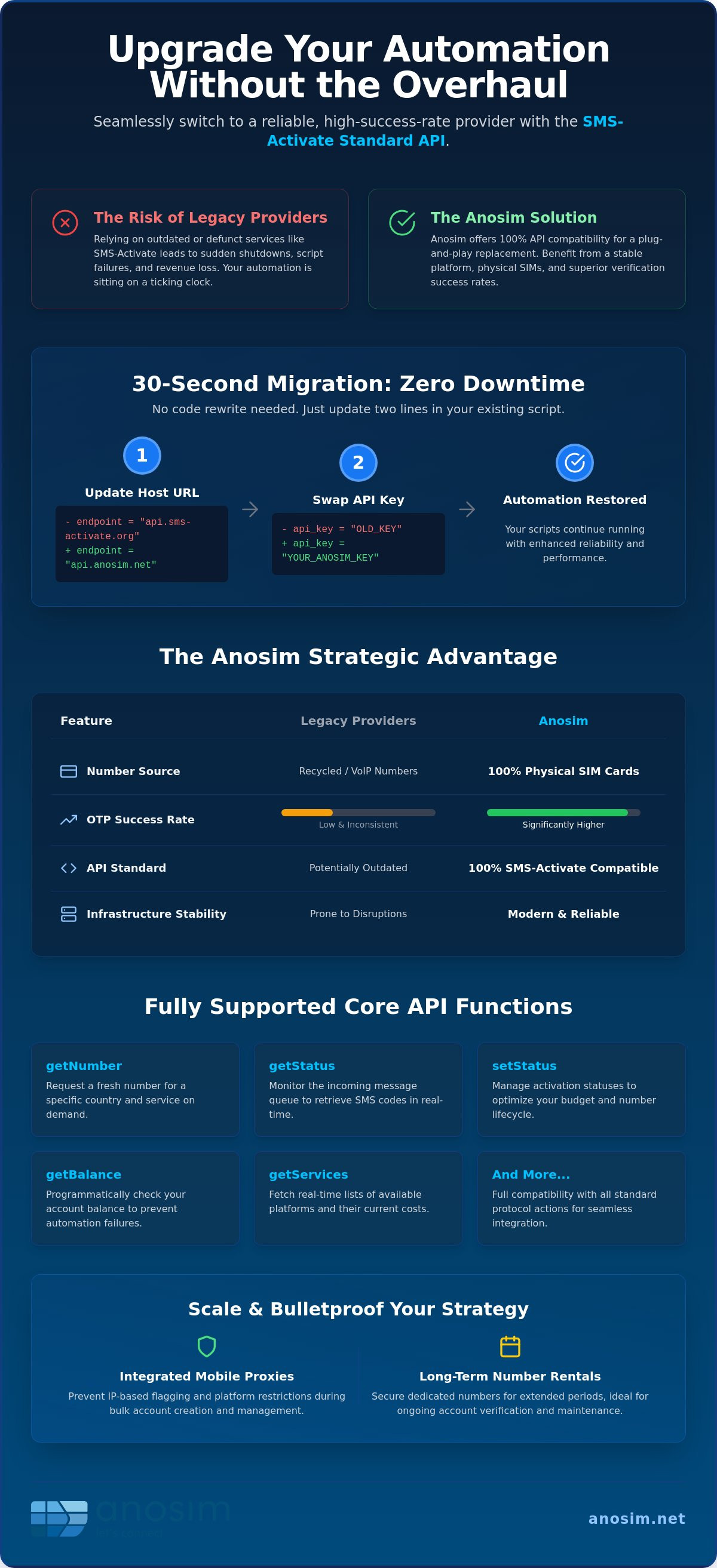
Migrating to a compatible service requires changing only two variables in your configuration: the Base URL and your API Key. The protocol relies on a predictable set of action parameters. For instance, the getNumber command initiates a request for a fresh mobile line, while setStatus tells the server when a code has been successfully received or if a number should be discarded. The getStatus command monitors the incoming message queue in real time. Most importantly, the server returns responses in a consistent JSON format. This consistency prevents your bot from crashing due to unexpected data structures; ensuring that your automation remains robust even as you scale.
Common Use Cases for API Automation
Digital professionals use this API to handle repetitive tasks that would be impossible to manage manually. Bulk account creation for social media platforms or messaging apps is the most frequent application. By automating the verification step, users can register hundreds of profiles in minutes. Developers also utilize these endpoints for automated testing of SMS-based verification flows, ensuring their own apps function correctly across different global regions. For enterprise-level operations, being sms-activate standard api compatible allows for managing thousands of activations with minimal human oversight, which significantly reduces operational costs and manual errors.
Core Functions Supported by the Anosim Compatible API
Anosim's infrastructure is designed for high-volume operations where every second counts. Because our platform is sms-activate standard api compatible, you gain access to a suite of commands that handle the entire lifecycle of a virtual number. This interoperability is a cornerstone of the modern API Economy, allowing developers to integrate diverse services without rebuilding their logic from scratch. You get the same technical familiarities while benefiting from our superior mobile network routing.
One of the primary functions is the balance check. By calling getBalance, your software can programmatically monitor your credits. This prevents automation failures during critical bulk registration tasks. Beyond financial monitoring, service discovery allows you to fetch real-time lists of available platforms and their current costs. This ensures your bot always selects the most cost-effective route for the specific country or operator you require.
Getting Started with getServices and getNumber
Precision is key when acquiring numbers. The getServices command provides a granular view of which countries and mobile operators are currently online. When you're ready to initiate a request, you'll use the getNumber action with specific service and country parameters. For a successful request, the API returns a string following the standard format: ACCESS_NUMBER:$id:$number. This predictable output allows your software to instantly parse the activation ID and the assigned phone number for use in your target application. If you're looking for a reliable way to test these endpoints, you can get started with an Anosim account to see the response times in action.
Managing Statuses and Retrieving Codes
Once a number is active, managing its status is critical for optimizing your budget. The API uses a numerical status system to guide the activation lifecycle. You'll typically set the status to '1' to indicate the number is ready to receive an SMS. From there, your bot enters a polling loop using the getStatus command. This ensures your script stays updated on the message arrival without manual checking.
High-speed retrieval is a priority; Anosim's backend is tuned to deliver verification codes the moment they hit the mobile network. If a service fails to send a code within the allotted time, you can send a cancellation status. This triggers an automatic refund of the credits to your balance, ensuring you only pay for successful verifications. Efficient polling loops should be implemented with short delays to catch one-time passwords (OTPs) without overloading your local resources. This level of control makes being sms-activate standard api compatible an essential requirement for any serious developer in the automation space.
Anosim vs. Legacy Providers: The Strategic Advantage
Legacy providers often focus on volume at the expense of infrastructure health. While being sms-activate standard api compatible allows for a smooth technical transition, the real strategic advantage lies in the underlying hardware. Most budget-tier services rely on recycled numbers or low-reputation VoIP ranges that digital platforms have already blacklisted. Anosim differentiates itself by maintaining high-trust mobile VoIP pools and real SIM infrastructure across Tier-1 countries. This ensures that the verification codes you receive are valid and that the resulting accounts remain active long after the initial registration.
Technical reliability also extends to how the backend is managed. Adhering to API design and governance best practices means our endpoints are built for consistency and security. Unlike legacy sites that often suffer from unannounced downtime or breaking changes, our API provides a stable environment for enterprise-scale automation. We offer direct technical assistance for integration, filling the support gap left by automated-only competitors who offer no recourse when a script fails.
Why 'Cheap' Numbers Often Cost More
The upfront price of a virtual number is often a misleading metric. If you purchase the cheapest available activation but the account is shadowbanned within minutes, the effective cost of that account is infinite. Legacy providers frequently cycle the same numbers across multiple services, increasing the likelihood of platform flagging. Anosim focuses on inbound SMS reliability for high-security platforms. By ensuring higher success rates on the first attempt, we improve the overall ROI of your automation scripts. You spend less time troubleshooting failed verifications and more time scaling your operations.
Integrated Privacy Infrastructure
A verification code is only one piece of the digital identity puzzle. Modern platforms look for a match between the phone number's origin and the user's IP address. This is why the synergy between our sms-activate standard api compatible endpoints and our mobile proxies is a critical advantage. You can manage the full account lifecycle; from the initial verification through to daily operations; all within a single ecosystem. This integrated approach prevents the IP-based flagging that occurs when using mismatched credentials. Anosim acts as a silent partner for professional operations, providing the discrete, high-performance tools necessary for maintaining long-term digital anonymity.
Developer Template: 30-Second Integration Guide
Migration should not require a development sprint. If your current tools are already built for the industry standard, switching to a more reliable provider is a matter of configuration, not code. Because Anosim is sms-activate standard api compatible, the transition is designed to be completed in under 30 seconds. This allows you to maintain your automation workflows while immediately benefiting from higher trust scores and better number availability.
- Step 1: Access your Anosim dashboard to generate a unique API key. Ensure your account is funded to prevent initial connection errors during the test phase.
- Step 2: Open your existing software or custom bot and locate the API settings or the specific configuration file where the provider details are stored.
- Step 3: Replace the legacy provider's Base URL with the Anosim API endpoint. This is the single most important step for redirecting your requests to our high-trust infrastructure.
- Step 4: Input your new API key and execute a balance check command. A successful response confirms that your authentication and connection are valid.
- Step 5: Perform a test activation for a low-cost service. This step verifies that your software correctly maps the JSON response and captures the activation ID as expected.
To begin your migration and secure a more stable endpoint for your scripts, register for an Anosim API key today and experience zero-downtime integration.
Python Example: Quick Migration Script
For developers using Python, the change is minimal. You only need to update the request string to point to the Anosim handler. The 'action' parameter in the URL determines the specific operation the server performs; such as retrieving a balance or requesting a new number. Most legacy scripts use the requests library, where you can simply swap the base string. Ensure your script handles the standard response format, which Anosim follows strictly to prevent parsing errors in your existing logic.
Troubleshooting Common Migration Errors
If you encounter an 'Invalid API Key' error, double check that no leading or trailing spaces were copied into your configuration. A 'No Balance' response usually indicates that the account hasn't met the minimum deposit requirement for the requested service. Most modern bots support the latest standard protocol, but if your responses seem inconsistent, verify that your software isn't using a deprecated version of the API logic. For custom requirements or high-volume enterprise needs, our support team is available to assist with specific integration parameters to ensure your sms-activate standard api compatible setup remains stable.
Scaling Your Automation with Anosim's Advanced Features
Basic activations are often the entry point for automation, but sustainable scaling requires a more sophisticated infrastructure. Professional operations eventually outgrow the need for one-time codes and move toward deeper account management. While many competitors restrict their API access to simple verification, Anosim provides a broader feature set designed for growth. Because our endpoints are sms-activate standard api compatible, you can easily expand your operations from simple registrations to complex, multi-stage digital identity management without changing your technical foundation.
Managing high-concurrency requests is a core requirement for enterprise users. Our backend architecture is built to handle thousands of simultaneous API calls without latency spikes. This ensures that even during peak load times, your bot receives responses instantly. We also offer detailed logs for every request, allowing you to debug your automation scripts in real time. We prioritize future-proofing by maintaining both our native Anosim API (v1) and the standard protocol; this dual support ensures that your setup remains functional even as industry standards evolve and platform security measures become more stringent.
API-Driven Number Rentals
While one-time activations are ideal for quick tasks, recurring verification needs require a dedicated solution. Through our API, you can transition to long-term number rentals to maintain access to specific accounts over weeks or months. This is particularly useful for business management or platforms that require periodic re-verification. You can automate the renewal process programmatically, ensuring your digital identities never expire due to a missed manual payment. Dedicated numbers are particularly effective for managing sensitive apps that frequently challenge users with secondary verification codes, providing a layer of stability that recycled lines can't match.
The Power of Mobile Proxy Integration
A common mistake in automation is pairing a high-trust phone number with a low-trust data center IP. Platforms easily detect this mismatch and flag the account immediately. Anosim solves this by integrating 4G/LTE mobile proxies directly into your workflow. By using a proxy that matches the mobile origin of your SMS verification, you significantly reduce the risk of IP-based flagging. This combined approach creates a seamless privacy shield for your bot. You can Learn more about our Mobile Proxy services to see how they complement your sms-activate standard api compatible setup and provide a complete infrastructure for your digital tasks.
Securing Your Automation Infrastructure for 2026
Migrating to a more reliable infrastructure doesn't have to be a technical burden. By choosing a provider that is sms-activate standard api compatible, you ensure that your existing scripts and bots remain operational with zero downtime. You've seen how a simple endpoint update grants access to high-trust mobile VoIP pools and global numbers for platforms like Tinder, Telegram, and Google. This transition isn't just about maintaining the status quo; it's about upgrading to a setup that includes integrated 4G proxies and long-term rental options that legacy providers can't match.
Reliability in the virtual number market is the difference between a successful bulk registration and a shadowbanned account. Anosim provides the stability and technical support necessary for enterprise-scale operations, allowing you to focus on scaling your business rather than troubleshooting failed verifications. Whether you're managing one-time activations or recurring digital identities, the right API is the silent partner your operation needs to thrive.
Upgrade your automation with Anosim's API today and build your digital footprint on a foundation of high-trust mobile network infrastructure. Your automation deserves a provider that prioritizes performance and security as much as you do.
Frequently Asked Questions
Is Anosim fully compatible with the SMS-Activate Standard API?
Yes, Anosim is 100% sms-activate standard api compatible, allowing for a seamless transition from legacy providers. Our infrastructure supports all standard action parameters, including getBalance, getNumber, and setStatus. This means your existing automation tools and custom bots will function exactly as they did before, but with the added benefit of our high-trust mobile network routing and superior verification success rates.
Do I need to change my code to use Anosim if I already use SMS-Activate?
You don't need to rewrite your code; you only need to update your configuration variables. Migration is a 30-second process where you replace the old provider's Base URL with the Anosim endpoint and input your new API key. Your software's internal logic for parsing JSON responses and managing number lifecycles remains identical, ensuring zero downtime for your ongoing automation projects.
What is the base API endpoint for Anosim's compatible service?
The base API endpoint for Anosim's compatible service is found in your account dashboard under the API settings section. Once you've registered, you'll see the specific URL designed to handle requests formatted for the sms-activate standard api compatible protocol. Simply copy this URL into your bot's host field to redirect all traffic to our servers instantly.
Can I manage long-term number rentals through the API?
Yes, Anosim supports both one-time SMS activations and long-term number rentals via our API. You can programmatically request a number for a specific duration and automate the renewal process to maintain a consistent digital identity. This feature is essential for platforms that require recurring verification or for businesses that need to manage dedicated mobile lines without manual intervention.
What happens if a number doesn't receive an SMS code?
If a number fails to receive a code within the activation window, you can send a cancellation status via the API to trigger an automatic refund. Anosim only charges for successful verifications, so you don't lose credits on failed attempts from the service platform's side. This automated refund policy ensures your budget is spent efficiently and protects your ROI during bulk operations.
Does Anosim support bulk SMS activations for automated bots?
Anosim is built specifically to handle high-concurrency requests from automated bots and bulk registration software. Our backend architecture processes thousands of simultaneous requests across various countries and services without performance degradation. This makes our platform a robust choice for enterprise-level operations that require a stable, high-volume endpoint for their verification workflows.
Is there a limit to the number of API requests I can make per minute?
Anosim offers high rate limits to accommodate professional scaling, though specific thresholds depend on your account tier and current server load. We design our infrastructure to support rapid polling and high-frequency activations without triggering artificial bottlenecks. If your operation requires custom rate limits for extreme volume, our technical support team can assist with a tailored configuration.
How do I get an API key for Anosim?
You can generate your unique API key by creating an account on the Anosim website and navigating to the developer dashboard. Once your account is verified and funded, your key becomes active immediately. Keep this key secure, as it provides programmatic access to your balance and allows you to manage all your SMS activations and mobile proxies from a single interface.