Managing online accounts across different countries has become increasingly complex. Businesses need to maintain reliable network connections, support regional verification requirements, protect account credentials, and ensure that their applications function correctly for international users.
For companies operating in multiple markets, a successful workflow involves more than creating an account or receiving a verification message. Network location, session consistency, phone number availability, SMS delivery, and account recovery all contribute to the overall user experience.
Two technologies that can support these requirements are residential proxies and virtual phone numbers.
Residential proxies provide access to the internet through IP addresses associated with residential networks. Virtual phone numbers offer an alternative way to receive SMS messages and manage phone-based communications without requiring a dedicated physical device for every number.
Although these services operate independently, they can complement each other in regional application testing, international business communications, authorized account administration, and software automation.
This article explains how residential proxies and virtual phone numbers work, examines seven practical ways to use them effectively, and explores how services such as RapidProxy and Anosim can support different parts of a reliable digital workflow.
Understanding Residential Proxies and Virtual Phone Numbers
Before combining these technologies, it is important to understand their individual roles. A residential proxy manages network connectivity, while a virtual phone number provides access to a phone-based communication channel.
They address different technical requirements and should not be treated as interchangeable solutions.
What Are Residential Proxies?
Residential proxies are intermediary servers that route internet traffic through IP addresses associated with residential internet service providers.
When an application connects through a residential proxy, its requests are forwarded through the proxy infrastructure before reaching the destination website. The website generally observes the proxy's exit IP address rather than the original public IP address of the application.
This capability is useful for organizations that need to test regional website behavior or access geographically localized public information.
For example, an international e-commerce company may need to check whether visitors in Japan see prices in Japanese yen while visitors in Germany see prices in euros. Residential proxies can help the company examine these different regional experiences without maintaining physical offices in each country.
Residential proxies are also used in SEO monitoring, authorized web data collection, application quality assurance, and market research.
However, a residential IP address does not guarantee unrestricted website access. Websites may evaluate additional signals, including account permissions, browser configuration, request frequency, and application behavior.
What Are Virtual Phone Numbers?
Virtual phone numbers allow users to receive phone-based communications through an online service rather than relying exclusively on physical SIM cards and dedicated mobile devices.
Depending on the provider, available features may include SMS activation, temporary number access, longer-term number rental, and API-based message retrieval.
These services can be useful for businesses testing SMS verification systems, developers evaluating international onboarding experiences, and organizations managing supported phone communication workflows.
For example, a software company launching an application in several countries may need to verify that its registration system correctly sends SMS messages to supported international numbers.
Using virtual numbers can make certain testing processes more flexible, particularly when maintaining physical devices for every target market would be impractical.
Anosim provides virtual phone number services, including SMS activation and number rental options.
It is important to recognize that virtual numbers are not universally accepted. Some platforms restrict particular number categories or require dedicated mobile numbers. Compatibility should always be confirmed before a number is used for an important business account.
Why Residential Proxies and Virtual Numbers Work Well Together
Residential proxies and virtual phone numbers support different stages of an online workflow.
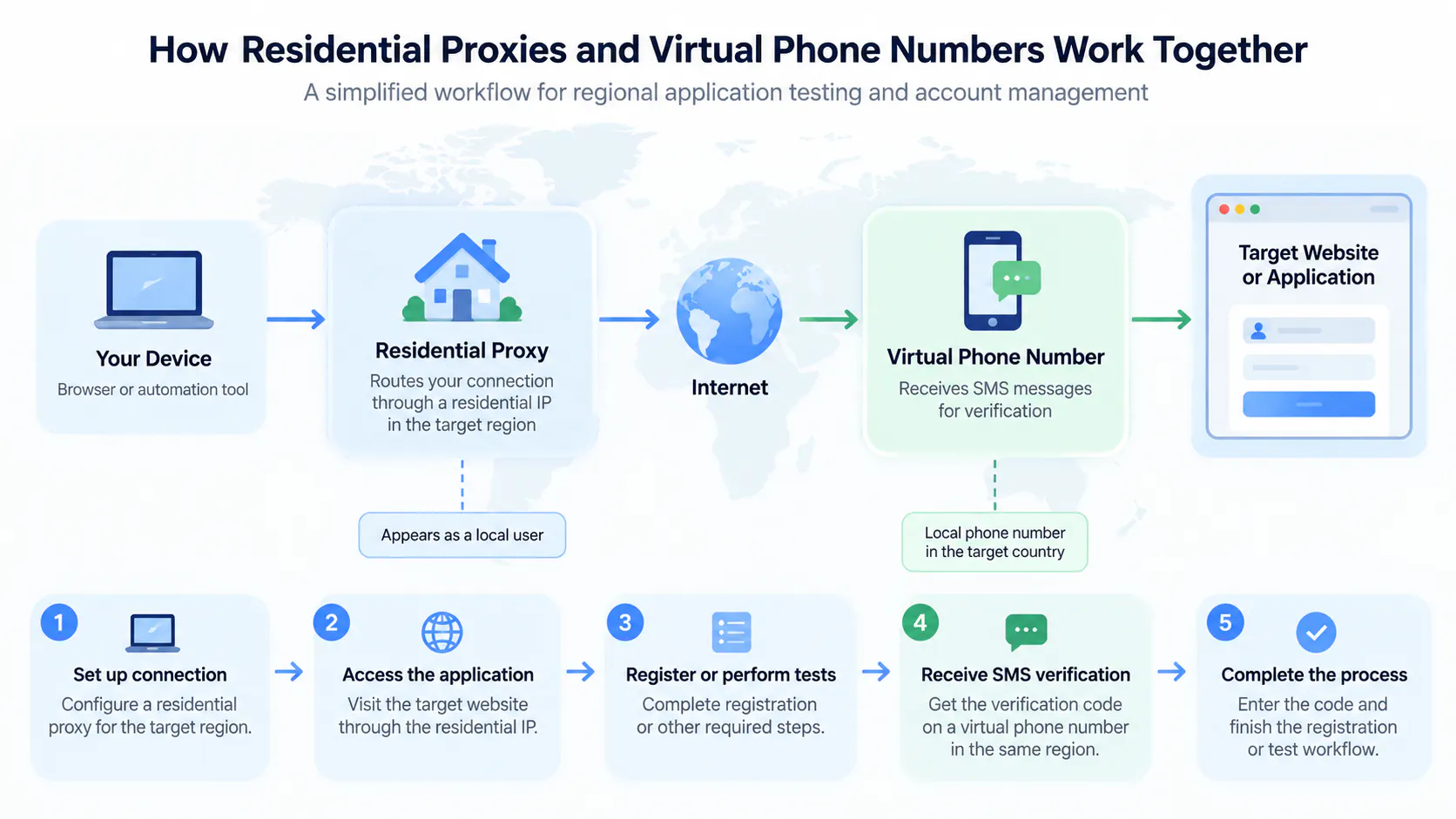
A residential proxy determines how an application connects to a website and which geographic network location the destination observes. A virtual phone number provides a channel for receiving SMS messages or supporting phone-based verification.
Consider a company preparing to launch a customer registration system in multiple countries.
Its quality assurance team may need to test the registration page from a German network connection, confirm that the correct language and regional options appear, and verify that an SMS message reaches an authorized German test number.
A residential proxy can support the regional network testing component. A virtual number can support the SMS reception component when the application and number provider permit it.
The two services do not automatically validate each other. A successful proxy connection does not guarantee SMS delivery, and a successfully received SMS does not guarantee that a website will approve an account.
- Primary purpose: residential proxies: network connectivity; virtual phone numbers: SMS reception and phone communication.
- Main resource: residential proxies: residential IP address; virtual phone numbers: telephone number.
- Geographic capability: residential proxies: country or region targeting; virtual phone numbers: country-specific number availability.
- Typical applications: residential proxies: regional testing, research, automation; virtual phone numbers: SMS verification testing, communications.
- Integration methods: residential proxies: HTTP(S), SOCKS5, proxy APIs; virtual phone numbers: web dashboards, SMS APIs.
- Important consideration: residential proxies: connection stability and IP location; virtual phone numbers: number compatibility and message delivery.
Understanding these differences helps businesses choose the right tools without introducing unnecessary complexity.
7 Best Practices for Combining Residential Proxies and Virtual Numbers
1. Maintain Geographic Consistency Across Testing Environments
Geographic consistency is important when evaluating how international websites and applications behave.
Many digital services customize their content according to a visitor's apparent location. This can affect language selection, product availability, payment methods, regional notices, and customer onboarding options.
For example, a company testing its German registration experience may use a German residential proxy to reproduce a local network environment. If the test also involves SMS verification, the team may use an authorized German test number to examine how the application handles that verification path.
This allows developers to identify regional problems that may not appear when testing exclusively from their office network.
However, geographic consistency requires more than choosing a country in a proxy dashboard.
IP geolocation databases can disagree about the location of the same IP address. One service may classify an address as belonging to Germany, while another database may associate it with a neighboring country or an outdated location.
For reliable testing, developers should verify the observed IP address and its reported location before beginning a test.
They should also record the browser's language, timezone, and application configuration. These variables can influence regional behavior independently of the proxy connection.
The objective is to reproduce legitimate regional user experiences accurately, not to misrepresent identity or circumvent service restrictions.
2. Use Sticky Sessions When Connection Continuity Matters
Residential proxy services commonly provide rotating and sticky sessions.
A rotating session changes the exit IP address according to the provider's configuration. This can be useful for independent data collection requests or regional research tasks that do not require a persistent connection identity.
A sticky session maintains the same exit IP for a defined period, making it more appropriate for workflows that involve several connected steps.
For example, imagine a developer testing a registration process that requires opening a website, completing a form, requesting an SMS message, and submitting a verification code.
If the exit IP changes unexpectedly during the test, the application may behave differently, introducing another variable into the troubleshooting process.
A sticky session provides a more consistent network environment and helps the developer isolate application errors from connection changes.
RapidProxy supports both rotating and sticky residential proxy sessions, allowing developers to select a connection strategy according to their requirements.
The appropriate session duration depends on the application. A short website availability check may not require a persistent IP, while a longer browser-based test may benefit from one.
Teams should avoid unnecessary IP changes during workflows where network continuity is important.
3. Choose the Appropriate Virtual Number Type
Virtual phone numbers are available in different arrangements, and the right choice depends on the intended workflow.
Some services provide temporary numbers for short-term SMS reception. Others offer rented numbers that remain available for a longer period.
A temporary number may be appropriate for an authorized, one-time software test when future access to the number is unnecessary.
A longer-term number is generally more suitable for business accounts that may require repeated verification, ongoing communication, or account recovery.
For example, a company testing its own application may only need to receive a verification message once. By contrast, an organization using a phone number for an important business service should consider whether it will retain access to that number months later.
Before selecting a virtual number, businesses should evaluate service compatibility, country availability, rental duration, message retrieval methods, and recovery requirements.
Anosim offers SMS activation and number rental services that can support different communication and verification scenarios.
For important accounts, organizations should prioritize long-term control and reliable recovery options rather than choosing a temporary number solely because it is inexpensive.
4. Separate Network Problems From SMS Verification Problems
A registration or verification workflow can fail for several reasons.
One common mistake is assuming that every unsuccessful attempt is caused by the proxy connection.
In reality, network connectivity and SMS delivery are independent processes.
A browser may fail to connect because of incorrect proxy credentials, DNS resolution problems, connection timeouts, or an unavailable destination server.
An SMS verification attempt may fail because the selected number is unsupported, the rental has expired, the message is delayed, or the application rejects the verification request.
These failures require different troubleshooting methods.
A reliable workflow should first confirm that the network connection is functioning correctly. Developers can test whether the application reaches an approved diagnostic endpoint and whether the observed exit IP matches the expected location.
The SMS component should then be tested independently by confirming that the selected number is active and can receive supported messages.
Separating these checks makes it easier to identify the source of a problem.
For larger systems, teams can record connection status, request latency, SMS delivery status, and verification completion time.
Sensitive verification codes should not be stored in plain-text logs or exposed through unsecured monitoring dashboards.
5. Select Proxy Infrastructure Based on Actual Workload Requirements
Choosing a proxy provider requires more than comparing the number of advertised IP addresses.
The most important characteristics depend on how the service will be used.
For a small regional application test, connection stability, accurate geographic targeting, and straightforward configuration may be the highest priorities.
For large-scale authorized data collection, developers may also need high concurrency, predictable bandwidth pricing, reliable rotation, and compatibility with automation frameworks.
For example, a company monitoring public product prices across several countries may need to process many independent requests. Its main concerns may include successful response rates, bandwidth consumption, and regional coverage.
A company testing an account registration flow may prioritize stable sessions and predictable network behavior instead.
RapidProxy provides residential proxy infrastructure with features including:
- 70M+ residential IPs
- Residential traffic starting at $0.55/GB
- Non-expiring traffic
- Rotating and sticky sessions
- HTTP(S) and SOCKS5 support
- High-concurrency capabilities
These capabilities can support applications built with Python, Node.js, Playwright, Selenium, and Puppeteer.
However, the best way to evaluate proxy infrastructure is to test it using a representative workload.
Developers should measure connection success, latency, observed geographic location, bandwidth consumption, and overall operational cost.
A smaller, stable configuration that meets the application's requirements may be more valuable than a larger configuration that is difficult to maintain.
6. Integrate APIs and Browser Automation Carefully
Automation can improve efficiency when businesses need to repeat the same testing process across multiple countries or environments.
Browser automation frameworks such as Playwright, Selenium, and Puppeteer can interact with websites programmatically.
Residential proxies can provide the network configuration, while a virtual number service may offer an API for retrieving supported SMS messages.
For example, a company testing its own registration system could create an automated workflow that opens the application through a selected residential proxy, submits test information, requests an SMS to an authorized number, and verifies the resulting application behavior.
A simplified workflow might include the following stages:
- Configure the browser with approved proxy credentials.
- Confirm the exit IP and expected geographic location.
- Open the application's testing environment.
- Submit the designated test account information.
- Request an SMS to an authorized test number.
- Retrieve the message through the supported verification API.
- Complete the test and record the outcome.
In a production-quality testing system, each stage should have its own timeout and error handling.
For example, a proxy connection failure should not trigger repeated SMS requests. Similarly, an SMS delivery delay should not automatically cause the browser to restart.
This separation reduces unnecessary traffic and makes failures easier to diagnose.
Automation should be performed only on systems and accounts the organization is authorized to use, while respecting applicable rate limits and service policies.
7. Prioritize Security and Long-Term Account Recovery
Security is a fundamental requirement for any system that combines network access and phone-based verification.
Proxy credentials, browser sessions, SMS messages, and account recovery information may all contain sensitive data.
Organizations should restrict access to these resources and avoid storing credentials directly in application source code.
Where possible, secrets should be managed through protected environment variables or dedicated secret-management systems.
Virtual phone numbers also introduce account recovery considerations.
A temporary number may become unavailable after its activation or rental period ends. If that number was used as the only recovery method for an important account, losing access to it could create serious operational problems.
For business-critical services, organizations should use durable authentication methods and maintain recovery channels under their control.
Passkeys, authenticator applications, and dedicated business-owned phone numbers may provide stronger long-term arrangements when supported.
Residential proxies do not replace authentication security, and virtual numbers do not guarantee account ownership.
A reliable system combines network stability, secure credential management, and appropriate recovery planning.
Real-World Use Cases for Businesses and Developers
International SaaS Registration Testing
Imagine a SaaS company preparing to expand into Germany, Japan, and the United States.
Before launch, its development team needs to confirm that visitors from each market see the correct registration pages and that the company's SMS verification system functions properly.
The team can configure residential proxies for the relevant countries and use authorized virtual test numbers to examine the verification process.
For each market, developers can record whether the correct language appears, whether the registration form accepts supported phone formats, how long SMS delivery takes, and whether the application handles errors correctly.
This testing process may reveal issues that would otherwise remain unnoticed until customers begin registering.
For example, a website might display the correct language but reject valid international phone number formats. Another market might experience delayed SMS delivery even though the browser connection is stable.
By testing network behavior and SMS reception separately, developers can identify these problems more accurately.
E-Commerce Localization and Customer Experience
International e-commerce businesses frequently need to evaluate how their websites appear to customers in different countries.
Regional differences can include product availability, shipping options, pricing, promotional campaigns, and checkout requirements.
Residential proxies can help quality assurance teams access localized versions of their websites.
If the company also uses phone verification during registration or checkout, supported virtual numbers can help test those processes.
For example, a retailer might use a residential proxy to confirm that its Japanese storefront displays prices in yen and offers the expected shipping options.
The team can then test whether its own checkout system correctly handles a supported Japanese phone number.
This combined approach helps organizations evaluate the complete customer experience rather than checking individual pages in isolation.
Authorized Business Account Administration
Businesses may maintain legitimate accounts across multiple digital platforms, including customer support systems, advertising services, and e-commerce tools.
These accounts often require secure authentication and reliable network access.
Residential proxies can provide controlled regional connectivity where permitted, while long-term virtual numbers may support approved business communication or verification requirements.
However, organizations should avoid treating temporary numbers as permanent account recovery methods.
A more reliable approach is to document account ownership, assign appropriate employee permissions, maintain stable recovery channels, and use consistent network configurations where operationally necessary.
The objective should be reliable account administration rather than bypassing a platform's security controls.
Software Quality Assurance and Automated Testing
Developers can also use residential proxies and virtual numbers to test how applications respond to different network and verification conditions.
For example, a quality assurance team might need to confirm that an application handles delayed SMS messages correctly.
The team can reproduce the expected regional network environment through a proxy and use a supported SMS testing service to evaluate message reception.
Other useful test cases include expired verification codes, unavailable numbers, network timeouts, and interrupted browser sessions.
These scenarios help developers identify weaknesses in their applications before they affect real users.
For applications under the organization's control, dedicated test accounts and simulated SMS delivery are often preferable for repeatable automated testing.
Common Technical Challenges and How to Solve Them
Even carefully designed workflows may experience technical problems.
One common challenge is inaccurate IP geolocation. Different websites and databases may report different locations for the same address. Developers should verify the observed IP location and record inconsistencies before drawing conclusions about application behavior.
Another challenge is unstable proxy connectivity. Temporary timeouts or authentication failures can interrupt automated workflows. Applications should implement reasonable timeouts, limited retries, and connection monitoring.
SMS delivery can also be unpredictable. A number may be unavailable, unsupported by the target service, or unable to receive a particular message. Teams should confirm number compatibility and avoid assuming that every delivery failure is caused by the network connection.
Session management introduces additional complexity. If a workflow requires a consistent exit IP, unexpected rotation may make troubleshooting more difficult. Sticky sessions can reduce this variable when supported by the provider.
Finally, integrating multiple services can complicate error reporting. Clear status tracking and independent monitoring for proxy connectivity and SMS reception help teams identify failures without exposing sensitive information.
A practical troubleshooting approach is to isolate one component at a time rather than changing the proxy, browser, phone number, and application configuration simultaneously.
How RapidProxy and Anosim Complement Different Workflows
RapidProxy and Anosim provide different components of a modern digital operations environment.
RapidProxy focuses on proxy connectivity, geographic flexibility, and session management. Its residential proxy infrastructure can support regional website testing, authorized data collection, and browser automation.
Anosim focuses on virtual phone numbers, SMS activation, and number rental services.
For businesses that require both capabilities, the services can be incorporated into a broader workflow without requiring them to perform the same function.
- Access localized website content: RapidProxy residential proxies
- Maintain consistent network sessions: RapidProxy sticky sessions
- Receive supported SMS verification messages: Anosim virtual numbers
- Retain access to a number for longer periods: Anosim number rental
- Test regional onboarding and SMS delivery: Both services
- Automate authorized testing workflows: Proxy configuration and supported SMS APIs
The main advantage of this approach is flexibility.
Organizations can choose a proxy configuration based on network requirements and select a phone number arrangement based on communication or verification requirements.
This separation also makes it easier to troubleshoot failures, control costs, and replace individual components when business needs change.
Choosing a Cost-Effective Setup
Cost efficiency is an important consideration when combining residential proxies and virtual phone numbers.
Proxy services may charge according to bandwidth usage, allocated IP addresses, or subscription duration. Virtual number services may charge per activation, rental period, or supported receiving service.
For example, RapidProxy residential traffic starts at $0.55/GB.
Its non-expiring traffic model can be useful for businesses with irregular workloads because unused traffic does not expire according to a fixed short-term usage window.
Eligible users can also apply the promotional code RAPID10 for a 10% discount.
For virtual numbers, the total cost depends on the country, number type, availability, and required rental duration.
A short-term number may be economical for a temporary test, while a longer-term number may be more appropriate for ongoing business communication.
Businesses should also account for operational costs that are not immediately visible in the advertised price.
These may include troubleshooting time, failed tests, integration maintenance, and account recovery risks.
For example, selecting the cheapest temporary number may not be cost-effective if losing access to it later creates an expensive recovery problem.
Similarly, choosing a proxy solely because it offers a large IP pool may not be useful if the application requires only a small number of stable regional connections.
The most meaningful metric is the total cost of completing the intended business workflow reliably.
Final Thoughts
Residential proxies and virtual phone numbers solve two distinct challenges in modern digital operations.
Residential proxies provide geographic network flexibility and connection management. Virtual phone numbers provide a separate communication channel for SMS reception and supported verification processes.
When combined responsibly, these technologies can support international application testing, business communications, authorized account administration, and software quality assurance.
The most effective approach is to select reliable infrastructure, maintain consistent network sessions when necessary, verify phone number compatibility, and implement appropriate security controls.
For businesses and developers exploring these capabilities, RapidProxy offers residential proxy solutions starting at $0.55/GB, while Anosim provides virtual phone number and SMS services.
By choosing the right tools for each requirement, organizations can build more flexible, maintainable, and reliable international workflows.