What if the "residential" IP you just purchased is actually the reason your accounts are being flagged as suspicious? In 2026, platforms have evolved to detect even the most subtle inconsistencies in network traffic, making standard proxy solutions increasingly unreliable. You've likely dealt with the frustration of frequent account bans, high latency, and the constant headache of IPs that rotate right when you need a stable session. It's a common hurdle for professionals who require consistent, high-trust digital footprints for their operations.
This guide will help you master the technical nuances of a dedicated mobile proxy to ensure maximum account stability and seamless automation. By leveraging carrier-grade network architecture, you can achieve the trust scores necessary for uninterrupted account management. We'll examine how to secure clean, private IP addresses that don't rotate unexpectedly and how to streamline your workflow using technical tools like the API of our proxy partner proxied.com. You'll gain a clear understanding of how to maintain a professional-grade infrastructure that prioritizes reliability, technical robustness, and digital privacy.
Key Takeaways
- Understand how CGNAT architecture provides a layer of anonymity by blending your traffic with thousands of legitimate carrier users.
- Learn why a dedicated mobile proxy is the essential tool for maintaining high trust scores and session persistence during sensitive account management tasks.
- Identify the technical benchmarks for 2026, focusing on the speed advantages of 5G and the necessity of SOCKS5 protocol support for modern software.
- Streamline your setup process by mastering authentication methods and carrier-specific targeting for localized operations.
- Explore how combining mobile proxies with SMS activation services creates a unified infrastructure for secure, automated identity management.
Table of Contents
- What is a Dedicated Mobile Proxy?
- Dedicated vs. Rotating Mobile Proxies: Choosing Your Workflow
- Key Technical Features to Evaluate in 2026
- How to Set Up and Integrate a Dedicated Mobile Proxy
- Maximizing Security with Anosim Mobile Infrastructure
What is a Dedicated Mobile Proxy?
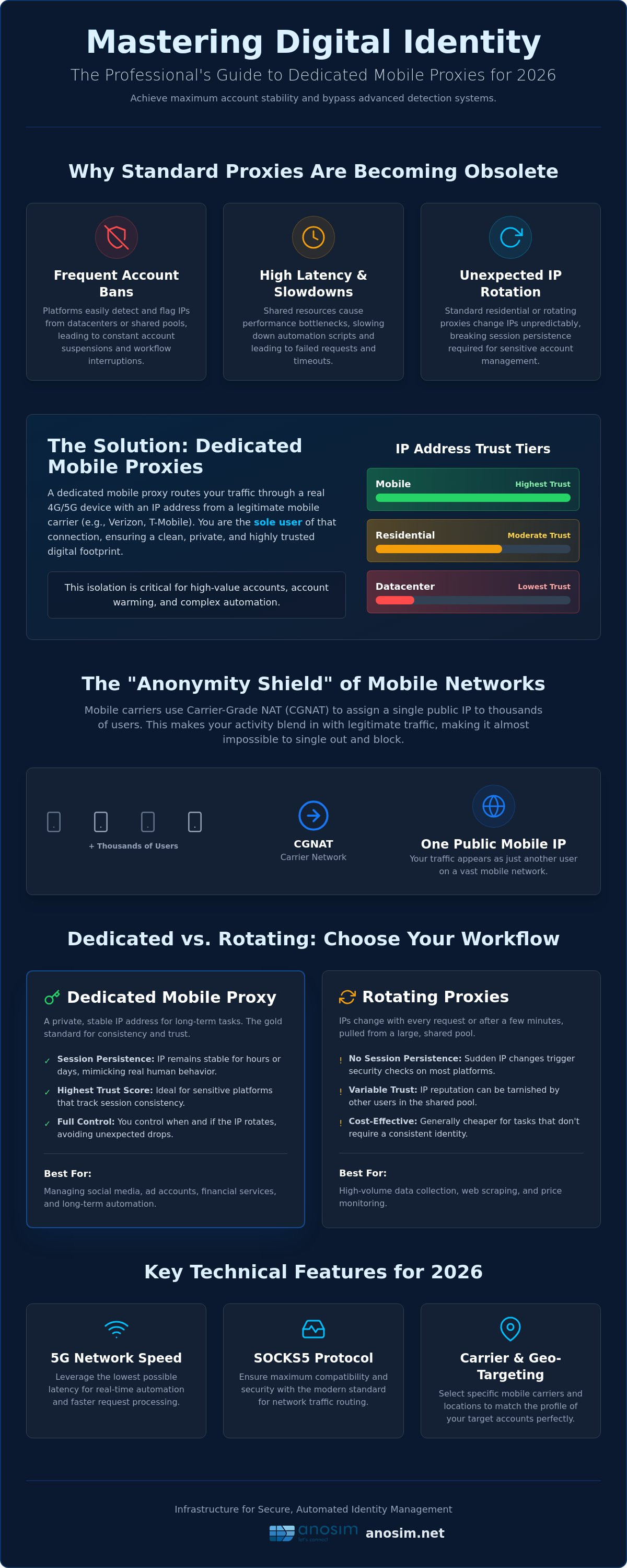
A dedicated mobile proxy is a private gateway that routes your internet traffic through a real cellular device connected to a 4G or 5G network. Unlike datacenter proxies that originate from server farms, these proxies use IP addresses assigned by legitimate mobile carriers like Verizon, Vodafone, or T-Mobile. Choosing a dedicated option means you're the sole user of that specific modem's bandwidth and IP reputation. You don't have to worry about other users performing high-risk actions that could get your connection blacklisted. This isolation is critical for professionals who manage high-value accounts or run complex automation scripts.
The primary advantage lies in how platforms perceive your traffic. Most websites categorize IP addresses into three tiers of trust:
- Datacenter: High speed but low trust. They're easily identified and often blocked by default.
- Residential: Moderate to high trust. These use home ISP connections but can be prone to unexpected downtime.
- Mobile: The highest trust tier. These carry the same digital signature as a real person browsing on a smartphone.
The Technical Architecture of Mobile IPs
Mobile carriers rely on Carrier Grade Network Address Translation (CGNAT) to distribute a limited pool of IPv4 addresses among millions of devices. This system allows thousands of individual mobile users to share a single public IP simultaneously. From the perspective of a target platform, blocking one mobile IP could inadvertently lock out thousands of legitimate customers. This creates a "shield" for your operations. The underlying Proxy Mobile IPv6 standard facilitates this network-based mobility management. It ensures that your connection remains stable even as the network handles complex routing behind the scenes without requiring client-side software.
Dedicated vs. Shared Mobile Proxies
Shared proxy pools often lead to performance bottlenecks and security triggers. In a shared environment, multiple users might be managing accounts on the same platform through the same IP. If one user triggers a security flag, every account in that pool is at risk. A dedicated mobile proxy eliminates this hazard. It provides the clean, stable environment necessary for account warming, where you gradually build up the trust score of a new profile. You get full control over the connection speed and the timing of IP rotations. This is essential for maintaining session persistence during automated tasks that require a consistent identity. Dedicated hardware ensures you aren't fighting for bandwidth, resulting in lower latency and more reliable API integrations.
Dedicated vs. Rotating Mobile Proxies: Choosing Your Workflow
Selecting the right proxy type depends entirely on your operational requirements for session longevity and trust signals. A dedicated mobile proxy provides a persistent connection tied to a single IP address for an extended period. This stability is vital for tasks that mimic human behavior over several hours or days. In contrast, rotating proxies cycle through different IP addresses from a large pool, usually every few minutes or with every request. While rotating options are cost-effective for high-volume data collection, they lack the stability needed for sensitive account management where a sudden IP change could trigger a security checkpoint.
The technical foundation of these connections often relies on the RFC 5213 protocol, which defines network-based mobility management. This standard allows your session to remain active even when the underlying network architecture shifts. Some providers offer "sticky sessions" as a middle ground, attempting to keep you on the same IP for a set duration. However, these are often limited by carrier-enforced rotations. If the carrier reassigns the IP, a sticky session will drop, whereas a dedicated mobile proxy environment is designed to handle these transitions more gracefully, maintaining your digital identity without interruption.
When to Use Dedicated Mobile Proxies
Dedicated lines are the industry standard for managing multiple social media profiles on platforms like Instagram, TikTok, or Facebook. These platforms track session consistency; logging in from a new IP every ten minutes is a high-risk signal that leads to immediate bans. You should also opt for dedicated hardware when running ad accounts that require consistent geo-location data or when accessing region-locked financial services. For developers building long-term automation, using mobile proxies with dedicated IPs ensures that your "warmed" accounts stay active and trusted by target servers.
When Rotating Proxies are Superior
Rotating proxies excel in scenarios where volume outweighs the need for session persistence. If your goal is large-scale SEO audits, SERP tracking, or e-commerce price comparison, you need thousands of unique IPs to avoid rate limits. High-frequency API requests also benefit from rotation, as it prevents any single IP from being flagged for aggressive scraping. In these cases, the risk of an IP being blocked is low because you only use it for a few seconds before moving to the next one in the pool.
Investing in a dedicated line is a strategic choice for businesses that cannot afford downtime. While the monthly cost per proxy is higher than shared or rotating pools, the ROI comes from preserved account health and reduced manual intervention. If your workflow involves logging into a dashboard and staying active for hours, a dedicated solution is the only way to ensure operational security.
Key Technical Features to Evaluate in 2026
As network detection algorithms become more sophisticated, the technical specifications of your infrastructure determine your success rate. In 2026, 5G is no longer a luxury; it's a critical trust signal. Real mobile users in major urban areas almost exclusively use 5G networks. If your dedicated mobile proxy shows 4G speeds in a 5G-saturated city, it might look like an outdated device or a virtualized environment to a target platform. High-speed connections with low latency, often under 30ms, are now the benchmark for maintaining a high-trust digital footprint.
Location accuracy has moved beyond simple country-level targeting. To manage localized services or verify region-specific ads, you need the ability to target specific cities and carriers. This granularity ensures your traffic matches the expected behavior of a local consumer. Additionally, look for providers that offer granular IP rotation control. Even on a dedicated line, you occasionally need to refresh your IP address. Having the option for manual rotation via an API call or a scheduled refresh allows you to maintain IP health without the instability of a shared pool.
The Importance of SOCKS5 and HTTP/S Support
SOCKS5 is the industry standard for high-performance proxying because it supports both TCP and UDP traffic. This versatility is essential for modern automation tools that require more than simple web scraping, such as streaming or complex app interactions. When evaluating a dedicated mobile proxy, check how it handles authentication. IP whitelisting is often preferred for server-to-server communication because it's faster and more secure. However, username and password methods offer more flexibility for remote teams. Ensuring your data remains encrypted across these mobile networks is a baseline requirement for operational security.
Uptime and Connection Stability
Uptime is non-negotiable for automated workflows. A 99.9% uptime requirement ensures your scripts don't fail mid-execution, which can lead to data corruption or account flags. Dedicated hardware prevents the connection drops common in shared pools, where high traffic from other users can overwhelm a single modem. Because you have exclusive access to the hardware, the connection remains stable even during peak hours. You should implement automated pings or status checks to monitor your proxy health. This proactive approach allows you to detect and resolve network issues before they impact your primary operations.
How to Set Up and Integrate a Dedicated Mobile Proxy
Setting up a dedicated mobile proxy requires a methodical approach to ensure the connection is both functional and secure. Unlike standard datacenter setups, mobile infrastructure involves carrier-specific nuances that can impact your success rate if ignored. Follow these steps to establish a reliable connection.
- Step 1: Selecting your target location and carrier provider. Identify the specific city or region required for your task. Because mobile IPs are tied to local cell towers, choosing a carrier like Verizon in New York or Vodafone in London provides the necessary localized trust signals.
- Step 2: Configuring authentication. You'll typically choose between IP whitelisting and traditional credentials. IP whitelisting is more efficient for server-to-server communication as it reduces the overhead of sending login data with every request. Credential-based authentication (username and password) offers better flexibility for remote teams.
- Step 3: Implementing the proxy. Input your proxy host, port, and authentication details into your browser or automation software. Ensure you're using the SOCKS5 protocol for the best performance.
- Step 4: Testing for leaks. Verify that your setup isn't exposing your real identity. Use specialized tools to check for IP leaks, DNS leaks, and WebRTC vulnerabilities. If your real IP is visible through a WebRTC leak, the proxy's protection is effectively neutralized.
- Step 5: Monitoring performance. Track your connection speed and latency. Use automated pings to ensure the line remains active and manage your IP rotations according to your account warming schedule.
Programmatic Integration via API
For developers managing large-scale operations, manual configuration isn't sustainable. You can use the API of our proxy partner proxied.com to programmatically manage your infrastructure. This allows you to automate IP resets and rotation schedules directly through your code. When building your scripts in Python, Node.js, or Go, implement robust error handling. If a proxy request fails, your code should be able to trigger a retry or a new IP rotation through the API without manual intervention. This level of automation is what separates professional-grade systems from basic setups.
Browser and Tool Configuration
If your workflow involves manual account management, anti-detect browsers like AdsPower or Multilogin are essential. These tools allow you to create isolated browser profiles, each with its own dedicated mobile proxy and unique fingerprint. To maintain high trust scores, don't just change the IP; you must also manage Canvas, WebGL, and font fingerprints to match a mobile device profile. For quick manual checks, use a proxy extension that allows for rapid switching, but always verify the profile's integrity before logging into sensitive accounts. To build a secure and scalable digital identity stack, you can get started with mobile proxies today.
Maximizing Security with Anosim Mobile Infrastructure
Integrating a dedicated mobile proxy into your workflow is a significant step toward operational security, but a high-trust IP address is most effective when paired with a matching digital identity. Anosim provides a comprehensive stack that combines the mobile proxies of our partner proxied.com with SMS activation and virtual number rentals. This unified approach allows developers to build and manage accounts using the same carrier-grade infrastructure for both traffic and verification. By sourcing your tools from a single provider, you ensure technical compatibility and reduce the friction often found when stitching together services from multiple vendors. It positions the service as a silent partner that provides the necessary infrastructure for complex digital tasks.
Scaling your operations in 2026 requires more than just a large pool of IPs. It demands a sophisticated toolkit that includes Rent Service options for long-term number stability and Rent Mobile VoIP for versatile communication needs. When you combine these with high-trust mobile IPs, you create a robust environment that is difficult for automated detection systems to penetrate. This full digital identity stack is designed for those who value technical accuracy and discretion above all else, ensuring that every layer of your automation remains clean and private.
Unified Account Management
Consistency between your network location and your verification data is a primary trust signal for modern platforms. If you use a dedicated mobile proxy based in a specific region while attempting to verify an account with an SMS number from a different country, security algorithms will likely trigger a "suspicious activity" flag. The combined infrastructure of Anosim and our partner proxied.com allows you to match your proxy location with your virtual number, creating a seamless profile that mimics a real local user. You can manage long-term rentals for both numbers and partner proxies to maintain session persistence over months or years. This is essential for preserving the health of high-value accounts that require a stable, non-rotating digital footprint.
Operational Efficiency for Developers
Reliability in automation depends on the stability of your API integrations. Anosim’s support for the Anosim API (v1) and compatibility with the SMS-Activate Standard API ensures that your existing scripts require minimal adjustment to scale. This pragmatic, security-first approach allows you to automate the entire lifecycle of an account, from initial registration with SMS activation to daily management via mobile proxies. You can monitor your digital footprint through a single interface, streamlining your workflow and allowing you to focus on core business tasks. To optimize your technical setup and ensure maximum account stability, Explore Anosim Mobile Proxy Solutions and integrate them into your stack today.
Securing Your Digital Operations for 2026
Maintaining a high trust score in 2026 requires a shift from fragmented tools to a unified identity stack. By utilizing a dedicated mobile proxy, you ensure that your network traffic carries the same digital signature as a legitimate mobile consumer. This stability is the foundation for long-term account management and successful automation. You've seen how carrier-grade network architecture protects your sessions and how programmatic integration via API can streamline your entire workflow. Combining these proxies with localized SMS activation services creates a robust shield against modern detection algorithms.
Anosim provides the technical infrastructure needed for professional-grade digital anonymity. Our API-driven platform is compatible with the SMS-Activate Standard API, offering pragmatic and security-conscious support for developers and enterprise users. If you're ready to eliminate account bans and connection latency, it's time to upgrade your toolkit. Get Started with High-Trust Mobile Proxies at Anosim to build a reliable and scalable operational environment. Protecting your digital footprint has never been more efficient.
Frequently Asked Questions
What makes a mobile proxy "dedicated" versus "shared"?
A dedicated proxy provides exclusive access to a single modem and its associated IP address. In a shared environment, multiple users route traffic through the same hardware, which increases the risk of a "dirty" IP reputation and performance bottlenecks. Dedicated access ensures that your actions are the only ones influencing the trust score of the connection, providing a cleaner environment for sensitive tasks.
Can I use a dedicated mobile proxy for web scraping?
You can use a dedicated mobile proxy for scraping, though it's typically reserved for targets with aggressive anti-bot measures. While rotating proxies are often better for high-volume extraction, a dedicated line is superior when you need to maintain a long-term session on a single site. It allows you to mimic a real user's browsing behavior without the risk of an IP rotation mid-session.
Do dedicated mobile proxies come with unlimited bandwidth?
Most dedicated mobile proxies provide unlimited data because you're renting the physical hardware or a fixed line. Unlike residential proxies that often charge per gigabyte, dedicated setups allow for high-volume traffic without additional costs. This makes them an efficient choice for data-heavy tasks like video streaming or large-scale account automation where data consumption is unpredictable.
How often should I rotate my dedicated mobile IP?
You should rotate your IP based on the specific security threshold of your target platform. For sensitive account management, a rotation every 12 to 24 hours is often sufficient to maintain a natural appearance. If you're performing more aggressive tasks, you might use an API call to trigger a manual rotation more frequently to avoid hitting rate limits or triggering security checkpoints.
Are mobile proxies more secure than residential proxies?
Mobile proxies offer a higher trust signal because they utilize CGNAT, which blends your traffic with thousands of other legitimate carrier users. While residential proxies are also highly trusted, platforms are more hesitant to block mobile IPs due to the risk of collateral damage to real customers. This makes a dedicated mobile proxy the most secure option for bypassing sophisticated detection systems in 2026.
Why are dedicated mobile proxies more expensive than datacenter proxies?
The higher cost reflects the physical infrastructure and carrier fees required to maintain a real cellular connection. Datacenter proxies are virtualized on servers with low overhead, while mobile proxies require actual SIM cards and modems connected to 4G or 5G networks. You're paying for the premium trust score and the near-impossibility of the IP being flagged as a proxy by target servers.
Can I target specific cities or carriers with my proxy?
Professional providers allow you to select specific locations and carriers to match your operational needs. This granularity is essential for verifying localized ads or managing accounts that require consistent geo-location data. You can choose a carrier like Verizon in New York or Vodafone in London to ensure your digital footprint matches the expected behavior of a local consumer in that region.
How do I test if my dedicated mobile proxy is working correctly?
You can test your proxy by checking your IP address and connection headers through a specialized leak-test tool. Ensure that the ISP is correctly identified as a mobile carrier and that there are no DNS or WebRTC leaks exposing your real location. You should also verify that the connection speed and latency meet the requirements for your specific automation scripts or browser profiles.