Anti-bot systems cannot block a mobile proxy without simultaneously blacklisting thousands of legitimate cellular users. This technical reality, rooted in Carrier-Grade Network Address Translation (CGNAT), creates a "collective anonymity" that makes mobile infrastructure the gold standard for high-trust operations. If you are tired of seeing your automation workflows fail due to low-trust datacenter IPs or frequent account bans, you already understand that standard proxies no longer suffice for modern retail or social platforms.
We agree that managing digital identities is becoming increasingly complex as security algorithms evolve. This technical guide provides the roadmap to mastering mobile architecture so you can leverage carrier-grade trust for secure, unblockable online tasks. We will analyze the IP trust hierarchy, explore the performance benefits of 5G Standalone networks with latencies as low as 30ms, and show you how to implement a scalable automation workflow that maintains high success rates across the most restrictive platforms.
Key Takeaways
- Understand how routing traffic through cellular towers creates a real user signal that bypasses advanced detection systems.
- Learn why a mobile proxy sits at the top of the trust hierarchy compared to easily detectable datacenter or residential IPs.
- Master the mechanics of Carrier-Grade NAT (CGNAT) and how the crowd effect makes mobile IPs virtually impossible for platforms to block.
- Discover how to scale web scraping and social media marketing without account bans using high-trust mobile infrastructure.
- Streamline your digital identity stack by combining the Anosim API (v1) for number provisioning with the mobile proxies of our partner proxied.com.
Table of Contents
- What is a Mobile Proxy? Understanding the High-Trust IP Layer
- Mobile vs. Residential vs. Datacenter Proxies: The Hierarchy of Trust
- The Mechanics of CGNAT: Why Mobile IPs are Nearly Impossible to Block
- Core Use Cases: From Web Scraping to Secure Account Management
- Implementing Mobile Proxies with Our Partner proxied.com for Secure Digital Workflows
What is a Mobile Proxy? Understanding the High-Trust IP Layer
A mobile proxy functions by routing your internet traffic through 4G, 5G, or LTE cellular towers using real SIM cards. Unlike other proxy types that rely on static infrastructure, this method utilizes the same network paths as millions of everyday smartphone users. When you access a website through this setup, the site's security systems identify the connection as a legitimate mobile device. This "Real User" signal is difficult to replicate because it relies on the physical hardware of the telecommunications provider rather than a virtual server in a data center.
The hardware behind a mobile proxy ranges from simple 4G dongles plugged into local servers to massive, cloud-based SIM farms. These setups act as a bridge between your computer and the cellular network. Technical professionals often use specific terminology to describe these configurations. 4G LTE and 5G refer to the cellular generation and speed, while a Backconnect system allows for automatic IP rotation through a single entry point. The Gateway Server serves as the physical or virtual machine that manages your connection requests before they hit the mobile network.
A Proxy server traditionally acts as a simple intermediary, but the mobile variant adds a layer of carrier-grade trust that is essential for modern digital operations. By using authentic SIM cards, these proxies inherit the reputation of the mobile carrier, making them nearly indistinguishable from standard consumer traffic.
How Mobile Proxies Differ from Traditional VPNs
VPNs focus primarily on encryption, often using datacenter IPs that are easily flagged by sophisticated anti-bot systems. In contrast, a mobile proxy prioritizes IP masking with clean, carrier-assigned addresses. While VPNs might protect your data from local snooping, they don't always provide the high trust scores needed for account management or scraping. Proxies are generally faster for automation because they lack the heavy encryption overhead of a VPN. They also help avoid "fingerprinting" issues by ensuring your network profile matches the mobile device you're attempting to emulate.
The Anatomy of a Mobile Proxy Connection
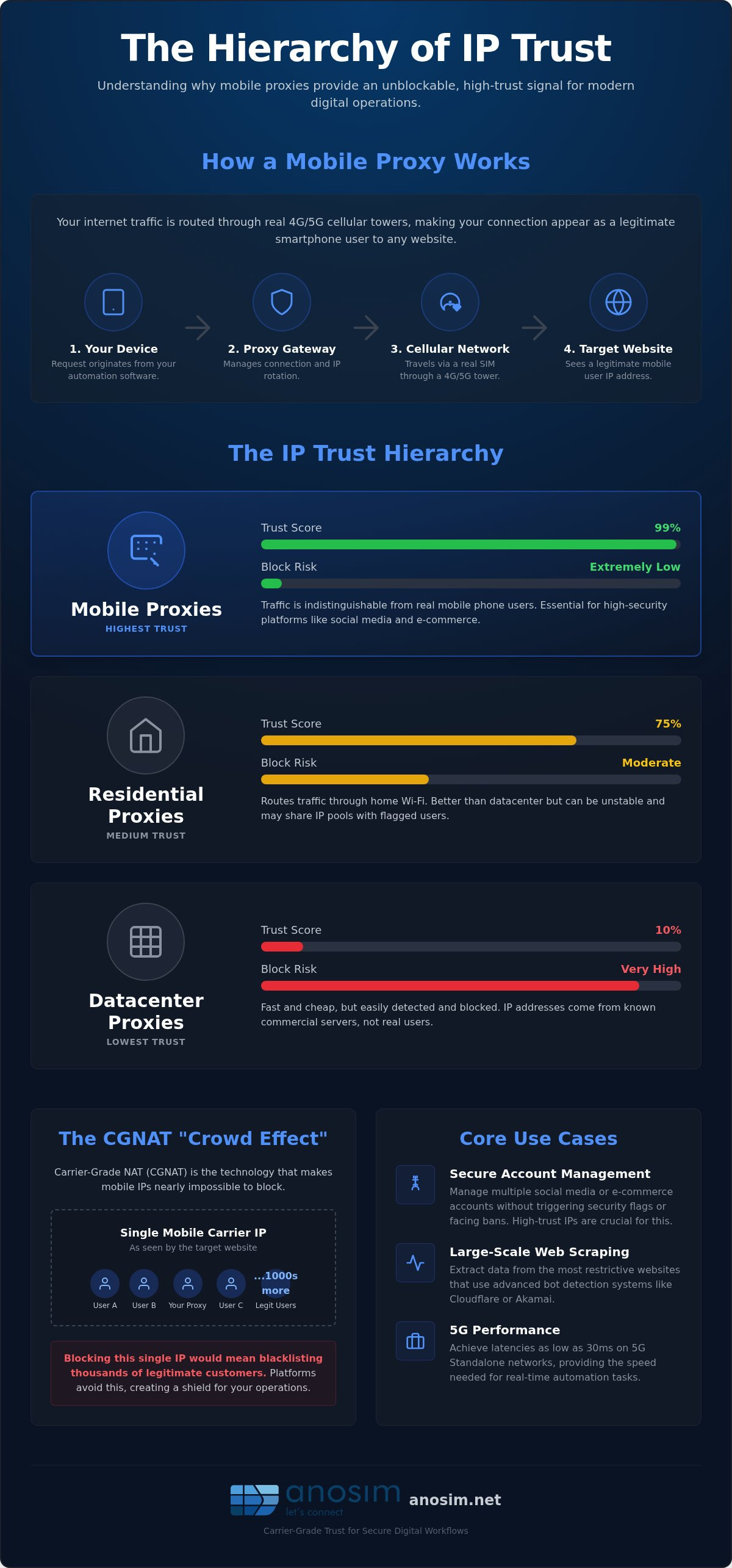
The journey of a request is methodical. It starts at your device, travels to the proxy gateway, moves through the cellular network via an active SIM card, and finally reaches the target website. This process ensures that the website only sees the carrier-issued IP. Most professional configurations support SOCKS5 and HTTP/S protocols to maintain compatibility with various software stacks. A mobile proxy is a gateway to carrier-grade IP addresses that mirror authentic mobile device behavior.
Mobile vs. Residential vs. Datacenter Proxies: The Hierarchy of Trust
Websites don't view all traffic equally. They categorize connections into a hierarchy based on the perceived risk of the IP source. Datacenter proxies represent the bottom tier of this hierarchy. These IPs originate from cloud servers and data centers. While they are fast and inexpensive, they lack human behavioral signals. Security systems like Akamai or Cloudflare can identify and block entire datacenter subnets with a single rule. If you're managing sensitive accounts, using a datacenter IP is often a direct path to a permanent ban.
Residential proxies occupy the middle ground. They route traffic through home Wi-Fi networks, making the connection appear as if it's coming from a standard household. This provides better trust than datacenter IPs, but stability can be an issue. If the resident's router reboots or the device disconnects, your session terminates. For operations where uptime and anonymity are critical, a mobile proxy is the superior choice. These proxies use carrier-grade IPs that anti-fraud systems are hesitant to block. This leniency exists because of the "crowd effect" found in cellular networks. You can find more about the technical challenges carriers face with IP allocation in this Carrier-Grade NATs survey.
The Risk-Reward Ratio of IP Types
Anti-fraud algorithms assign a trust score to every incoming request. Mobile IPs consistently receive the highest scores because they belong to major telecommunications providers. While the cost of a mobile proxy is higher than other types, it acts as an insurance policy. It prevents the loss of valuable social accounts or the interruption of expensive scraping jobs. For basic data collection on unprotected sites, datacenter IPs are sufficient. However, for mobile-first platforms like TikTok or Instagram, mobile infrastructure is mandatory. If you want to dive deeper into optimizing these workflows, check out our technical blog for advanced strategy guides.
Exclusivity: Dedicated vs. Shared Mobile Pools
Trust isn't just about the IP type; it's also about how many people use it. Choosing the right level of exclusivity depends on your budget and the sensitivity of your target platform.
- Dedicated Proxies: These offer the highest level of security. You are the only user on the IP, which eliminates the risk of "bad neighbor" effects where another user's actions get the IP flagged.
- Shared Pools: These are more affordable and work well for broad web scraping. However, there is a small risk that another user on the same pool might trigger a platform's security limits.
The Mechanics of CGNAT: Why Mobile IPs are Nearly Impossible to Block
The primary reason a mobile proxy offers such high trust is the technical architecture of cellular networks. Most mobile carriers face a significant shortage of IPv4 addresses. To solve this, they implement Carrier-Grade Network Address Translation (CGNAT). This technology allows a single public IP address to represent thousands of individual mobile devices simultaneously. When you use mobile infrastructure, you aren't just hiding your identity; you're hiding within a massive crowd of legitimate users.
This "Crowd Effect" creates what security professionals call the "Nuclear Option" problem. If a website decides to blacklist a specific mobile IP, they risk blocking every legitimate customer currently assigned to that address. Because a single IP might host 3,000 active shoppers or social media users, platforms are extremely reluctant to implement hard bans. Instead, they apply much higher rate limits and trust thresholds to these IP ranges. This technical lenity is the core advantage of using mobile-based networking to bypass modern security filters.
Collective Anonymity in Action
Your automated traffic blends perfectly with standard consumer activity. To an anti-bot system, your request looks identical to someone scrolling through TikTok or streaming video on their commute. CGNAT makes traditional IP blacklisting ineffective because the reputation of the IP is constantly refreshed by the sheer volume of legitimate traffic. This provides a level of technical resilience against bot detection that datacenter or residential IPs simply can't match. If your operation requires high-volume requests, the shared nature of these IPs acts as a natural shield against aggressive detection algorithms.
IP Rotation and Session Persistence
Managing your digital identity also requires control over how your IP changes. Professional setups offer two main types of rotation. Time-based rotation switches your IP at set intervals, while on-demand rotation uses an API to trigger a change exactly when you need it. For tasks like multi-step account signups, you can use "sticky sessions" to maintain the same IP until the process is complete. This prevents the security flags that occur when an IP changes mid-transaction. CGNAT creates a 'privacy in numbers' effect that protects proxy users from targeted bans.
Core Use Cases: From Web Scraping to Secure Account Management
A mobile proxy is more than just an anonymity tool; it's a functional requirement for operations that rely on high-trust signals. While previous sections detailed the technical trust scores and CGNAT mechanics, understanding how to apply this infrastructure is key to operational success. Whether you're scraping data or managing social accounts, the cellular network provides the most resilient path forward.
Web scraping at scale often fails when target marketplaces detect non-human traffic patterns. Major retailers use sophisticated fingerprinting to block datacenter IPs. By routing requests through 4G or 5G towers, your scraper adopts the persona of a casual mobile shopper. This allows for deeper data extraction without triggering CAPTCHAs or IP blocks. Similarly, ad verification teams use these proxies to check localized ad placements. This ensures that ads appear correctly to real-world users without triggering geo-blocks that often flag static residential or datacenter connections.
App testing is another critical application. Simulating real-world mobile network conditions is essential for quality assurance. Developers use mobile infrastructure to test how apps behave under various cellular latencies and carrier-specific routing. This provides a level of accuracy that Wi-Fi-based testing cannot replicate.
Bypassing Verification Barriers
Many platforms now enforce strict "one account per IP" rules. If you're managing high-risk accounts on Telegram or Tinder, a single flagged IP can lead to a total sweep of your digital assets. Pairing a high-trust IP with SMS activation creates a complete digital identity that bypasses these verification hurdles. This combination allows you to maintain multiple profiles without the risk of data leaks or linked account bans. It's a pragmatic solution for users who need to manage a diverse digital footprint securely.
E-commerce and Sneaker Botting
Securing limited-edition releases requires both speed and reputation. Sites with aggressive bot protection, such as those in the sneaker and high-fashion niches, prioritize traffic from mobile carriers. Using a mobile proxy during a high-traffic drop reduces the likelihood of your session being terminated. Beyond purchasing, these tools are vital for price monitoring. Many e-commerce sites offer dynamic pricing based on the user's network profile. Mobile users in specific regions may see different rates than those on desktop connections. Using cellular IPs allows you to see the real prices offered to the mobile demographic. This level of insight prevents shadowbans on seller accounts on platforms like Amazon and eBay, where maintaining a clean network reputation is mandatory for long-term stability.
If you're ready to secure your operations with carrier-grade infrastructure, you can buy mobile proxies of our partner proxied.com to begin scaling your workflows today.
Implementing Mobile Proxies with Our Partner proxied.com for Secure Digital Workflows
Implementing a mobile proxy is the final step in building a resilient digital identity stack. A complete setup requires more than just an IP address; it needs a combination of high-trust networking and verified communication channels. By integrating mobile infrastructure with Mobile VoIP rentals, you can achieve total operational anonymity. This approach ensures that every layer of your digital presence, from the network layer to the voice and messaging layer, originates from a legitimate cellular source. Professional operators treat these tools as a unified toolkit rather than isolated services.
Security remains a priority when deploying these tools. You should avoid free proxy services; they often harvest user data or provide "leaky" IPs that expose your real location. Protecting your credentials and using encrypted protocols like SOCKS5 is essential for maintaining the integrity of your automated workflows. Reliable infrastructure acts as a silent partner in your operations, providing the stability needed for long-term success. It's a pragmatic choice for users who value results over the risks associated with unverified providers.
Programmatic Control and API Integration
Scale requires automation. The Anosim API documentation provides the technical framework for managing IP rotations programmatically. This API (v1) allows developers to trigger IP changes based on specific success criteria or time intervals. Our infrastructure is compatible with industry-standard multi-login browsers and automation frameworks. Whether you are running a single account or a massive automated farm, the API ensures your connection remains stable and your identity stays protected. This programmatic control reduces manual overhead and allows for rapid scaling of complex tasks.
The Future of Mobile Proxies: 5G and Beyond
The shift to 5G Standalone (SA) networks has redefined performance standards. Real-world speeds now reach between 100 and 500+ Mbps, with latencies dropping to 30-50ms. These improvements make mobile proxies more viable for data-heavy tasks that previously required fiber connections. As AI-powered automation becomes the norm, the demand for "AI-native" proxy infrastructure is growing. This involves features for programmatic discovery and configuration without human intervention. In an AI-driven web, "Clean IPs" are the only way to bypass sophisticated machine-learning filters that flag even the slightest technical inconsistency.
When selecting a provider, use this final checklist:
- Verified ethically sourced IP pools that comply with modern data privacy regulations.
- Support for 5G SA network slicing to guarantee quality of service.
- Robust API (v1) for seamless software and script integration.
- Compatibility with SMS and VoIP services for a unified identity stack.
Mastering the Future of Network Trust
Technical excellence in 2026 requires more than just masking an IP; it requires inheriting the reputation of legitimate cellular networks. We've analyzed how a mobile proxy leverages Carrier-Grade NAT to provide collective anonymity that traditional residential or datacenter options can't match. This level of reliability is also essential for high-end media services; you can explore Tiered IPTV Subscription Fees to see how these network standards are redefining the quality of digital content delivery. From bypassing aggressive anti-bot filters on major retail platforms to managing high-risk social identities, the transition to carrier-grade infrastructure is a pragmatic necessity for any serious automation workflow.
By integrating API-driven rotation and pairing your network layer with verified communication tools, you create a digital identity stack that is resilient against modern security algorithms. Anosim provides the high-trust carrier IPs and global infrastructure support needed to maintain this operational efficiency at scale. Our API-ready systems ensure that your automation remains seamless and secure regardless of the target platform's requirements.
Scale your secure operations with the Mobile Proxies of proxied.com and take control of your digital footprint with the robust, carrier-grade infrastructure of our partner proxied.com. Building a secure and unblockable online presence starts with choosing the right technical foundation.
Frequently Asked Questions
Are mobile proxies legal to use?
Mobile proxies are legal in most jurisdictions when used for legitimate activities such as market research, ad verification, or personal privacy. While the technology itself is legal, you must ensure your specific use case complies with local laws and the terms of service of the platforms you access. Using these tools for illegal acts remains prohibited regardless of the underlying network architecture.
What is the difference between 4G and 5G mobile proxies?
The primary differences are speed and latency. A 5G mobile proxy utilizes standalone networks to deliver speeds between 100 and 500+ Mbps with latencies as low as 30ms. While 4G proxies are slower, they still provide the high trust scores needed for social media management. 5G is the superior choice for high-volume data scraping or real-world application testing.
Can I use a mobile proxy on my computer, or do I need a phone?
You don't need a physical phone to use this service. These proxies function as a gateway that you can configure directly in your computer's browser, multi-login software, or custom automation scripts. The cellular hardware and SIM cards are managed at the provider's infrastructure site, allowing you to access mobile IPs from any desktop or server environment.
Why are mobile proxies more expensive than other proxy types?
The higher price reflects the operational costs of maintaining physical cellular hardware and active SIM card contracts. Unlike datacenter IPs, which are virtually unlimited, mobile data is a metered resource with high carrier overhead. This investment is justified by the carrier-grade trust and the CGNAT benefits that prevent the frequent account bans common with cheaper, lower-trust alternatives.
How often does the IP address rotate in a mobile proxy?
Rotation frequency depends on your specific service plan. Most providers offer time-based rotation, where the IP changes automatically every 5 to 30 minutes. Advanced setups allow for on-demand rotation through an API v1. This ensures you can trigger a fresh IP address exactly when your workflow requires a new identity for a specific task or account signup.
Do mobile proxies support SOCKS5 and HTTP protocols?
Professional mobile proxies support both SOCKS5 and HTTP/S protocols. SOCKS5 is often the preferred choice for technical users because it handles various traffic types and offers better compatibility with specialized automation tools. Having both options ensures that the infrastructure integrates seamlessly with any software stack or digital identity management tool you choose to implement.
What happens if a mobile proxy IP is already blacklisted?
If an IP is flagged, the solution is a simple rotation. Because thousands of legitimate users share these IPs through CGNAT, platforms rarely implement permanent blacklists against them. If you encounter a block or a CAPTCHA, triggering a rotation via the API provides a new address from the carrier's pool, allowing your operations to continue without significant downtime.
How do I integrate a mobile proxy with an SMS activation service?
To integrate these services, first route your traffic through the proxy to establish a high-trust network footprint. Once the connection is active, use an SMS activation service to provide a virtual number for account verification. This dual-layer approach ensures that both your IP address and your phone verification appear as authentic mobile device signals to the target platform's security systems.