In 2026, using a standard proxy isn't just ineffective; it's a direct signal to platform security systems that your account is automated. Many professionals find that even high-priced IPs are quickly flagged as datacenter traffic, making high-trust mobile proxies for account management a necessity rather than an option. You've likely dealt with the frustration of high latency and the constant cycle of replacing burned assets. It's a common struggle when platform security algorithms are more sophisticated than ever before.
This guide will show you how to master the technical requirements of carrier-grade mobile proxies to ensure long-term stability and prevent bans. You'll learn how to utilize specialized API v1 integrations to keep your operations invisible to detection systems. We'll examine the shift toward AI-native proxy management and how to align your networking with inbound SMS verification. By the end of this article, you'll understand how to configure a seamless, high-trust environment that supports growth without the constant fear of account loss.
Key Takeaways
- Understand why carrier-grade infrastructure is essential for providing the legitimate digital signals needed to bypass modern detection algorithms.
- Learn how to implement mobile proxies for account management to maintain long-term session stability and avoid being flagged as datacenter traffic.
- Discover the technical requirements for pairing mobile proxies with anti-detect browsers and managing IP rotation to prevent geographic location flags.
- Identify the critical synergy between mobile proxies and SMS activation, ensuring your accounts remain open even when platforms trigger security checks.
- Explore how to scale your operations efficiently by combining the API of our proxy partner proxied.com for status checks and IP rotation with the Anosim API v1 for numbers and SMS.
Table of Contents
- Defining High-Trust Mobile Proxies for Account Management
- Why Account Stability Depends on Carrier-Grade Infrastructure
- Implementing Mobile Proxies in Multi-Account Workflows
- The Synergy: Combining Mobile Proxies with SMS Activation
- Scaling Your Stack: API Integration for High-Trust Proxies
Defining High-Trust Mobile Proxies for Account Management
A proxy server acts as an intermediary between your device and the internet, but the quality of that connection determines the survival of your digital assets. High-trust mobile proxies route traffic through 4G, LTE, or 5G cellular network infrastructure. This process creates a digital footprint that is indistinguishable from a standard smartphone user. When you utilize mobile proxies for account management, your trust score is derived from an IP's association with a major mobile carrier. This is a fundamental shift from traditional methods that rely on static server addresses located in datacenters.
The Trust Hierarchy: Mobile vs. Residential vs. Datacenter
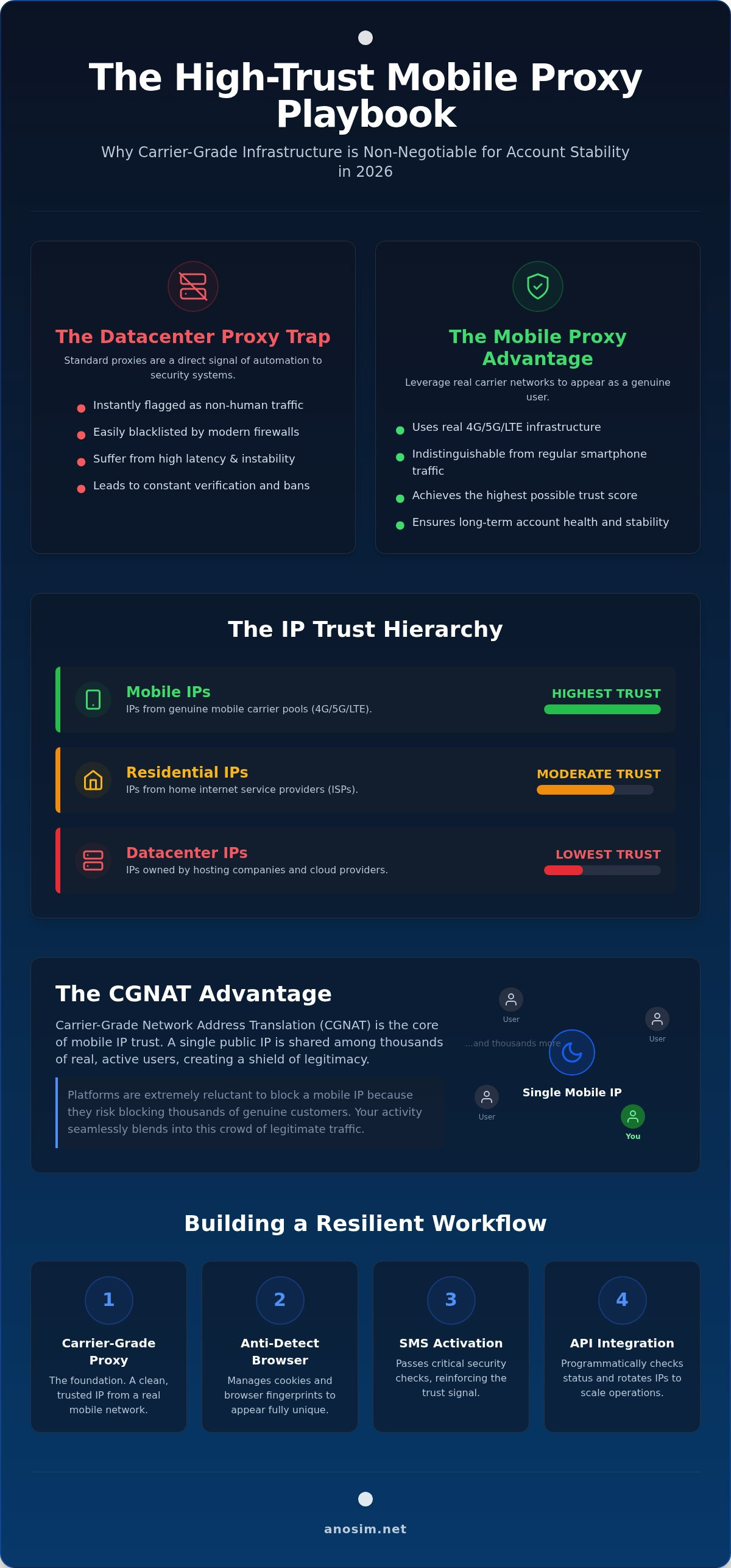
Digital security systems categorize IP addresses based on their origin. Datacenter IPs sit at the bottom of the hierarchy; they're the easiest to identify and are frequently blocked by advanced firewalls because they lack any association with real human activity. Residential IPs offer moderate trust but often suffer from high churn and connection instability. Mobile IPs represent the highest level of trust available. The mobile proxies of our partner proxied.com leverage legitimate carrier pools to mimic authentic human behavior, providing the stability required for professional operations. Using these pools ensures your traffic doesn't trigger the "bot" flags that typically follow datacenter or low-quality residential connections.
Why Platforms Trust Mobile IP Addresses
The primary reason platforms trust mobile addresses is the architecture of the mobile web itself. Most carriers use Carrier-Grade Network Address Translation (CGNAT). This system assigns a single IP address to thousands of real users simultaneously. If a platform like Instagram or Amazon blocks one mobile IP, they risk locking out hundreds of genuine customers. It's a risk most platforms aren't willing to take. Furthermore, mobile traffic includes specific headers and signatures that verify the device's legitimacy. Statistics from 2026 show that mobile traffic is significantly less likely to be associated with large-scale, aggressive scraping compared to other IP types. This makes mobile connections the preferred choice for long-term account health.
Account management in 2026 requires "clean" IPs that haven't been flagged for suspicious behavior. Platforms now maintain extensive databases of blacklisted addresses. If your proxy has a history of spam, your account is compromised before you even log in. High-trust mobile proxies provide a rotating or dedicated pool of fresh addresses that maintain a high reputation. This allows you to manage multiple profiles without the risk of cross-contamination or "guilt by association" flags. For more technical insights on maintaining these connections, you can explore the Anosim blog to stay updated on the latest carrier infrastructure shifts.
Why Account Stability Depends on Carrier-Grade Infrastructure
Maintaining account longevity in 2026 requires more than just a hidden IP. It requires a signal that matches the behavior of millions of legitimate users. Social media algorithms and e-commerce firewalls have evolved to look for specific "High Trust" markers that only carrier-grade infrastructure can provide. When you use mobile proxies for account management, you're leveraging the same network pathways used by everyday mobile devices. This alignment prevents the sudden verification loops that plague lower-tier proxy users who rely on static or poorly configured connections.
Understanding CGNAT and IP Sharing
The foundation of this trust is Carrier-Grade NAT (CGN) technology. CGNAT is a mechanism where one public IP serves multiple private endpoints. In the context of account security, this architecture is a massive advantage. Because you're sharing an IP with real, active users, your automated management activities are masked within a crowd of legitimate traffic. Platforms can't easily block these IPs without risking collateral damage to their actual customer base. The proxy infrastructure of our partner proxied.com is built specifically to mirror these local carrier patterns, ensuring your traffic remains indistinguishable from organic mobile data.
Avoiding the 'Proxy Detected' Flag
Detection systems don't just look at the IP address; they analyze the packet structure. Advanced platforms use TCP Fingerprinting and Maximum Transmission Unit (MTU) checks to determine if a connection is coming from a genuine mobile device or a server. Cheap proxies often leak their true datacenter origin because they fail to maintain consistent OS fingerprints. If your proxy claims to be an iPhone on a 5G network but sends packets typical of a Linux server, you'll be flagged immediately. High-quality mobile proxies for account management ensure that every technical layer, from the MTU size to the TCP window, matches the expected profile of a mobile carrier.
Stable sessions are the lifeblood of business operations. In 2026, high-performing 5G connections have shown success rates as high as 99.6% on e-commerce targets with an average time-to-first-byte (TTFB) of just 0.42 seconds. This technical precision separates a professional operation from one that is constantly fighting bans. If you're ready to stabilize your workflow, you can explore high-trust mobile solutions to see how professional infrastructure supports your specific requirements. By using professional mobile proxies, you gain the granular control needed to manage rotation intervals and maintain a consistent digital presence.
Implementing Mobile Proxies in Multi-Account Workflows
Effective implementation of mobile proxies for account management involves more than selecting a provider. It requires a structured approach to environment isolation and session management. When managing dozens or hundreds of profiles, the goal is to ensure each account appears to originate from a unique, legitimate mobile device. This prevents platforms from linking your accounts through shared fingerprints or inconsistent metadata. Without proper isolation, even the highest quality mobile IP cannot protect an account from being flagged due to browser leaks.
Integration with Anti-Detect Browsers
Pairing mobile proxies with anti-detect browsers like AdsPower, Multilogin, or GoLogin is the industry standard for professional workflows. These tools allow you to create isolated browser instances with unique fingerprints. To ensure maximum stability, you must synchronize the proxy's geolocation with the browser's time zone and WebRTC settings. If your proxy is located in London but your browser's WebRTC leaks a local IP or shows a different time zone, security algorithms will flag the account immediately. Most professional setups require a "kill switch" configuration. This ensures that if the proxy connection drops, the browser stops all traffic rather than leaking your true IP address.
Rotation Strategies for High-Volume Management
Your choice between static mobile IPs and rotating mobile proxies depends on the specific task. Account warming, which involves building trust through passive browsing, often benefits from longer sticky sessions. These sessions maintain a consistent identity for 30 minutes or more, mimicking a user browsing on a single cellular connection. Conversely, active posting or data collection may require faster rotation to avoid rate limits. If you're managing a large fleet of accounts, you need to calculate the ideal rotation frequency to avoid "geographic jumps" where an account appears to move hundreds of miles in seconds.
You can use the Anosim Blog to stay updated on platform-specific rotation limits and carrier-grade best practices. Monitoring proxy health and latency is equally important. High latency can cause automation scripts to timeout, leading to incomplete actions that look like bot errors to platform filters. Maintaining a lean, efficient workflow means constantly auditing these connection metrics to ensure seamless integration with your automation tools. By matching your rotation strategy to the specific platform's sensitivity, you reduce the risk of triggering automated verification loops that can lead to permanent bans.
The Synergy: Combining Mobile Proxies with SMS Activation
High-trust proxies are the infrastructure of a secure account, but SMS activation provides the necessary identity verification. Platforms like Instagram, TikTok, and Amazon often demand phone verification during registration or after detecting a new device fingerprint. Even the most sophisticated mobile proxies for account management can trigger a security checkpoint if the platform requires proof of a legitimate user. By integrating a professional SMS activation service into your workflow, you create a cohesive digital presence that satisfies both network-level and identity-level security requirements. This dual-layer approach is the only way to maintain operations at scale in 2026.
Why Proxy + SMS is the Gold Standard
Security algorithms prioritize data consistency across all layers of a connection. If your proxy IP originates from a specific carrier tower but you provide a virtual number from an unrelated ISP or a different country, the mismatch flags the account for manual review. Matching the ISP data of your proxy with the mobile carrier of your virtual number is essential for bypassing advanced fraud detection. This synergy ensures that the digital footprint remains uniform. High-trust pools also reduce the risk of "Phone Number Already Used" errors. These errors occur when lower-tier providers recycle numbers that have already been burned on major platforms. Using clean, carrier-grade pools ensures your registration process remains frictionless.
Managing Long-Term Account Health
Professional account management often requires periodic re-verification to maintain access during platform updates or security sweeps. In these scenarios, one-time activations are insufficient for high-value assets. Utilizing long-term number rentals allows you to receive multiple inbound codes over weeks or months, providing a reliable safety net for checkpoint triggers. For high-security registrations that are sensitive to virtual number detection, strategic use of Mobile VoIP can bypass traditional filters that block standard VoIP ranges. This unified stack approach allows you to handle inbound SMS challenges programmatically, ensuring that your accounts stay open without constant manual intervention.
Technical precision in your verification stack prevents the "geographic jumps" that lead to immediate bans. When your IP and your phone number originate from the same local carrier infrastructure, you present the most trusted signal possible to the target platform. If you are looking to stabilize your operations, you should synchronize your proxy and SMS infrastructure to ensure your accounts survive the strictest 2026 security protocols. This methodical approach to mobile proxies for account management separates professional agencies from those struggling with constant account loss.
Scaling Your Stack: API Integration for High-Trust Proxies
Manual management becomes a bottleneck once your operation expands beyond a handful of profiles. To maintain efficiency at scale, programmatic control over your networking infrastructure is mandatory. Utilizing mobile proxies for account management through an API allows you to automate the most labor-intensive aspects of your workflow, such as IP rotation and status monitoring. This technical approach reduces human error and ensures that your automation scripts always operate within the safety parameters required by modern platform algorithms. By moving to a programmatic model, you shift from reactive troubleshooting to proactive infrastructure management.
Developer's Guide to the Anosim API
The Anosim API (v1) is designed for seamless integration with custom software and high-volume management tools. Authentication is handled securely via an API key, which can be passed as a query parameter or within the request header. This flexibility allows developers to order numbers, rent lines and retrieve inbound SMS codes without manual dashboard intervention. The proxy side runs separately: our partner proxied.com provides the API with which you trigger an immediate IP rotation for your proxy line. For those moving from other platforms, the infrastructure supports SMS-Activate Standard API compatibility, allowing for a rapid transition without rewriting your entire codebase. You can review the full technical specifications in the API Documentation to begin your custom integration.
Workflow Automation for Enterprise Users
Enterprise-level operations require a unified stack where mobile proxies for account management and verification services communicate through a single automated pipeline. Connecting Anosim services to your custom bots or marketing software ensures that when a platform triggers a security check, your system can respond instantly. This includes receiving inbound SMS codes and verifying account status programmatically. Monitoring your resource usage and billing through the API prevents service interruptions that could lead to account timeouts or lost sessions. For teams that prefer not to build from scratch, utilizing Anosim Partners provides access to pre-built automation solutions that are already optimized for carrier-grade infrastructure.
Reducing operational overhead is the primary goal of any scaling strategy. Automated verification and proxy management allow your team to focus on growth rather than the technical minutiae of connection stability. By leveraging the synergy between high-trust mobile IPs and programmatic SMS reception, you create a robust environment that can handle thousands of concurrent accounts. This level of automation is what separates enterprise-grade operations from smaller, manual setups that are vulnerable to the rapid changes in platform security protocols seen in 2026.
Securing Your Digital Infrastructure for 2026
Success in modern account management depends on matching the sophisticated detection algorithms of major platforms with equally advanced networking tools. You've seen how carrier-grade infrastructure provides the high-trust signals necessary to avoid flags and how pairing these connections with inbound SMS verification creates a complete digital identity. Implementing mobile proxies for account management is no longer just about hiding an IP; it's about blending into legitimate cellular traffic patterns through CGNAT and precise device fingerprinting.
As platforms continue to tighten security, having a unified stack for both networking and verification becomes your greatest competitive advantage. Our partner proxied.com provides the global mobile carrier IP pools, while Anosim handles number rental and SMS activation. Our infrastructure is fully compatible with the SMS-Activate Standard API, making it easy to migrate and scale your existing workflows. Secure your account management stack with the High-Trust Mobile Proxies of proxied.com and build a foundation for stable, long-term growth. Your operations deserve the reliability that only professional-grade tools can provide.
Frequently Asked Questions
Are mobile proxies better than residential proxies for account management?
Yes, mobile proxies provide higher trust scores because they utilize CGNAT, which shares a single IP among thousands of legitimate users. This architecture makes platforms hesitant to block these addresses, as doing so would affect genuine customers. In 2026, using mobile proxies for account management is the preferred method for bypassing the strict detection filters used by platforms like Instagram and TikTok.
Can I manage multiple social media accounts on a single mobile proxy?
You can manage multiple profiles, but it requires using anti-detect browsers to isolate each environment. While the carrier-grade nature of mobile IPs supports several concurrent sessions, running too many accounts on a single line can lead to rate limiting. For professional operations, it is best to limit each proxy session to a small group of accounts to maintain a natural activity profile.
What is the difference between rotating and static mobile proxies?
Rotating proxies change the IP address at set intervals or via an API trigger, while static proxies maintain the same address for a longer duration. Rotating options are ideal for high-volume tasks like data collection or bulk registrations. Static or "sticky" sessions are better for daily account management and warming, as they provide the consistent digital footprint that security algorithms expect from human users.
Why does my account still get banned while using a mobile proxy?
Bans often result from browser leaks, mismatched time zones, or inconsistent device fingerprints rather than the proxy itself. If your browser's WebRTC leaks your true location, the proxy cannot protect the account. Additionally, failing to pair your proxy with a matching virtual number for SMS verification can signal automation, leading to immediate "checkpoints" or permanent restrictions on your profiles.
How do I integrate mobile proxies with my automation software?
Integration is performed via standard HTTP or SOCKS5 protocols or through the API of our partner proxied.com. Most automation tools and anti-detect browsers allow you to input the proxy credentials directly into their connection settings. For custom setups, you can use API endpoints to programmatically manage IP rotation and check proxy status, ensuring your software maintains a high-trust connection without manual intervention.
Does Anosim support the SMS-Activate Standard API?
Yes, Anosim is fully compatible with the SMS-Activate Standard API. This compatibility allows developers to migrate existing account management workflows without significant code changes. You can handle inbound SMS verifications through a single interface while the proxy side runs through our partner proxied.com, which simplifies the technical stack required for high-volume operations and improves overall session stability.
What happens if the mobile proxy IP I am using gets blacklisted?
You can simply trigger an IP rotation to receive a fresh address from the carrier's legitimate pool. Because mobile IPs are shared by thousands of real users via CGNAT, platforms rarely blacklist them permanently. If you encounter a flagged IP, the rotation feature provides an immediate solution, allowing you to continue your work without the need to purchase a new proxy subscription.
How many accounts can I safely run per mobile proxy session?
A safe limit is typically three to five accounts per active session to avoid triggering platform rate limits. While mobile infrastructure is more robust than datacenter options, aggressive activity across too many profiles can still appear suspicious. Spacing out your actions and using sticky sessions helps maintain a natural user profile, ensuring each account remains stable and avoids automated security flags.