What if the most effective way to bypass sophisticated anti-bot systems in 2026 isn't to hide your identity, but to blend into a crowd of millions? You've likely experienced the frustration of datacenter IPs being flagged instantly, or residential connections failing to maintain the high trust scores required by modern platforms. Relying on static infrastructure often leads to frequent bans and the headache of manual rotation. It's a bottleneck that stops automated workflows in their tracks and compromises your operational efficiency.
This technical guide helps you master rotating mobile proxies to secure your operations with carrier-grade trust. You'll learn how to leverage the shared identity of mobile networks, where thousands of users share a single public IP through Carrier-Grade NAT (CGNAT). With 5G traffic now dominating mobile data, blending into these high-velocity streams is essential for anonymity. We'll examine the mechanics of IP rotation, explain how to automate the process without manual intervention, and demonstrate how to pair the mobile proxies of our partner proxied.com with the Anosim API (v1) for numbers and SMS across your entire software stack.
Key Takeaways
- Leverage Carrier-Grade NAT (CGNAT) to blend into legitimate mobile traffic, significantly reducing the risk of IP bans during automated tasks.
- Implement rotating mobile proxies using specific rotation triggers, such as time intervals or API calls, to ensure continuous connection uptime.
- Evaluate the ROI of mobile versus residential proxies based on trust scores and the specific security requirements of your 2026 operations.
- Integrate mobile infrastructure into your existing software stack using HTTP/HTTPS or SOCKS5 protocols for maximum technical compatibility.
- Optimize account management workflows by pairing high-trust mobile proxy pools with inbound SMS activation services.
Table of Contents
- What Are Rotating Mobile Proxies and Why Do They Dominate Automation?
- The Mechanics of Mobile IP Rotation: CGNAT and Carrier-Grade Trust
- Mobile vs. Residential Proxies: A Strategic Comparison for 2026
- Implementing Rotation: Technical Integration and Best Practices
- Scaling Your Stack: High-Trust Infrastructure for Secure Operations
What Are Rotating Mobile Proxies and Why Do They Dominate Automation?
A Proxy server serves as a gateway between a user and the internet, but not all gateways are built with the same level of integrity. Rotating mobile proxies represent the most advanced tier of this technology. They route your data through real mobile carrier networks, such as 4G, 5G, or LTE, and automatically swap the assigned IP address. This constant cycling ensures that your automated tasks never appear as a single, suspicious source. It's a silent, efficient method for maintaining a high-reputation digital presence.
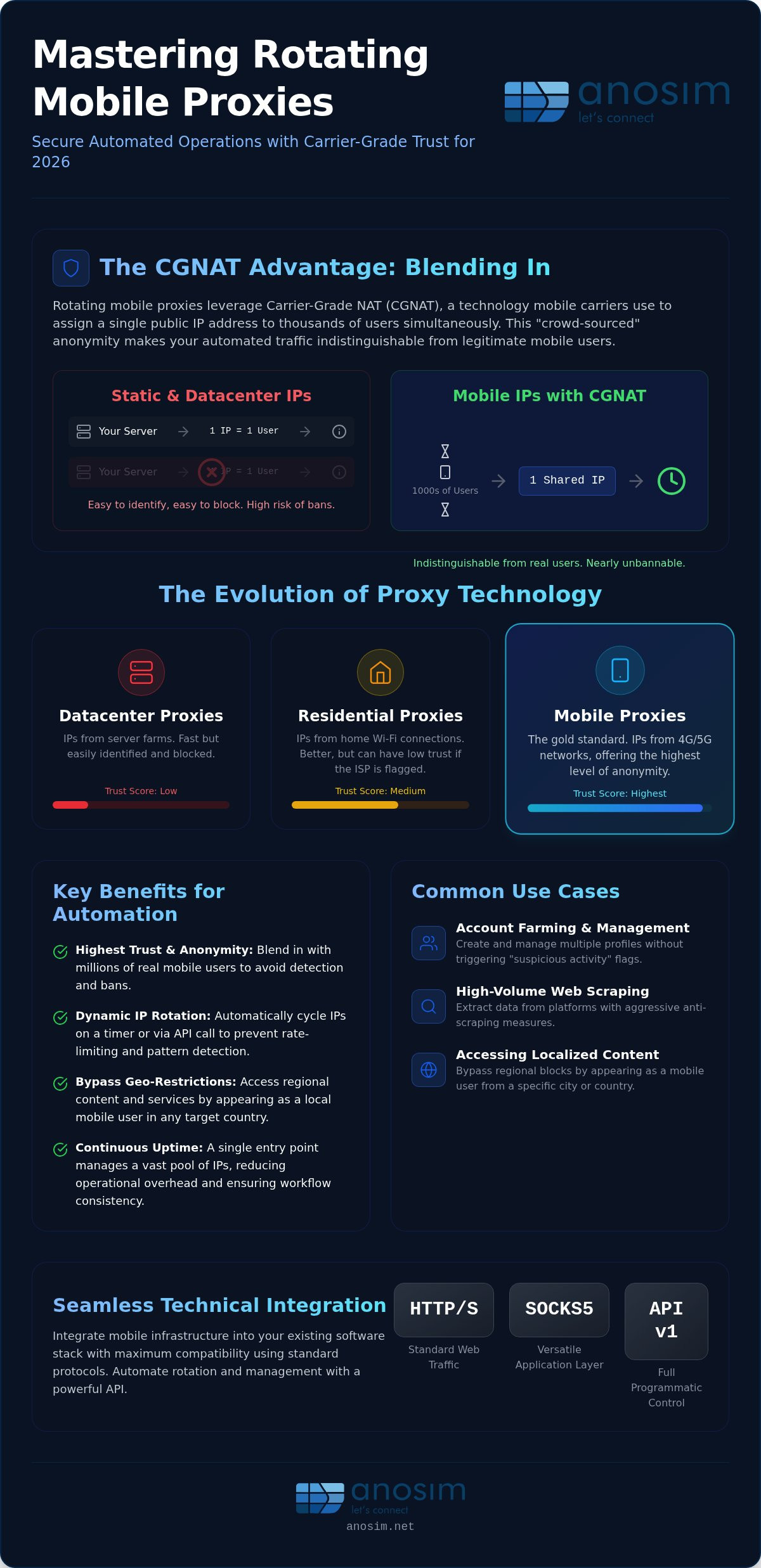
The core advantage lies in Carrier-Grade NAT (CGNAT). Because mobile carriers have fewer IPv4 addresses than customers, they assign a single public IP to thousands of simultaneous users. If an anti-bot system blocks a mobile IP, it risks blacklisting thousands of legitimate customers. This "crowd-sourced" anonymity makes mobile IPs nearly unbannable, allowing for high-trust automation in 2026 where static datacenter IPs fail. Common use cases include:
- Account Farming: Creating and managing multiple profiles without triggering "suspicious activity" flags.
- Web Scraping: Extracting data from platforms with aggressive anti-scraping measures.
- Regional Restrictions: Accessing localized content by appearing as a mobile user in a specific city or country.
The Evolution of Proxy Technology: From Datacenter to Mobile
Digital security has moved beyond simple IP tracking. Datacenter IPs are hosted in server farms; they're fast, but their subnets are easily identified and blocked by modern firewalls. Residential proxies improved on this by using home Wi-Fi connections, yet they often suffer from low trust scores if the ISP is flagged. Mobile infrastructure is now the gold standard. It provides the highest level of digital anonymity because it mimics the most common way humans access the web. With 5G now accounting for half of all mobile data traffic as of mid-2026, these high-bandwidth proxies are essential for modern scrapers. For more insights on infrastructure, check the Anosim blog.
Key Benefits of Rotation for Automated Workflows
Automation requires scale. If you send too many requests from one IP, you hit a rate limit. Rotation solves this by providing a fresh identity before the target server detects a pattern. It's a pragmatic solution for high-volume operations. Instead of manually managing a massive list of static IPs, you use a single entry point that handles the rotation logic for you. This reduces operational overhead and ensures your scrapers or account bots maintain a consistent uptime. By simulating organic user behavior across various geographic locations, you can bypass regional blocks and maintain a low profile. It's about efficiency and security.
The Mechanics of Mobile IP Rotation: CGNAT and Carrier-Grade Trust
To understand why rotating mobile proxies are superior for automation, you must first understand the technical constraints of mobile network operators. Mobile carriers manage millions of devices but possess a limited pool of public IPv4 addresses. They solve this through Carrier-Grade NAT (CGNAT), a large scale network address translation technology. This mechanism allows a single public IP to represent thousands of individual mobile users simultaneously. When your automation traffic flows through these gateways, it becomes indistinguishable from the data generated by real smartphones.
The "unbannable" factor is a direct result of this shared architecture. Websites and anti-bot systems hesitate to block mobile IP ranges because doing so would inadvertently deny access to thousands of legitimate customers. This creates a high-trust environment where your requests are shielded by the collective reputation of the carrier's user base. For a deeper dive into these network structures, you can consult this technical survey of Carrier-Grade NATs, which outlines the complexity of modern address mapping.
Trust scores are also heavily influenced by the Autonomous System Number (ASN). An ASN identifies the network owner, and IPs associated with major mobile carriers like Verizon, T-Mobile, or Vodafone naturally carry higher trust scores than those from residential ISPs or datacenter providers. In 2026, the shift toward 5G has improved rotation reliability. While LTE is stable, 5G infrastructure allows for faster IP handoffs and lower latency, making it the preferred choice for high-speed automated workflows.
How CGNAT Protects Your Automated Sessions
CGNAT functions by mapping private IP addresses from individual devices to a centralized public mobile gateway. Because anti-fraud systems see a massive volume of diverse, legitimate traffic coming from these gateways, they're less likely to trigger security challenges or CAPTCHAs. CGNAT is the technology that allows mobile proxies to hide automation within legitimate user traffic. This layer of abstraction ensures that even if one session is flagged, the underlying IP remains reputable for the next rotation. If you're building custom tools, the rotation API of our partner proxied.com manages these rotations, while the Anosim API (v1) covers number rental and SMS retrieval.
Carrier-Grade vs. Standard Residential IP Trust
Residential IPs are often tied to a single household. If a "neighbor" on the same ISP subnet engages in malicious activity, the entire range can suffer a reputation drop. Mobile carriers are different. Their IPs are constantly reassigned and shared by such a vast number of people that blacklisting is rarely a permanent solution for target websites. By 2026 standards, mobile proxies offer superior uptime because they don't rely on a single person's home router staying online. They leverage enterprise-grade cellular towers that are designed for 99.9% availability, providing a more stable foundation for sensitive account management tasks.
Mobile vs. Residential Proxies: A Strategic Comparison for 2026
Choosing between proxy types requires a pragmatic assessment of your target's security level. Residential proxies use home Wi-Fi connections provided by standard ISPs. While they offer better anonymity than datacenter options, they often fall short when facing the aggressive anti-bot systems of 2026. Rotating mobile proxies hold a distinct advantage in trust scores because they originate from major cellular carriers. This reputation difference is critical when your ROI depends on avoiding shadowbans or immediate account flags on high-security platforms.
Success rates on social media and e-commerce sites are significantly higher with mobile infrastructure. High-security targets like Instagram or TikTok prioritize mobile traffic because their user base is primarily smartphone-driven. Regarding speed, 5G has become the global standard as of mid-2026, with over 3 billion subscribers worldwide. This shift means 5G mobile proxies often match or exceed the performance of standard home Wi-Fi, offering lower latency for time-sensitive automated sessions. While the cost is typically higher for mobile, the reduction in account loss and CAPTCHA solving costs justifies the investment for professional operations.
When to Choose Rotating Mobile Proxies
If your workflow involves social media account management on platforms like Instagram, TikTok, or Tinder, mobile infrastructure is a requirement. These platforms use advanced device fingerprinting and IP reputation checks that identify residential IPs as automated if they don't match mobile user patterns. You should also use rotating mobile proxies when scraping sites protected by Cloudflare or Akamai. These services often apply lighter security filters to mobile carrier ranges to avoid disrupting legitimate users. Finally, they're the only reliable choice for mobile-first application testing, ensuring your software performs correctly on real cellular networks.
When Residential Proxies Might Suffice
Residential proxies remain a viable choice for high-bandwidth tasks that don't trigger extreme security responses. If you're conducting large-scale SEO monitoring or simple price comparison scraping, the absolute trust score of a mobile IP isn't always necessary. These projects benefit from the massive IP diversity residential pools provide at a lower price point. They're also suitable for budget-constrained operations where the goal is to rotate through a high volume of unique IPs rather than maintaining a specific carrier-grade reputation. For these use cases, residential connections offer a balance between cost and functionality. You can find more technical comparisons on the Anosim blog.
Implementing Rotation: Technical Integration and Best Practices
Integrating rotating mobile proxies into your tech stack requires a clear understanding of your automation's specific needs. The first decision is selecting a rotation trigger. Time-based rotation is ideal for tasks requiring session persistence, such as account management, where an IP change mid-action could trigger a security flag. Request-based rotation is more efficient for web scraping, as it provides a fresh identity for every GET or POST request. For developers who need total control, an API-forced rotation allows you to trigger a change exactly when your logic dictates.
Most modern tools support HTTP/HTTPS or SOCKS5 protocols. While HTTP is standard for web traffic, SOCKS5 is often preferred for more complex integrations because it handles any type of traffic without interpreting it. For programmatic management, the proxy API of our partner proxied.com automates these switches, and the Anosim API (v1) covers the number and SMS side of the workflow. By sending a simple GET request to the rotation endpoint of proxied.com, you can force an IP change instantly. This is particularly useful when your script detects a CAPTCHA or a block. You can monitor IP health and rotation success rates directly through your dashboard to ensure your scripts aren't hitting dead ends. To get started with a high-trust pool at our partner proxied.com, you can configure your mobile proxy endpoint here.
Setting Up Your First Rotating Proxy Session
Your initial configuration begins with authentication. You can choose between username/password credentials, which are flexible for various environments, or IP whitelisting for a more secure, static setup. Once authenticated, select your target country and carrier. Localized operations require an IP that matches the expected geography of the target site to avoid regional blocks. Test your rotation interval before scaling. If your session expires too quickly, you'll lose progress on multi-step tasks; if it's too slow, you risk hitting rate limits.
Optimization for High-Volume Automation
High-volume tasks require more than just a changing IP. You must manage session cookies alongside your rotation to maintain account stability. If the IP changes but the cookies remain identical across thousands of requests, anti-bot systems will detect the pattern. Your code should also include robust error handling. If a proxy fails or a connection times out, implement retry logic with exponential backoff. You must balance your rotation frequency with the specific technical requirements and rate limits of your target site to maintain a low profile.
Scaling Your Stack: High-Trust Infrastructure for Secure Operations
Achieving scale in 2026 requires more than just a pool of IP addresses; it demands a unified infrastructure that addresses every layer of digital identity. While rotating mobile proxies provide the high-trust connection needed to bypass initial firewall checks, the account lifecycle often stalls at the verification stage. Anosim provides the inbound data solutions for that stack, while the mobile network infrastructure comes from our partner proxied.com. This synergy allows developers to move from IP rotation to OTP verification without managing fragmented datasets.
Developers choose Anosim for the number and SMS side, while our partner proxied.com maintains the clean, high-reputation IP pools that are strictly monitored for quality. By leveraging the shared reputation of legitimate mobile carriers, that infrastructure ensures that your automated sessions are viewed as low-risk by target platforms. This operational efficiency is central to our 2026 roadmap, focusing on providing a silent partner for your digital tasks. Whether you're farming accounts or verifying mass registrations, the ability to manage the verification side through a single interface reduces the complexity of your software stack.
A Unified Solution for Digital Identity Management
Security-conscious users understand that a high-trust IP is only half the battle. To secure an automated workflow, you must combine rotating mobile proxies with virtual number rentals for multi-factor authentication. This combination ensures that the geographic location of your IP matches the region of your verification number, a key signal used by modern anti-fraud systems. The Anosim dashboard covers the number side while the proxy side runs in your proxied.com dashboard, which keeps your operations consistent across your digital footprint. For more technical details on network layers, see our guide on Mobile Proxy: The Complete Technical Guide to High-Trust Networking in 2026.
Developer-First Infrastructure
Efficiency depends on seamless integration. Our infrastructure supports the SMS-Activate Standard API, allowing for cross-platform compatibility with existing automation tools. If your setup requires custom logic, the API of our partner proxied.com handles programmatic proxy management, while the Anosim API (v1) provides the endpoints for number rental and SMS retrieval. We prioritize technical robustness and discretion, offering a sophisticated toolset for enterprise-level use cases. If you encounter complex configuration requirements, our FAQ and technical support resources are available to guide your implementation. Start scaling your operations with the mobile proxies of our partner proxied.com today to secure your automated workflows with carrier-grade trust.
Future-Proofing Your Automated Infrastructure
Success in 2026 automation depends on your ability to blend into legitimate user traffic. By leveraging the mechanics of CGNAT and the high trust scores of 5G carrier networks, you can bypass the most aggressive anti-bot systems. You've seen how rotating mobile proxies provide the necessary reputation for sensitive tasks like account farming and high-volume scraping. Choosing the right rotation trigger and protocol is just the first step; the real advantage comes from a unified infrastructure that manages your entire digital identity lifecycle.
Anosim provides the technical foundation for the verification side of this workflow. The global high-trust mobile carrier network of our partner proxied.com, paired with the Anosim API (v1), allows for seamless developer integration. When you combine these proxies with our SMS activation services, you create a robust, unbannable workflow. It's time to move beyond fragile datacenter setups and embrace carrier-grade reliability. Secure your automation with the high-trust rotating mobile proxies of our partner proxied.com and maintain your competitive edge with confidence.
Frequently Asked Questions
What is the difference between a static and a rotating mobile proxy?
Static mobile proxies assign a single IP address for the duration of your lease, while rotating mobile proxies automatically cycle through a pool of carrier IPs. Static options are suitable for tasks requiring a persistent identity over several hours. Rotation is better for high-volume scraping because it prevents rate limits. By constantly changing your public signature, you significantly reduce the footprint of your automated bot.
How often should I rotate my mobile IP for social media automation?
Most social media platforms in 2026 require a balance between stability and anonymity. You should rotate your IP every 15 to 30 minutes or whenever you switch between different user accounts. Rotating too frequently within a single active session can trigger security flags. It's best to match the rotation interval to the natural behavior of a mobile user moving between different network towers.
Are rotating mobile proxies legal for web scraping in 2026?
Using rotating mobile proxies for web scraping remains legal in 2026 as long as you respect local data protection regulations like GDPR. The legality depends on the type of data you extract and how you use it. You must avoid accessing non-public data or bypassing paywalls. Most businesses use these tools for legitimate market research, ad verification, and competitive price monitoring.
Can I use rotating mobile proxies with SOCKS5 protocol?
Yes, SOCKS5 is a standard protocol for mobile infrastructure. It's highly versatile because it doesn't interpret the traffic, making it ideal for automation that goes beyond simple web browsing. SOCKS5 provides lower latency and better support for specialized software that requires UDP or complex authentication methods. It's a reliable choice for developers who need maximum technical flexibility in their proxy setup.
Do mobile proxies work for bypassing SMS verification?
Mobile proxies don't directly bypass SMS verification; they provide the high-trust IP environment necessary for the verification prompt to appear without a block. You'll still need an inbound SMS activation service to receive the code. Pairing a high-reputation mobile IP with a virtual number rental ensures the platform views the registration as a legitimate user from a real cellular device.
What happens if a mobile proxy IP is blacklisted?
Blacklisting a mobile IP is rare because carriers use CGNAT to share IPs among thousands of users. Websites rarely block these ranges permanently to avoid losing real customers. If a block does occur, the rotation mechanism simply swaps the flagged IP for a fresh one from the pool. This ensures your automation continues without interruption and without you needing to manually troubleshoot connection errors.
How do I integrate the Anosim API with my existing automation bot?
Integration involves making standard GET or POST requests to the Anosim API (v1) endpoints. You can find your unique API key in the dashboard and use it to order numbers and fetch inbound SMS codes programmatically; proxy details and instant IP swaps come from the API of our partner proxied.com. Most automation bots allow you to input a custom rotation URL, making the process straightforward for anyone with a baseline level of technical literacy.
Is there a limit to how many times a mobile IP can rotate per hour?
While most providers allow frequent changes, technical constraints on the carrier network usually limit rotation to once every 30 to 60 seconds. Rotating more often than this can cause session drops or connection timeouts as the network reassigns your gateway. It's more efficient to rotate based on specific request thresholds or logical task completions rather than attempting to swap IPs every few seconds.