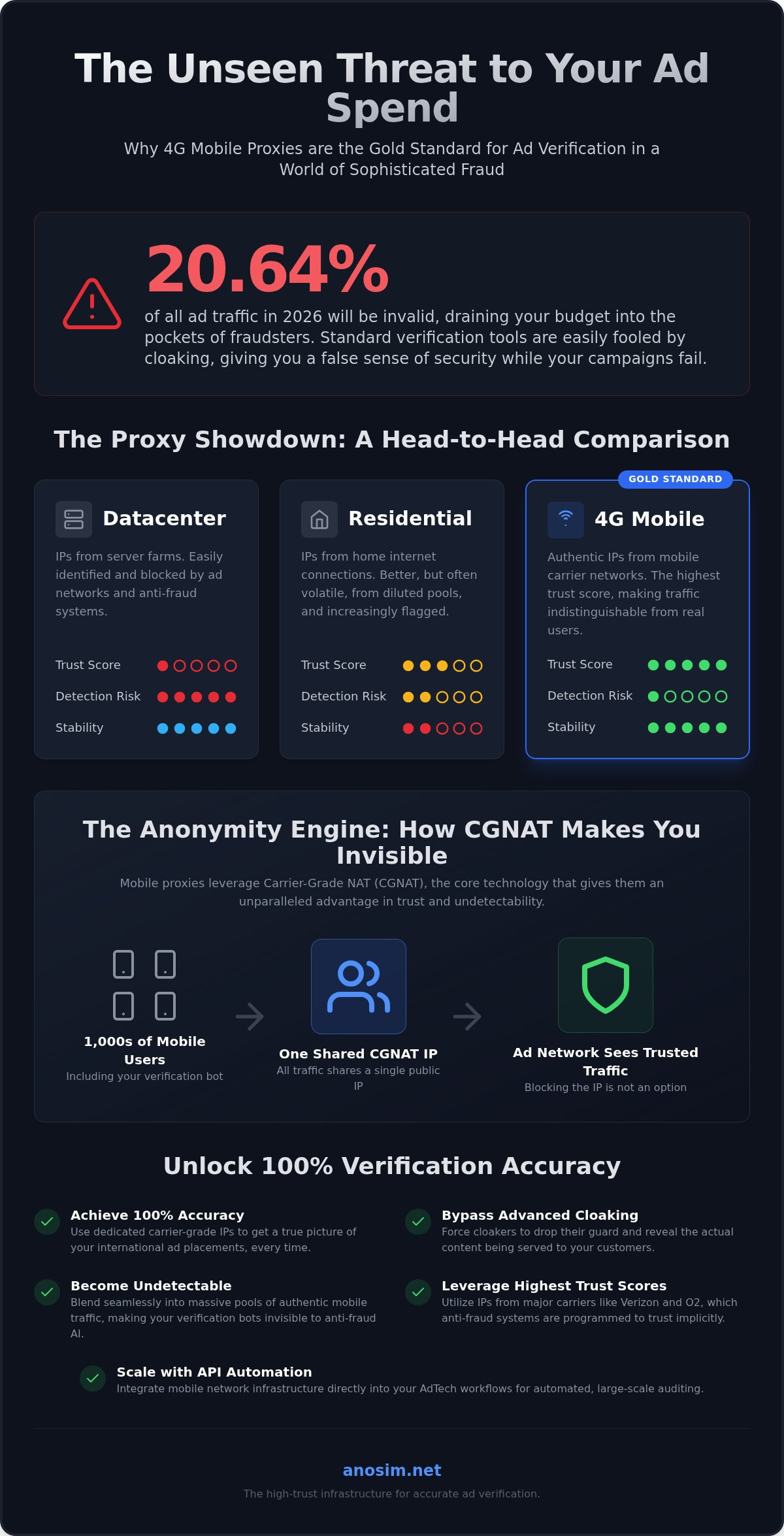
With 20.64% of all ad traffic in 2026 classified as invalid traffic, your campaign budget is likely leaking into the pockets of sophisticated fraudsters. It's frustrating to see clean previews in your dashboard while your actual customers are being served cloaked, fraudulent content. Using standard data center IPs often results in immediate bans or distorted data because ad networks easily flag them. Leveraging mobile proxies for ad verification has become the only reliable way to see what's actually happening on the ground.
You need a solution that mimics real user behavior without the latency or detection risks of traditional tools. This guide explains how to use high-trust 4G mobile proxies to eliminate ad fraud and bypass the most advanced cloaking techniques with 100% accuracy. We'll explore the technical mechanics of mobile carrier infrastructure, how to achieve zero detection by anti-fraud scripts, and the methods for scaling your verification processes via API. By the end, you'll have a pragmatic framework for protecting your brand and ensuring your global campaigns render exactly as intended.
Key Takeaways
- Identify why 4G infrastructure outranks residential and datacenter proxies in bypassing sophisticated bot detection and anti-fraud scripts.
- Learn how to configure mobile proxies for ad verification using precise IP rotation to mimic authentic user sessions across global regions.
- Gain technical insights into bypassing ad cloakers to ensure your campaigns are rendering correctly for real customers.
- Discover how to integrate mobile network infrastructure into your existing AdTech workflows using the API of our proxy partner proxied.com for automated, large-scale auditing.
- Understand the strategic advantage of using dedicated carrier-grade IPs to achieve 100% accuracy in international ad placement verification.
Table of Contents
- Why 4G Mobile Proxy Rental is the Gold Standard for Ad Verification in 2026
- 4G vs. Residential Proxies: Which Drives Better Verification Accuracy?
- Implementing 4G Mobile Proxy Rental for AdTech Workflows
- Overcoming Ad Fraud and Cloaking with High-Trust IP Infrastructure
- Scaling Ad Verification with High-Trust Mobile Proxy Solutions
Why 4G Mobile Proxy Rental is the Gold Standard for Ad Verification in 2026
Ad verification proxies are specialized tools designed to mimic legitimate user behavior, allowing brands to audit their placements across the online advertising ecosystem. In 2026, the complexity of ad fraud has reached a critical point. Simple datacenter proxies no longer suffice because ad networks use sophisticated AI to identify and block non-consumer traffic. If you're relying on static IPs, you're likely seeing a sanitized version of your campaign while real users encounter malicious cloaking. The shift toward 4G/LTE infrastructure provides the hyper-realistic simulation required to defeat modern bot detection. Unlike 5G, which is still being mapped and categorized in some regions, 4G networks have a deeply established footprint that anti-fraud AI perceives as the baseline for standard consumer activity.
The Problem with Traditional Ad Verification Methods
Datacenter IPs are essentially red flags for modern anti-fraud scripts. Because these IPs originate from known server farms, ad networks and fraudsters easily categorize them as bots. Even the residential proxy market has become diluted. Many providers sell repurposed ISP IPs that lack the dynamic behavior and trust scores associated with actual mobile hardware. When a fraudster detects these signatures, they serve a clean ad to your verification tool, hiding the fact that they're redirecting your real traffic to fraudulent landing pages. This creates a false sense of security while your budget is drained by invalid traffic.
How Mobile Proxies Bypass Sophisticated Detection
Mobile network IPs carry the highest trust scores because of the crowd effect inherent in cellular infrastructure. Carriers use Carrier-Grade NAT (CGNAT) to assign a single IP address to thousands of simultaneous users. Consequently, ad networks cannot block these IPs without risking the loss of thousands of legitimate customers. Using mobile proxies for ad verification allows you to blend into this massive pool of authentic traffic. This approach goes beyond simple IP rotation; it involves matching OS fingerprints and mobile headers to the specific carrier being used.
4G mobile proxies serve as the essential bridge between raw data and authentic user signals. By routing your requests through real mobile towers, you force ad cloakers to drop their guard. They see a standard mobile user on a 4G/LTE connection rather than a security auditor. This transparency is vital for maintaining brand safety and ensuring that your ad spend isn't being siphoned off. For teams managing high volumes, the verification of the ad accounts themselves runs through the Anosim API (v1), while our partner proxied.com supplies the proxy side that lets you monitor global campaigns in real time without triggering detection. It's about moving from reactive monitoring to proactive protection using high-trust infrastructure.
4G vs. Residential Proxies: Which Drives Better Verification Accuracy?
While Section 1 established why datacenter IPs fail, choosing between residential and 4G options requires a deeper look at network infrastructure. Residential proxies typically rely on peer-to-peer (P2P) networks, where traffic is routed through the home internet connections of individual participants. In contrast, 4G proxies route traffic through dedicated mobile carrier towers. This distinction is critical for maintaining compliance with FTC's truth-in-advertising laws, as accurate verification ensures that consumers aren't being misled by cloaked or fraudulent content. Ad networks prioritize traffic from major carriers like Verizon or O2 because these IPs carry a legacy of high-trust scores associated with verified mobile subscribers.
The Technical Advantage of CGNAT in Mobile Networks
Carrier-Grade NAT (CGNAT) is the hidden engine behind mobile proxy efficacy. Because IPv4 addresses are scarce, mobile carriers assign a single public IP to thousands of different mobile devices simultaneously. This creates a "crowd anonymity" effect. If an ad network blocks a CGNAT IP, they risk alienating thousands of legitimate customers. This makes mobile proxies for ad verification nearly immune to the "guilt by association" that often plagues residential IP pools. Your verification bot effectively hides in plain sight, appearing as just one more smartphone user among thousands of others on the same tower.
Stability and Uptime: Why AdTech Professionals Prefer 4G
The volatility of residential proxies is a major operational pain point. If a residential user turns off their computer or disconnects their Wi-Fi, your verification session dies instantly. 4G mobile towers provide a constant, stable connection. This reliability is essential for multi-step ad funnel verification where you need to maintain a long-lived session to track a user's journey from the initial click to the final landing page. Mobile infrastructure also ensures superior geo-targeting accuracy, allowing you to pinpoint specific cities and carriers with high precision.
Residential networks often report inaccurate location data because they rely on the fluctuating status of home routers. While the initial investment in 4G infrastructure is higher, the reduction in ban rates and the increase in data accuracy provide a significantly better ROI. If you need reliable, high-trust connections for your auditing tasks, you can rent mobile proxies from our partner proxied.com, which provide the stability required for enterprise-level verification. Using carrier-grade hardware ensures your verification scripts run without the interruptions common in peer-to-peer networks.
Implementing 4G Mobile Proxy Rental for AdTech Workflows
Transitioning from a general understanding of network infrastructure to a functional deployment requires a methodical approach. Ad fraud isn't just a technical glitch; it's a multi-billion dollar industry. According to FTC fraud statistics, the scale of digital deception continues to climb, making precision auditing a necessity rather than an option. Setting up mobile proxies for ad verification involves five critical steps to ensure your traffic is indistinguishable from a real consumer's.
- Step 1: Regional and Carrier Identification. Determine exactly where your ads are served. If you're auditing a campaign in Tokyo, you need proxies routed through local carriers like NTT Docomo or SoftBank to see the local ad variants.
- Step 2: IP Rotation Configuration. Avoid static patterns. Set your IP rotation intervals to match typical human browsing sessions, usually between 5 and 20 minutes, to prevent triggering rate limits.
- Step 3: Workflow Integration. Connect your proxy endpoints directly to your auditing scripts or verification platforms. Ensure your software supports SOCKS5 or HTTP protocols for secure data transmission.
- Step 4: Header Optimization. Your browser fingerprint must match the proxy. If you're using a mobile IP, your User-Agent string should reflect a mobile device on that specific carrier's network.
- Step 5: Programmatic Scaling. Move away from manual dashboard management. Use API endpoints to switch locations or rotate IPs automatically as your verification volume increases.
Programmatic Integration via API
For enterprise-level auditing, manual configuration is a bottleneck. The Anosim API (v1) covers the number and SMS side of your workflow; our partner proxied.com handles proxy lifecycle management, from IP rotation to geo-switching, with minimal latency. When managing high-volume tasks, you should implement logic that handles concurrent sessions across different carrier towers to distribute load and maintain high trust scores. API-driven proxies reduce manual overhead in brand protection. This automation ensures that your verification bots remain active and undetected, even when running thousands of checks across multiple continents simultaneously.
Optimizing for Mobile-First Ad Networks
Modern ad networks prioritize mobile-first environments, where in-app ads and mobile web placements dominate. Verifying these requires more than just a mobile IP; it requires a complete device simulation. In-app ads often use deep-packet inspection to verify the integrity of the request. By using high-trust mobile proxies, you can simulate real-world device environments that pass these checks. Ensure your verification scripts include mobile-specific headers like X-Requested-With for Android apps. This level of detail forces ad cloakers to reveal the actual destination of the ad, providing you with the 100% accuracy needed for legitimate brand auditing.
Overcoming Ad Fraud and Cloaking with High-Trust IP Infrastructure
Ad cloakers represent the most significant hurdle in modern campaign auditing. These sophisticated scripts operate by maintaining extensive databases of known data center and residential IP ranges. When your verification bot attempts to audit an ad, the cloaker analyzes the request's metadata, including the IP's reputation and its association with commercial hosting providers. If the system flags the traffic as suspicious, it serves a "safe" version of the ad, effectively hiding fraud from your team. Utilizing mobile proxies for ad verification disrupts this process. Because these proxies route through legitimate mobile carrier infrastructure, they bypass the filters that usually catch automated auditors.
Mobile proxies force cloakers to reveal the true destination of an ad by appearing as standard consumer traffic. This is particularly vital when verifying affiliate links and CPA offers across international borders. Fraudulent actors often use geo-targeting to show compliant content to users in one region while serving prohibited or deceptive offers to others. By using a 4G connection from the target country, you can see exactly what the local audience sees. This transparency allows you to audit third-party ad placements in "hidden" regions where manual checking isn't feasible, ensuring your brand reputation remains intact regardless of the geography.
Detecting Non-Human Ad Impressions
Modern click farms have evolved to mimic mobile traffic patterns, making them difficult to distinguish from real users. By using mobile proxies, you can establish a baseline for "expected" ad behavior in specific mobile environments. You can then compare this against the "actual" rendering you observe during audits. Strategic use of rotating IPs allows you to map out fraud networks by identifying clusters of suspicious activity that only appear when viewed from specific carrier towers. If an ad consistently fails to render or redirects to a dead link when accessed via a high-trust mobile IP, it's a clear signal of invalid traffic.
Brand Protection and Compliance Auditing
Ensuring your ads don't appear next to prohibited or extremist content is a core component of brand safety. Many ad networks struggle with "long-tail" inventory where automated moderation is weak. You can use dedicated mobile proxies for long-term monitoring of sensitive campaigns to ensure ongoing compliance. This is especially important for verifying that local pricing and language in your ads match regional regulations. If you're ready to eliminate the blind spots in your campaign auditing, you should secure your verification infrastructure with rented Anosim numbers and, for the IP side, carrier-grade mobile IPs from our partner proxied.com.
Scaling Ad Verification with High-Trust Mobile Proxy Solutions
Scaling an ad verification operation across multiple continents requires more than just a large IP pool. It requires direct access to mobile network infrastructure to ensure high trust scores and minimal detection. Unlike aggregators that resell traffic from shared pools, our partner proxied.com provides direct routing through carrier hardware. This ensures that your mobile proxies for ad verification are clean and haven't been previously flagged by major ad networks. Direct infrastructure access is the only way to maintain the crowd anonymity discussed in earlier sections while scaling to hundreds of concurrent sessions.
Implementing mobile proxies for ad verification at an enterprise scale requires a silent partner that provides the necessary infrastructure for digital tasks without adding unnecessary complexity. Anosim covers the numbers and SMS activations for that setup, while the mobile IPs come from our partner proxied.com, which lets you bypass the technical limitations of resold aggregator pools. By accessing IPs directly from mobile towers, you eliminate the risk of high latency or sudden connection drops that plague low-tier providers.
The Synergy of Proxies and SMS Verification
Ad auditing often begins before the first ad is even served. It starts with the creation and verification of the ad accounts themselves. By combining high-trust mobile proxies with SMS activation services, you can manage the entire lifecycle of an ad campaign from a single interface. Using rented mobile numbers allows your team to verify ad accounts in the same target region as your proxy. This creates a consistent digital footprint that anti-fraud AI is less likely to flag. Consolidating your data and verification needs under one provider reduces friction in automated workflows and simplifies brand protection.
Getting Started with Anosim
Selecting the right mobile proxy plan depends on your specific verification volume and geographical requirements. Our partner proxied.com provides a range of options, from short-term rentals for one-off audits to dedicated enterprise infrastructure for continuous monitoring. If your workflow involves complex automation, you can combine the proxy API of proxied.com with the Anosim API (v1) for numbers and SMS activations. This programmatic approach allows you to switch locations and rotate IPs without manual intervention, maintaining 100% accuracy in your global audits.
Secure your ad verification workflow with mobile proxies from our partner proxied.com today.
Protecting Your Brand Spend with Carrier-Grade Infrastructure
In 2026, the gap between dashboard metrics and actual ad rendering continues to widen. Success in this environment requires infrastructure that remains invisible to anti-fraud AI. You've seen how 4G mobile proxies leverage the crowd anonymity of CGNAT to bypass cloakers that easily flag residential or datacenter IPs. By combining carrier-grade 4G/LTE infrastructure with global SMS and proxy synergy, you can manage the full lifecycle of your ad accounts and audits from a single, unified source.
Automation is no longer optional for enterprise-level auditing. The proxy API of our partner proxied.com, together with the Anosim API v1 for numbers and SMS, provides the programmatic control needed to scale your operations across multiple regions without manual overhead. By integrating mobile proxies for ad verification into your security stack, you move from reactive monitoring to proactive brand protection. This transition ensures your budget is spent on real impressions rather than sophisticated bot traffic. It's the most efficient way to maintain visibility in an increasingly opaque digital landscape.
Scale your ad verification with high-trust mobile proxies and ensure your campaigns maintain 100% accuracy across every global market. You have the technical foundation required to reclaim control over your digital advertising integrity.
Frequently Asked Questions
Why are mobile proxies better than residential proxies for ad verification?
Mobile proxies provide higher stability and trust scores than residential alternatives. Residential connections rely on home users who may disconnect at any time, which causes session failures during sensitive audits. Mobile towers offer consistent uptime and route through CGNAT, making your auditing traffic indistinguishable from thousands of real mobile subscribers sharing the same IP.
Can ad networks detect if I am using a 4G mobile proxy?
Ad networks generally perceive 4G mobile proxies as legitimate consumer traffic. Because mobile carriers assign one IP to thousands of devices simultaneously, blocking a 4G IP would risk alienating thousands of legitimate customers. This crowd anonymity makes it nearly impossible for anti-fraud scripts to isolate your verification bot as long as your headers match the carrier data.
How often should I rotate my mobile proxy IP for ad auditing?
You should rotate your IP every 5 to 20 minutes to match typical human browsing patterns. Rotating too quickly can trigger bot detection, while staying on one IP for too long increases the risk of being flagged for unusual high-volume activity. Programmatic rotation via API ensures you maintain a natural session flow during large-scale auditing tasks.
Do I need a different proxy for every country I am verifying ads in?
Yes, verifying ads in different countries requires a proxy from that specific region. Ad networks serve different creative variants based on local carrier data and IP geolocation. To see exactly what a user in London or Tokyo sees, you must route your traffic through a local carrier tower located in that specific city or country.
What is the difference between a mobile proxy and a VPN for AdTech?
Mobile proxies offer application-level granularity that VPNs lack. Most VPNs use datacenter IPs that ad networks easily flag and block. Using mobile proxies for ad verification allows you to use real carrier infrastructure and modify headers to simulate specific mobile devices, which is critical for bypassing advanced ad cloakers that VPNs cannot defeat.
How do APIs help with automated ad verification?
The proxy API of our partner proxied.com automates the most time-consuming aspects of proxy management. It allows your developers to switch locations, rotate IPs, and manage concurrent sessions through code rather than manual dashboards. The Anosim API (v1) covers the number and SMS side when ad accounts need verification. This level of automation is essential for maintaining brand safety across high-volume, global campaigns without increasing manual labor. Using mobile proxies for ad verification through an API ensures your scripts run 24/7 without interruption.
Can I use mobile proxies to verify in-app advertisements?
You can and should use mobile proxies to verify in-app advertisements. Mobile apps often use deep-packet inspection to check for carrier-specific signatures and mobile headers. Using a high-trust 4G proxy ensures your verification bot passes these checks, forcing the app to serve the same ad it would show to a real smartphone user on a cellular network.
Is 4G mobile proxy rental cost-effective for small marketing agencies?
4G mobile proxy rental is highly cost-effective for small agencies when measured by ROI. While the upfront cost is higher than datacenter IPs, the ability to eliminate ad fraud and see cloaked content prevents significant budget waste. Protecting even a single campaign from invalid traffic usually covers the cost of the proxy infrastructure many times over.