Your automated systems shouldn't be held hostage by flagged numbers or bloated, overpriced APIs that fail when you need them most. In a digital environment where TCPA regulations and carrier filtering have become increasingly stringent, finding a reliable sms activation api for developers is no longer just a convenience. It's a technical necessity for maintaining operational efficiency and digital privacy.
We understand that dealing with complex documentation and high latency is a constant drain on your engineering resources. This 2026 guide provides the technical blueprint for programmatically receiving SMS verification codes at scale using high-trust virtual numbers and streamlined APIs. You'll learn how to achieve seamless integration with your existing codebase while maintaining the cost-effectiveness required for high-volume tasks. We'll explore the transition from legacy systems to modern, inbound-only protocols that prioritize reliability and technical robustness over marketing fluff.
Key Takeaways
- Understand why inbound-focused verification infrastructure is essential for bypassing modern carrier filters and ensuring high OTP delivery rates.
- Learn how to integrate the sms activation api for developers using either the native Anosim API (v1) or the compatible SMS-Activate Standard protocol.
- Evaluate the technical trade-offs between cost-effective one-time activations and strategic long-term number rentals for persistent account management.
- Improve automation reliability by implementing intelligent retry logic and matching geographic footprints with mobile proxies from our partner proxied.com.
- Scale operations globally by accessing high-trust virtual numbers from hundreds of countries through a single, unified programmatic interface.
Table of Contents
- Why Developers Need a Dedicated SMS Activation API in 2026
- Core Methods: Integrating the Anosim API (v1) and SMS-Activate Standard
- One-Time Activation vs. Long-Term Number Rental via API
- Best Practices for High-Volume Automation and Reliability
- Scaling with Anosim: The Developer-First Infrastructure
Why Developers Need a Dedicated SMS Activation API in 2026
An SMS activation API is a specialized programmatic interface designed for a single purpose: receiving inbound verification codes. Unlike traditional messaging platforms that focus on bulk outbound marketing, these APIs provide developers with the infrastructure to capture One-Time Passwords (OTPs) and verification strings automatically. This shift from outbound CPaaS to inbound-focused verification reflects a changing digital environment where the ability to receive data is as critical as the ability to send it.
Modern software development requires high-velocity testing and account management. Physical SIM cards are a bottleneck in these workflows; they don't scale, they require manual handling, and they're prone to physical failure. Choosing a specialized sms activation api for developers allows for the immediate acquisition of virtual numbers across diverse geographic regions without the overhead of hardware. This is essential for automated testing, bulk account creation, and maintaining privacy-centric signups where personal data exposure must be minimized.
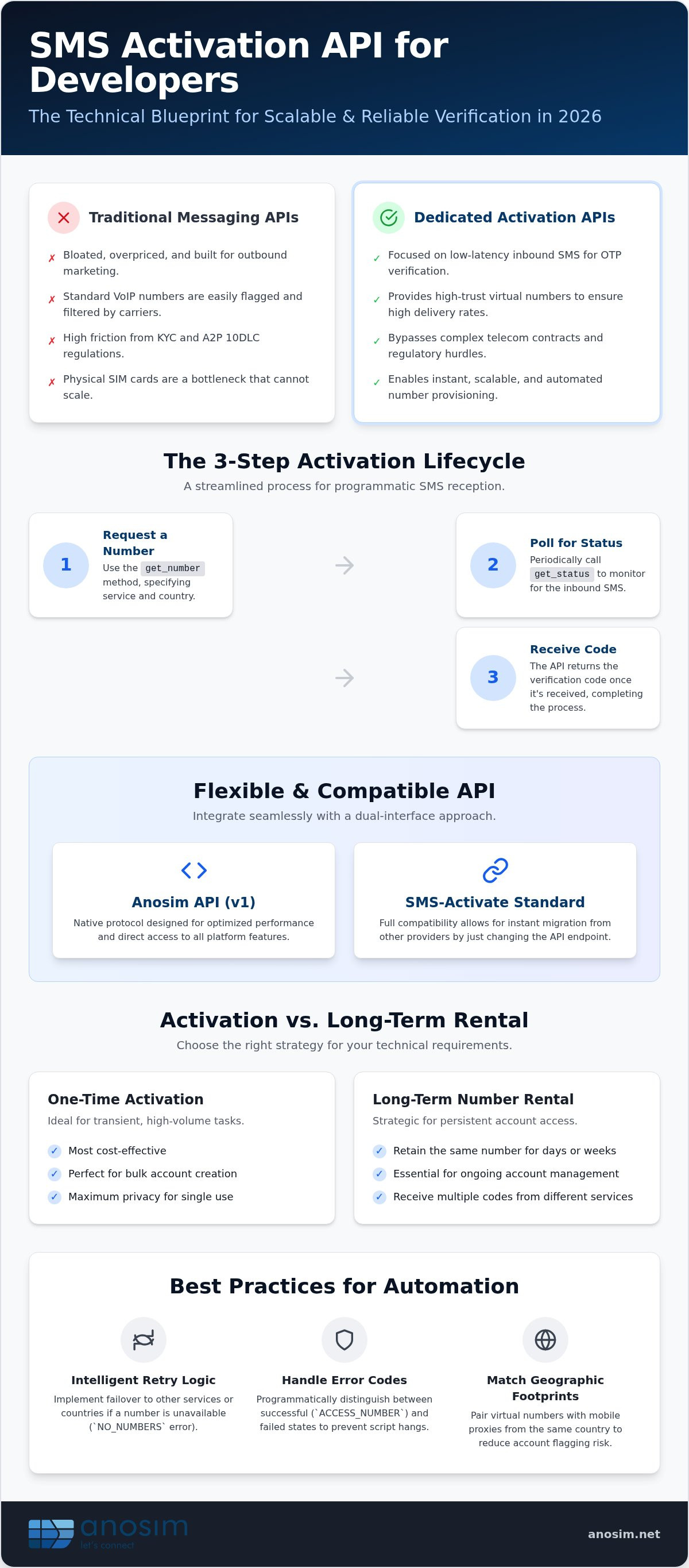
Reliability in 2026 hinges on the quality of the virtual number. Many platforms now implement sophisticated detection algorithms to flag standard VoIP numbers used for two-factor authentication. Developers need access to high-trust numbers that mimic legitimate user behavior. By leveraging an API that provides high-trust virtual numbers, engineers can ensure their verification requests aren't filtered by carrier-level security protocols.
Inbound vs. Outbound API Architecture
Technical requirements for receiving verification codes differ significantly from those used for sending alerts. Inbound architecture must prioritize low-latency reception and high-trust number pools. While standard VoIP numbers are often blocked by major platforms, Rent Mobile VoIP services provide the legitimacy required for successful activations. Successful integration often requires pairing these numbers with Mobile Proxies to ensure the request's IP address matches the number's geographic origin; this reduces the risk of account flagging during the verification process.
The Problem with Standard Messaging APIs
Traditional enterprise messaging providers are frequently ill-suited for simple verification tasks. Their pricing models are built for high-volume outbound campaigns, making small-scale inbound tasks unnecessarily expensive. Furthermore, strict KYC (Know Your Customer) and A2P 10DLC regulations have introduced significant friction for developers who need to spin up numbers quickly; in these instances, leveraging a data query hub like SOAWebServices can assist in validating official information for Brazilian users. Standard APIs often lack specialized "activation" logic, forcing developers to build complex custom handlers for transient numbers. Implementing a dedicated sms activation api for developers bypasses these regulatory and technical hurdles, offering a direct path to successful verification without the administrative burden of traditional telecom contracts.
Core Methods: Integrating the Anosim API (v1) and SMS-Activate Standard
Developing robust verification systems requires an sms activation api for developers that offers both native performance and protocol flexibility. Anosim provides a dual-interface approach. It supports the native Anosim API (v1) for optimized inbound management while maintaining full compatibility with the SMS-Activate Standard API. This compatibility is a strategic advantage for engineering teams; it allows for immediate migration from other providers by simply updating the API endpoint host without rewriting core integration logic.
Efficient automation relies on clean data exchange. The API uses standard HTTP GET and POST requests, returning JSON payloads that are easy to parse in any modern language. Handling error codes programmatically is vital. For instance, your code should distinguish between ACCESS_NUMBER, which confirms a successful grab, and NO_NUMBERS, which indicates a temporary stock depletion in a specific region. Proper error handling prevents your scripts from hanging and allows for intelligent failover to alternative countries or services, ensuring your automation remains resilient under heavy load.
The Activation Lifecycle: Get, Wait, Receive
The process begins with the get_number method. This call requests a virtual number for a specific service and country. Once the number is assigned, your system enters a polling phase using get_status to monitor for the inbound SMS. While some legacy systems rely solely on polling, modern implementations often look for webhooks or optimized low-latency checks to reduce execution time.
- Request a number for a specific target platform via the get_number endpoint.
- Monitor the status until the verification code is received using the get_status method.
- Extract the OTP from the JSON response for immediate use in your registration script.
The set_status method acts as the finalizer for successful activations, signaling the system to close the transaction and release the number.
Authentication and Security
Security is paramount when managing programmatic access to telecommunications infrastructure. Adhering to NIST guidelines on Multi-Factor Authentication requires developers to treat verification assets with the same level of protection as primary credentials. API keys should never be hardcoded; instead, manage them through environment variables or secure vault services to prevent accidental exposure in version control systems.
Rate limiting is another critical factor. To prevent throttling during high-volume operations, developers should implement exponential backoff logic. You can find detailed technical specifications and endpoint structures in the Anosim API Documentation. For those ready to begin building their first integration, exploring the available SMS activation options is the first step toward a functional prototype.
One-Time Activation vs. Long-Term Number Rental via API
Choosing the right verification strategy depends on the lifecycle of the accounts you're managing. For transient tasks, such as one-off automated testing or temporary service access, one-time activations are the most efficient path. They provide a cost-effective solution for receiving a single verification code without committing to recurring overhead. However, the strategic advantage shifts toward long-term virtual number rentals when managing persistent accounts. If a platform triggers a security check or requires re-verification months after the initial signup, losing access to the original number can result in permanent account lockouts.
An sms activation api for developers allows for a programmatic cost-benefit analysis between these two models. While one-time activations minimize upfront costs, long-term rentals offer stability for high-value digital assets. Managing these options via API enables your system to check balances and extend rental periods automatically based on specific account triggers. This ensures that your infrastructure remains lean while protecting the longevity of your operational accounts.
Programmable Number Rentals
Integrating a Rent Number service into your workflow provides a dedicated inbound channel that remains active for weeks or months. This is particularly critical for platforms like WhatsApp Business, Telegram, or financial services that frequently utilize SMS for ongoing authentication. Developers can use the API to monitor the expiration timestamp of each rented number and trigger renewal requests programmatically. Automating this process prevents the loss of numbers that are tied to essential business communication or sensitive data recovery workflows.
Scalability for High-Volume Workflows
For enterprise-level operations, managing a diverse pool of virtual numbers across different geographic regions is a technical requirement. The API facilitates batching requests, allowing you to acquire and manage multiple numbers simultaneously for various services. This global coverage ensures your systems can bypass regional restrictions and maintain high delivery rates regardless of the target platform's location. To optimize these large-scale integrations, you can read more about Bulk SMS Activation and how to implement compatible standards for seamless scaling. Using an sms activation api for developers to orchestrate these pools allows for a high degree of technical robustness, ensuring that your automation scripts always have access to clean, high-trust numbers when demand spikes.
Best Practices for High-Volume Automation and Reliability
Scaling a verification pipeline requires more than just basic API integration; it demands a resilient architecture that can handle carrier delays and service-specific hurdles. Choosing a robust sms activation api for developers is the foundation, but your implementation must account for the inherent volatility of global telecommunications. High-volume tasks require an sms activation api for developers that supports rapid rotation and intelligent error handling to maintain a high success rate across thousands of requests.
Reliability starts with intelligent retry logic. If a verification code doesn't arrive within a defined window, typically 90 to 120 seconds, your system should automatically cancel the request and attempt the activation with a different number or geographic region. This prevents your automation scripts from stalling on a single "stuck" transaction. Additionally, maintaining zero downtime requires automated balance monitoring. By using the API to check your current funds and triggering top-ups when they reach a specific threshold, you ensure that your verification tasks never pause due to insufficient credit.
Handling Service-Specific Restrictions
Major platforms utilize sophisticated fraud detection systems that analyze more than just the phone number. They often correlate the geographic origin of the number with the IP address of the registration request. If you use a German virtual number but your request originates from a US-based data center, the platform is likely to flag the account or block the SMS. Mitigating this requires the use of Mobile Proxies to match the geographic footprint of your virtual numbers. Using "clean" mobile IPs that haven't been blacklisted by major services is essential for successful bulk account creation. You can find technical details on implementing these safeguards in our Mobile Proxy API Guide.
Optimizing Latency and Response Times
Response time is critical when your system is processing hundreds of concurrent activations. To minimize latency, select API endpoints that are geographically closest to your primary data centers. While some developers rely on synchronous polling, optimizing your code for asynchronous execution allows your system to monitor multiple SMS statuses without blocking other operations. This approach ensures that as soon as a code is available, your script can extract and process it immediately. Anosim minimizes latency between carrier reception and API availability by maintaining direct upstream relationships and optimized processing queues. For engineers looking to scale, you can optimize your verification pipeline by integrating these high-performance endpoints into your stack today.
Scaling with Anosim: The Developer-First Infrastructure
Anosim provides the foundational infrastructure necessary for modern digital tasks. Its sms activation api for developers is built on a global virtual number pool spanning hundreds of countries. This geographic breadth ensures that your automation can overcome regional restrictions without the logistical nightmare of physical hardware. By removing the need for physical SIM card delivery, Anosim offers an immediate efficiency gain for engineering teams focused on rapid deployment. It functions as a silent partner, providing the technical robustness required for high-utility applications.
Reliability in 2026 requires more than just clean code; it requires operational transparency. There are no hidden fees or complex hardware requirements to navigate. If technical challenges arise, developers have access to comprehensive resources, ranging from a detailed FAQ to direct technical assistance. This support structure is designed to respect your time, providing direct solutions rather than marketing fluff. As verification protocols evolve, Anosim adapts its infrastructure to ensure consistent delivery rates, future-proofing your integration against carrier-level shifts and changing regulatory environments.
Getting Started with Anosim API
Transitioning from a manual process to full programmatic automation is straightforward. The journey begins with account creation and API key generation. Once authenticated, your first successful activation is only a few requests away. For high-volume users managing enterprise-level tasks, the Anosim Partner Program offers tailored support and optimized resource allocation. You can find a detailed implementation guide for setting up a Virtual Mobile Number for Developers to ensure your integration follows current best practices and maximizes success rates from day one.
Advanced Developer Tools
Not every project requires the same protocol. While the native v1 API is recommended for new builds, developers can leverage the Alternative API v1 to maintain specific legacy integrations without a full codebase rewrite. This flexibility is critical for agencies managing diverse client portfolios. Additionally, for scenarios where SMS is insufficient, Rent Mobile VoIP options provide numbers capable of voice-based verification. This multi-layered toolset positions Anosim as a comprehensive partner for digital anonymity and operational robustness. If you are ready to eliminate verification bottlenecks, start building with Anosim API today to secure your automated workflows.
Future-Proof Your Verification Infrastructure
The shift toward specialized inbound verification infrastructure is a technical response to an increasingly regulated digital landscape. By prioritizing high-trust number pools and protocol compatibility, engineers can bypass the limitations of legacy outbound platforms. Implementing a robust sms activation api for developers ensures that your automation scripts remain resilient, whether you're managing transient one-time activations or long-term account rentals.
Success in 2026 relies on a multi-layered approach that combines reliable API endpoints with geographic precision via mobile proxies from our partner proxied.com. Anosim provides the necessary tools for this level of operational robustness, supporting both the native Anosim API (v1) and the SMS-Activate Standard API for seamless transitions. With global coverage for over 100 services and high-trust mobile VoIP options, you have the infrastructure needed to scale without hardware constraints. This methodology prioritizes technical accuracy and security over manual overhead.
Take the next step in optimizing your digital workflows. Get Started with Anosim SMS Activation API and build a verification pipeline that values efficiency and privacy. Your systems are ready for a more professional way to handle inbound data.
Frequently Asked Questions
How do I get an API key for SMS activation?
You can obtain an API key by creating an account on the Anosim platform and navigating to your profile settings. Once generated, this unique string must be included as a parameter in every HTTP request to authorize your programmatic access. It's essential to store this key securely in your environment variables rather than hardcoding it into your scripts.
Is the Anosim API compatible with the SMS-Activate standard?
Yes, the infrastructure fully supports the SMS-Activate Standard API alongside the native Anosim API (v1). This allows you to use existing third-party libraries or custom tools by simply updating the API endpoint host in your configuration. It's a pragmatic solution for teams looking to switch providers without undergoing a complete codebase rewrite.
Can I receive SMS from any service like Google, WhatsApp, or Tinder?
The global pool of virtual numbers supports inbound verification for over 100 major platforms, including Google, WhatsApp, and Tinder. When you make a request to the sms activation api for developers, you specify the unique service ID for the platform you're targeting. This ensures the system allocates a number that is currently compatible with that specific service's verification protocols.
What happens if I don’t receive the SMS code through the API?
If a code isn't received within the service's timeout window, you should use the set_status method to cancel the activation request. No funds are deducted from your balance for unsuccessful activations where a code was never delivered. This fail-safe mechanism allows you to implement retry logic and request a fresh number without incurring unnecessary costs.
Can I rent a virtual mobile number long-term using the API?
You can utilize the Rent Number or Rent Service options via the API for extended verification needs. These services provide persistent access to a specific number for durations ranging from several hours to multiple weeks. Managing rentals programmatically is the most efficient way to handle accounts that require periodic re-verification or ongoing two-factor authentication.
Do I need a mobile proxy to use the SMS activation API?
While the API functions independently, using mobile proxies is a technical best practice for high-volume automation. Matching the geographic location of your IP address to the virtual number's country significantly reduces the likelihood of a platform flagging your account. Integrating a sms activation api for developers with a proxy service creates a more stable and legitimate digital footprint.
What are the pricing models for developer-focused SMS APIs?
Pricing typically follows a dynamic, pay-per-use model where costs are determined by the specific service and country requested. This allows for cost-effective scaling since you only pay for successful activations or active rental periods. You can use the /ProductPrices endpoint to programmatically check current rates before initiating a request, ensuring your automation remains within budget.
How do I handle multi-step verification via API?
For accounts requiring multiple codes in a single session, the Rent Number service is the appropriate choice. Unlike one-time activations that close after the first SMS, a rental remains open for the duration of your term. This allows your system to receive sequential codes on the same number, which is necessary for complex sign-up flows or frequent security checks.