What if the real cost of verification isn’t the code, but the time your team spends coordinating personal phones and inconsistent manual steps? A business case for bulk virtual numbers for verification should start with a specific operational need, not a promise that every platform will accept them.
If your team relies on personal numbers or ad hoc processes, consider whether a managed workflow could improve consistency without creating new privacy or compliance risks. The answer depends on the use case, the third-party service’s terms, and how access to numbers and messages is managed.
This article shows how to explain the need, distinguish one-time SMS activation from longer-term number rental, and decide which option fits a workflow. It also outlines a controlled evaluation, with checks for security, applicable policies, supported destinations, and service limitations. That gives decision-makers practical evidence to assess operational fit before considering broader use.
Key Takeaways
- Describe a specific workflow problem, such as reliance on personal numbers or inconsistent manual steps.
- Choose between one-time SMS activation and longer-term number rental based on how long the workflow needs access to a number.
- Compare options by continuity, supported destinations, API requirements, and administrative effort.
- Evaluate bulk virtual numbers for verification through a limited pilot with authorized services, access controls, and success measures defined in advance.
- Give your boss the evidence, safeguards, pilot results, and a clear decision to make.
Table of Contents
- Why Use Bulk Virtual Numbers for Verification?
- How do bulk virtual numbers and verification workflows work?
- How should you compare bulk verification options before recommending one?
- How can you propose a low-risk pilot and measure its results?
- How can you present a decision-ready recommendation to your boss?
Why Use Bulk Virtual Numbers for Verification?
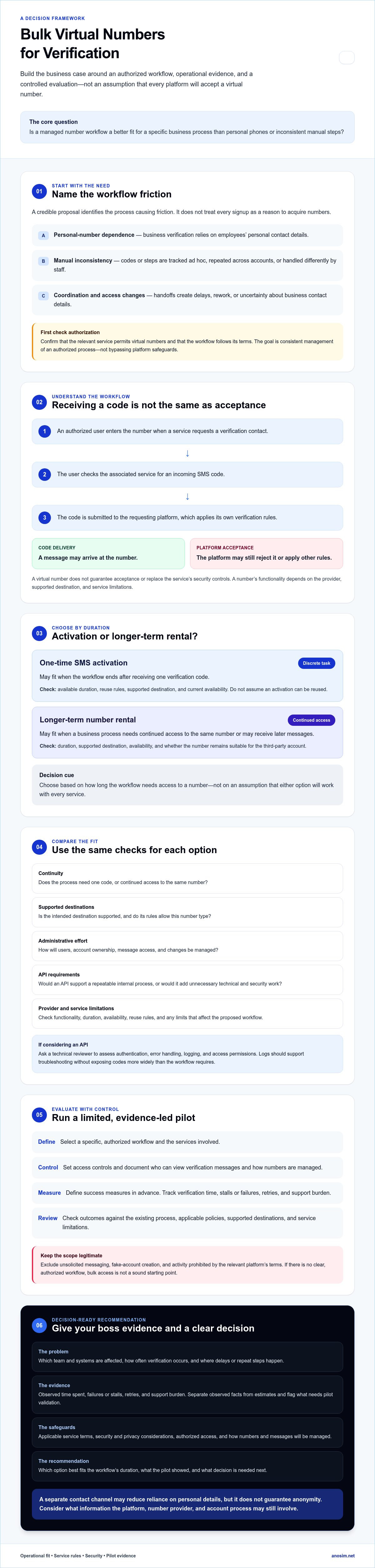
Verification can become fragmented when employees use personal phone numbers, track codes manually, or repeat steps across separate accounts. This can lead to extra coordination, rework when access changes hands, and uncertainty about which contact details belong to a business workflow. A proposal for bulk virtual numbers for verification should identify the process causing friction, rather than treating every signup as a reason to acquire numbers.
First, check whether the relevant service permits virtual numbers and whether the workflow complies with its terms. Numbers used to receive verification codes may support a step in multi-factor authentication (MFA), but they don’t replace the service’s security controls or guarantee acceptance. The goal is to manage an authorized verification workflow consistently, not to bypass a platform’s safeguards.
Which operational problems could virtual numbers address?
Potential use cases include approved software testing, account administration where a service allows separate contact details, and business processes that should not depend on an employee’s personal number. The right fit depends on the service’s rules and how long the workflow needs access to a number.
Before assessing a solution, record the affected team and systems, how often verification occurs, who is responsible for each account, and where delays or repeated attempts happen. Exclude unsolicited messaging, fake-account creation, and any activity prohibited by the relevant platform’s terms. If there’s no clear, authorized workflow, bulk access isn’t a sound starting point.
What evidence will make the proposal credible?
Build the case from existing process data, not assumptions. Record the time spent on verification, where the process fails or stalls, how often staff retry steps, and the support burden associated with access or number changes. Ask affected employees and IT or security teams for specific examples. Separate observed facts from estimates, and flag anything that needs validation in a pilot.
Also check whether personal numbers are collected, stored, or exposed to colleagues when they aren’t needed for the task. Using a separate contact channel may reduce reliance on employees’ personal details, but it doesn’t guarantee anonymity. The platform, number provider, and account process may still involve identifying information. Document who can access verification messages and how the number will be managed, then use those controls to shape the proposal.
How do bulk virtual numbers and verification workflows work?
A virtual number is provided through a service to receive communications, such as an SMS verification code. Its functionality depends on the provider, supported destination, and limitations of the service or third-party platform involved. Bulk virtual numbers for verification can help organize a defined inbound-SMS workflow, but having a number available doesn’t mean every platform will accept it.
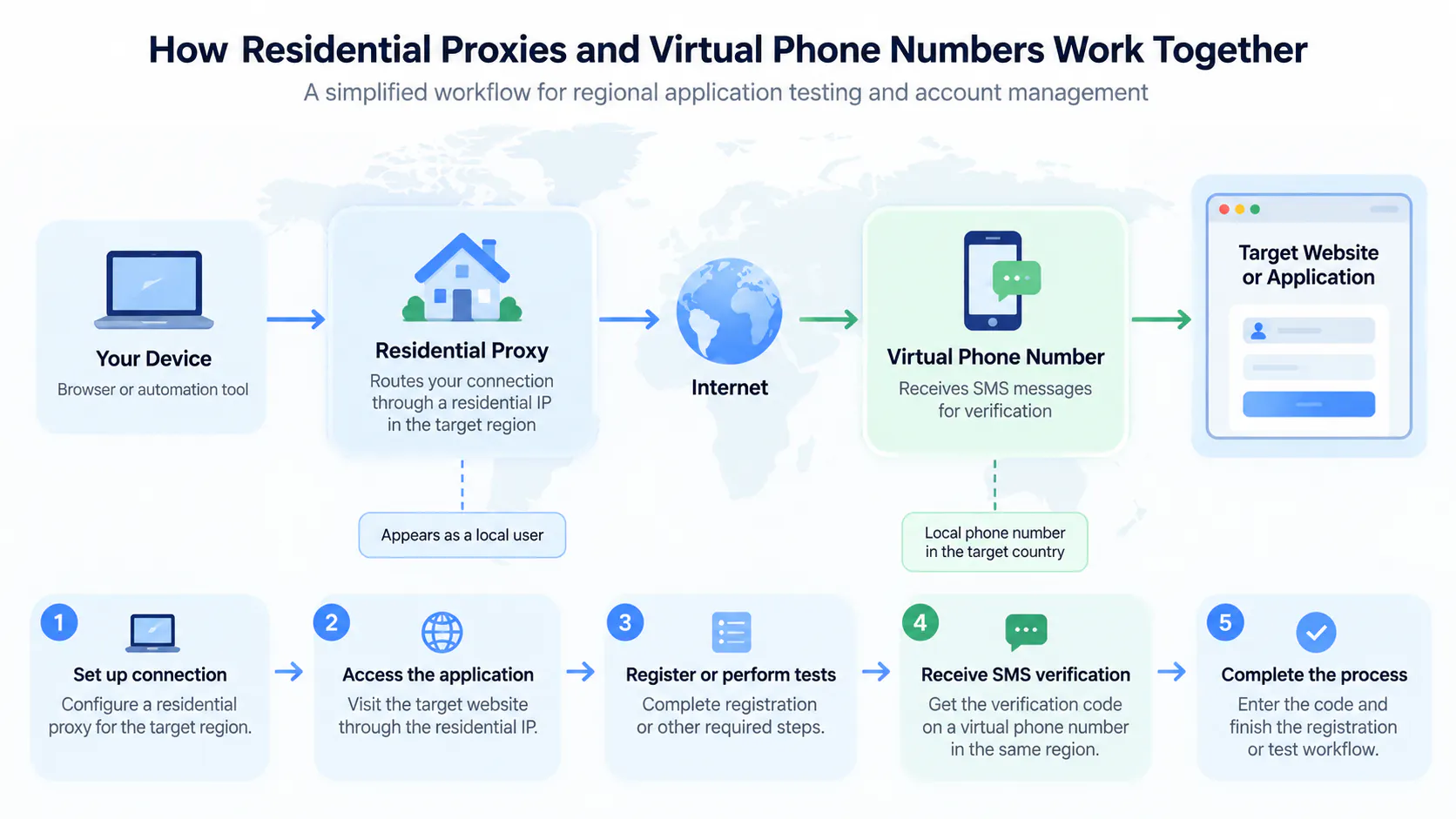
The basic flow is simple: an authorized user enters the number when a service requests a verification contact, then checks the associated service for an incoming code and submits it to the requesting platform. Delivery and acceptance are separate. A code may arrive, but the platform can still reject the number or apply its own verification rules. Review those rules before building a workflow around a virtual number.
When does SMS activation fit better than number rental?
SMS activation suits a discrete inbound verification task. A rental may fit a workflow that needs continued access to the same number. If a task ends after one code, activation may be appropriate. If the business process may need to receive later messages at that number, consider a longer-term rental instead.
Before choosing, confirm the available duration, reuse rules, supported destination, and current availability. Don’t assume an activation can be reused or that a rental will remain suitable for a particular third-party account. Anosim provides inbound SMS activation and longer-term number rentals, but acceptance remains subject to each destination service’s rules.
Where can API integration fit into the workflow?
If verification is part of a repeatable internal process, an API may connect supported service functions to company software and reduce manual handoffs. It also adds technical and security considerations, and isn’t necessary for every workflow. Review the Anosim API documentation to assess whether its capabilities and integration requirements fit the intended use.
Ask a technical reviewer to check authentication, error handling, logging, and access permissions before connecting an API. Logs should support troubleshooting without exposing verification codes more widely than the workflow requires. For broader guidance on identity and authentication design, consult the NIST Digital Identity Guidelines. Determine which recommendations apply to your system, and don’t treat an SMS code as proof of identity on its own.
How should you compare bulk verification options before recommending one?
Compare options against documented demand and workflow requirements, not a projected need for numbers at scale. Suitability depends on the workflow, applicable terms, and whether the third-party service accepts the number. Treat acceptance as something to verify, not a capability to assume.
Use the comparison below as a starting point. Then confirm current availability, supported destinations, and service-specific limitations with the provider.
- Workflow duration: SMS activation covers a discrete verification task, a longer-term rental fits when ongoing access may be needed, and the existing manual process depends on staff and the current process.
- Number continuity: for SMS activation, check whether reuse is supported; for a longer-term rental, assess continuity requirements and rental terms; the existing manual process may rely on employee numbers or ad hoc arrangements.
- Destination and policy fit: for SMS activation, verify supported destinations and platform terms; for a longer-term rental, verify the same, plus rental limitations; for the existing manual process, confirm the current method complies with service terms.
- API fit: for SMS activation and longer-term rental alike, consider an API only if the workflow needs programmatic access; the existing manual process may require manual coordination.
- Administration: for SMS activation, assess code handling and task tracking; for a longer-term rental, assess ongoing access, ownership, and message handling; for the existing manual process, measure staff time, handoffs, and exception handling.
Which criteria matter for a high-volume workflow?
Estimate expected verification events using internal records, such as recent completed tasks or logged requests. Don’t base a bulk requirement on speculative growth. Then check whether each target service permits virtual-number verification and whether the relevant destination is supported.
Map who will manage access, account ownership, incoming codes, logs, and exceptions. Include data handling, provider support arrangements, and documented limitations in the review. If staff can’t tell which number supports which authorized account, clarify the workflow and controls before scaling it.
Should the team choose activation or a rented number?
Choose activation for a discrete task only after confirming the service terms and requirements. Consider rental if documented workflows need continued access to a number, subject to availability and applicable rules. For broader context, browse the Anosim blog, then confirm current rental terms and destination rules before applying them. Don’t rely on a number model until the target service’s acceptance and reuse rules are clear.
How can you propose a low-risk pilot and measure its results?
A controlled pilot turns a proposal for bulk virtual numbers for verification into a bounded test with clear approval, safeguards, and evidence for a decision. Before it begins, define the authorized services, participating users, workflow, and test period. Set a maximum volume based on documented demand, and agree on conditions that would pause the test.
What should a controlled pilot include?
Keep the scope narrow. Choose an existing, authorized workflow rather than testing account creation or verification methods that breach third-party rules. Assign a pilot owner, identify who approves the test, and involve the people responsible for security and data handling. Define success criteria in advance, including what would justify stopping or continuing.
Use this sequence:
- Define scope: Record the users, workflow, authorized services, expected volume, and pilot duration.
- Review terms: Confirm that each target service permits the proposed use, and check provider limitations and supported destinations.
- Configure access: Limit access to approved users. Document account ownership, handling of verification messages, retention needs, and escalation steps.
- Test: Run the approved workflow and record results consistently. Stop if the process conflicts with service terms or creates an unapproved data-handling issue.
- Evaluate: Compare results with the existing process, document exceptions, and have the designated approver decide whether to stop, adjust, or continue.
How do you assess results without overstating them?
Use the same definitions and measurement method for the pilot and the current process. Track completion time, manual handling, failed or undelivered messages, support effort, and policy exceptions. Record the number of attempts and relevant workflow context so a small test isn’t mistaken for proof of broad compatibility or future performance.
Report limitations plainly. Include unavailable destinations, failed receipts, unresolved policy questions, and cases where staff needed extra help. Separate observed results from estimates, and don’t treat a received code as evidence that every target service will accept the number.
Once the approved requirements are clear, review SMS activation options against the pilot scope, including destination support and applicable limitations. Keep the decision with the assigned approver. Continue only if the results meet the agreed criteria and the workflow remains within the approved boundaries.
How can you present a decision-ready recommendation to your boss?
A strong recommendation for bulk virtual numbers for verification makes the business need, trade-offs, and controls easy to assess. Keep it concise and evidence-based. The goal isn’t broad approval for every possible use, but a decision on a documented workflow.
What should your one-page proposal contain?
Organize the proposal around six items: the problem, supporting evidence, options, safeguards, pilot plan, and requested decision. Summarize where the current process uses staff time or creates rework, based on observed records and clearly labeled estimates. Compare the status quo, SMS activation, and longer-term rental against agreed criteria such as workflow duration, continuity, destination support, policy fit, and administrative effort.
Make the request specific: approval for a bounded pilot, a named owner, and a review date. State which users and services are in scope, what results will be measured, and who can pause the test. This gives your boss a concrete decision rather than an open-ended commitment.
How should you address compliance and implementation concerns?
List unresolved questions directly. Ask legal, security, and platform owners to confirm applicable policies before deployment. Identify destination availability, data access and retention, account ownership, and technical requirements that still need review. If the workflow requires API access, base the assessment on documented capabilities and integration requirements, not assumptions about automation or acceptance.
Be clear about service scope: Anosim provides inbound SMS for activation and number rental. It doesn’t provide outgoing SMS or outgoing calls; only numbers from the Rent Mobile VoIP service can also receive calls. Neither activation nor rental bypasses third-party verification safeguards, and no virtual number should be presented as universally accepted. Addressing these limits up front makes the recommendation more credible.
Close with a measured next step. Once the workflow, approved services, and continuity requirements are defined, review number rental options against those criteria. Recommend rental only if the documented process needs continued access and the provider’s current limitations and the destination service’s terms are suitable. For a one-time task, assess activation instead. Ask your boss to approve the pilot boundaries and review point, not an untested assumption about broader use.
Make the Next Step a Measured One
A persuasive proposal for bulk virtual numbers for verification starts with a documented operational problem, not a request to scale immediately. Show where the current process creates delays or relies on personal contact details, then compare activation, longer-term rental, and the existing workflow against clear criteria.
Keep the decision controlled. Confirm platform terms, destination availability, data handling, and technical requirements before setting pilot boundaries and measures. Activation may suit a discrete inbound SMS task, while rental may fit a workflow that needs continued access. Neither guarantees acceptance by a third-party service.
Anosim offers inbound SMS activation and longer-term virtual number rentals. If programmatic access is relevant, its API options include Anosim API v1 and SMS-Activate Standard API. Review the applicable documentation and limitations as part of your evaluation.
Review Anosim virtual number options against your approved workflow requirements. Define ownership, check applicable policies, and use a limited pilot to give your boss a practical basis for a decision.
Frequently Asked Questions
How do I convince my boss to approve bulk virtual numbers for verification?
Start with a documented workflow problem, not a product pitch. Show where the current process creates delays, rework, or reliance on personal numbers, then identify the authorized task that needs a separate verification number. Compare activation and rental with the existing process. Request approval for a limited pilot with a named owner, clear safeguards, and measurable success criteria. Confirm applicable platform policies before testing begins.
Are bulk virtual numbers suitable for business verification?
They can suit some legitimate business workflows, but suitability depends on the specific service, destination, and third-party rules. A provider may receive an SMS without the platform accepting its number. Before use, confirm that the business is authorized to run the workflow, review applicable terms and data-handling needs, and check number availability. Also determine whether the process needs one-time access or continued access to a number.
What is the difference between SMS activation and renting a virtual number?
SMS activation is generally intended for receiving an inbound verification message for a specific task. A rental is intended for access over a longer period. Choose based on whether the workflow ends after one verification or needs continuity. Before recommending either option, check its duration, availability, reuse rules, supported destination, and applicable terms. Don’t assume a number can be reused or accepted by a particular platform.
Can virtual numbers receive every verification code?
No. Delivery depends on factors such as destination support, number availability, network conditions, and the platform’s verification policies. Some services may restrict virtual or VoIP numbers. Validate receipt only within an authorized pilot, and distinguish successful SMS delivery from platform acceptance. Don’t assume any provider guarantees compatibility across services or use repeated attempts to work around a platform’s restrictions.
How can a company test bulk virtual numbers before adopting them?
Define a small, authorized workflow and confirm platform rules before testing. Set limits for users, services, scope, and duration, then assign an owner and configure access controls. Agree on measures such as handling time, message receipt outcomes, and support effort. Record unavailable destinations, failures, and policy exceptions. Review results with relevant technical, security, and legal stakeholders before deciding whether to stop, adjust, or expand the pilot.
Can bulk virtual numbers be integrated into an internal application?
An API may support programmatic integration if it exposes the functions your workflow needs. Review current documentation and verify supported operations before implementation. Technical reviewers should assess authentication, error handling, permissions, logging, and data retention, then test the integration within an authorized workflow. Anosim supports Anosim API v1 and SMS-Activate Standard API for integration, but API use doesn’t remove third-party restrictions or guarantee message delivery.