The best SMS verification service for your use case is the one that delivers codes promptly and fits your needs for country coverage, pricing clarity, security, support, and integration. To learn how to choose a reliable SMS activation provider, compare those criteria rather than relying on a headline claim about speed or coverage. Verification codes typically expire within minutes, so delivery time matters.
A straightforward process should let you select a suitable number, receive a code, and complete an authorised verification. A low price or long feature list alone won’t show whether the service fits your task, privacy needs, or technical setup.
This guide explains how to assess delivery and number availability, understand pricing, evaluate security and compliance, and compare dashboards, APIs, and support. You’ll also see how temporary verification differs from long-term account recovery, so you can choose a service that matches the job.
Key Takeaways
- Compare delivery performance, country and service availability, and code access tools rather than relying on broad reliability claims.
- Assess the full pricing structure and support options so you can understand what affects the cost and how order issues are handled.
- Review security practices and relevant standards, including ISO 27001 from the International Organization for Standardization.
- Match dashboard and API capabilities to your workflow, especially if you need to integrate verification into an application.
- Choose a number type and usage period that fit the account’s purpose, and don’t rely on a temporary number for long-term recovery.
Table of Contents
- 1. Message reliability, deliverability, and delivery receipts
- 2. Pricing, support, security, and compliance comparisons
- 3. SMS platform capabilities and provider selection
- 4. Provider pricing and commercial offers
- 5. Criteria for choosing an SMS verification provider
- Anosim: SMS Activation
1. Message reliability, deliverability, and delivery receipts
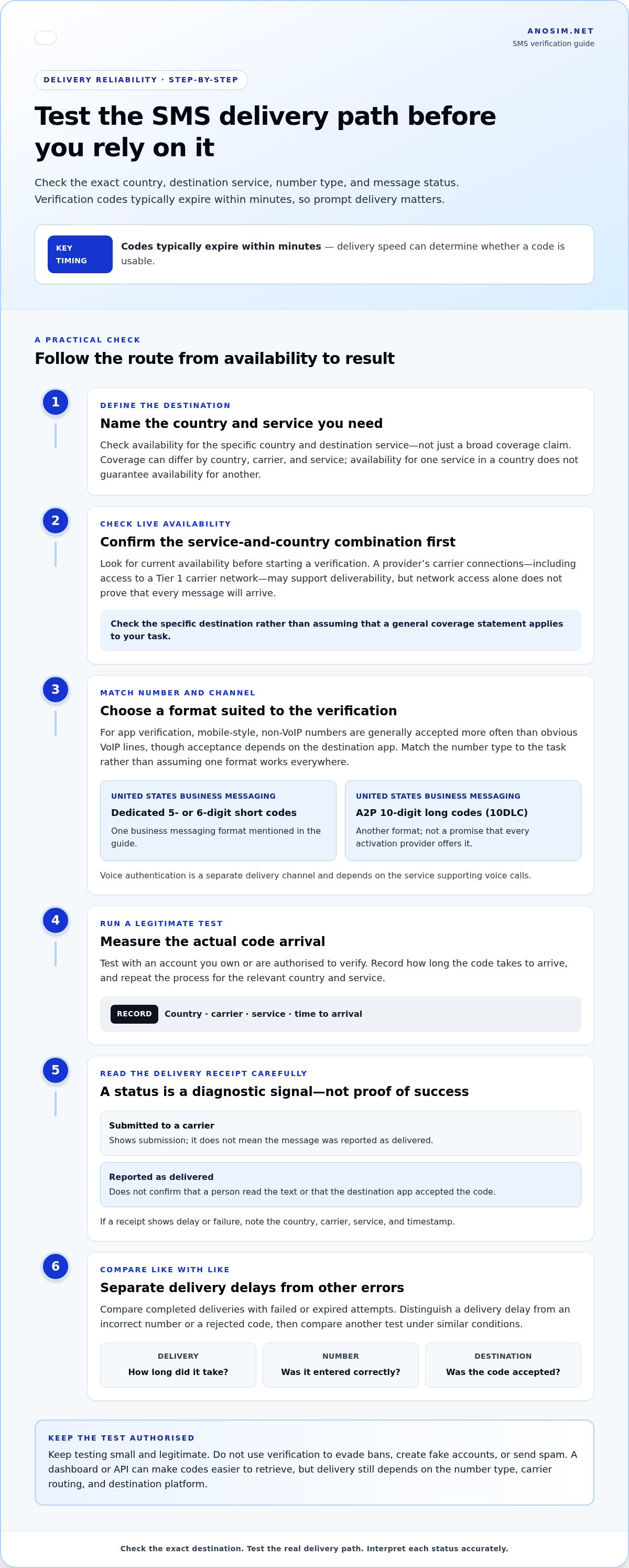
Compare providers by the countries and services they support, their carrier connections, and how they report message status. A provider using a Tier 1 carrier network may support deliverability, but network access alone doesn’t prove that every verification message will arrive. Codes typically expire within minutes, so prompt delivery matters. Check the specific country and destination service you need, not just a broad coverage claim.
Coverage can differ by country, carrier, and verification service. One provider may offer numbers for a particular service in the United States but not for another service in the same country. Look for live service-and-country availability before starting a verification. For an authorised one-time code, the SMS activation workflow centers on receiving a text; voice authentication is a separate delivery channel that depends on the service supporting voice calls.
In the United States, business messaging options include dedicated 5- or 6-digit short codes and A2P 10-digit long codes, or 10DLC. These are business messaging formats, not a promise that every SMS activation provider offers each type. For app verification, mobile-style, non-VoIP numbers are generally accepted more often than obvious VoIP lines, though acceptance still depends on the destination app. Match the number type to the task rather than assuming one format works everywhere.
Delivery receipts help distinguish a message submitted to a carrier from one reported as delivered. They don’t confirm that a person read the message or that a code was accepted by the destination app. Treat each status as one diagnostic signal. If a receipt shows a delay or failure, note the country, carrier, service, and timestamp, then compare another test under similar conditions.
Test delivery with an account you own or are authorised to verify. Record how long the code takes to arrive, then repeat the process for the relevant service and country. Compare completed deliveries with failed or expired attempts, and distinguish delivery delays from errors such as an incorrect number or rejected code. Keep testing small and legitimate. Don’t use verification to evade bans, create fake accounts, or send spam.
For international use, check coverage for each country and destination service, then confirm which channels the provider supports. A dashboard or API can make codes easier to retrieve, but delivery still depends on the number type, carrier routing, and destination platform. These checks are more useful than a broad claim about speed or reliability.
2. Pricing, support, security, and compliance comparisons
Compare the full cost, not just the displayed rate. For SMS activation, check whether the price varies by country or selected service, and whether you’re paying per code or renting a number for a set period. Look for pricing shown before purchase and clear terms explaining charges. Don’t assume a low starting price applies to every service or country. Compare the same verification task across providers.
Support matters when an order stalls or a code doesn’t arrive. Look for an accessible support channel and a clear way to report the service, country, order status, and time of the issue. A helpful response should clarify whether the problem relates to the number, a destination-app restriction, or delivery. Test the support process with a real, authorised task before relying on it for repeated account use.
Security review starts with data minimisation. Check what personal information the provider requests, how verification codes are displayed, and whether account access is protected. ISO 27001 is a security certification to look for in an SMS provider, according to the International Organization for Standardization. A certification is one evaluation point, not a substitute for understanding how the service handles numbers, codes, and account data.
SMS marketing requires separate attention to consent and compliance. Marketing platforms should support opt-in, opt-out management, list hygiene, and data protection. TCPA is relevant to SMS marketing compliance in the United States, while GDPR is relevant in Europe. Cross-border campaigns need processes suited to the markets receiving the messages.
Do websites and apps prohibit SMS activation or virtual phone numbers in their terms? Some services restrict temporary or virtual numbers, while others set rules for account creation and verification. Read the destination service’s terms and use a number only for an account you own or are authorised to access.
Are SMS activation services legal in the United States? Legality depends on how the service is used and the requirements that apply. Authorised verification is different from using numbers to evade bans, create fake or bulk accounts, spam, or impersonate someone. For marketing, assess consent and TCPA compliance separately from account verification.
Fraud controls matter because SIM swapping can compromise accounts protected by SMS verification. Don’t treat text codes as the only protection for sensitive accounts; consider whether the service offers alternatives such as email, push, or TOTP. Providers handling business messaging should also explain how they support 10DLC registration and campaign vetting. For authorised one-time verification, compare SMS activation options against the task, destination, and data you need to protect.
3. SMS platform capabilities and provider selection
First, distinguish verification services from SMS marketing platforms. Verification requires a way to select a service and country, use a number, and retrieve its code. Marketing platforms focus on campaigns, audience management, and engagement. Bulk messaging, personalisation, scheduling, and analytics don’t automatically improve verification. Choose features for the task you need to complete.
For a global workflow, examine how the platform connects to your existing systems. SMS providers should offer an API, with webhooks or a polling endpoint, so an application can request a number and process status updates without manual dashboard work. Check the API documentation for authentication, error responses, and examples matching your development stack. A webhook or polling endpoint for inbound messages is especially relevant when your application needs to receive and route incoming content.
RCS supports richer business messaging, while SMS can serve as a fallback when a recipient or device can’t receive an RCS message. Check whether your platform handles that fallback or whether your application must implement it. RCS matters more for customer communications and campaigns than for a basic verification code. Choose a channel based on recipient support and the message’s purpose.
Two-way SMS is useful when a recipient needs to reply, such as confirming an appointment or responding to a campaign. MMS carries media, unlike a plain-text verification message. Keep inbound replies and media delivery separate from one-time code retrieval in your requirements. For example, a support team may need inbound replies, while an account verification flow only needs to display a received code.
Evaluate the dashboard as carefully as the API. A web dashboard can suit occasional manual reservations, while an API is better aligned with repeated application-driven tasks. Some verification services provide dashboards and mobile apps for reserving numbers and reading codes. Test the complete sequence: select the destination service, reserve a number, receive a message, and identify the code. Note each point where a user or developer must intervene.
Before choosing, map each required feature to an actual workflow. List your target countries, destination services, message direction, and integration needs. Test a representative task in the interface or API, including an unsuccessful response. A useful platform makes the next action clear, shows relevant status information, and fits your existing setup without requiring unrelated campaign features. Focus on operational fit rather than an impressive but unnecessary feature list.
4. Provider pricing and commercial offers
Compare the charging model against your actual usage pattern. Pay-as-you-go pricing links charges to each action, while a subscription may suit predictable, recurring volume. For an activation or temporary-number service, prices are usually shown before purchase, and volume customers may ask for an individual offer; cost factors include destination country, service, number type, and rental duration. Compare equivalent tasks, not different packages with different coverage.
For usage-based services, identify what triggers a charge. SMS Activation bills each received OTP individually, while Rent Service charges for a number over a chosen duration. Use a sample workflow, such as requesting a number for a supported service, and note the applicable price before proceeding. This shows whether the charge matches the task you need to complete.
Volume pricing needs a realistic forecast. Estimate routine demand from expected account verifications, then account for busy periods without assuming every request will succeed on the first attempt. A larger commitment only makes sense if the included services, countries, and number types match your use. Compare the effective terms at your expected volume, including unused-credit rules and any expiration conditions.
Credit transparency matters as much as the headline model. Before purchasing, look for prices displayed by country and service, plus a clear explanation of how credits are deducted. Credits should remain usable across supported services rather than being tied to a single order. For example, if a selected service has no available number, the platform should make the next billing action understandable before you proceed.
Also separate native platform charges from integration costs. An API may reduce manual steps, but your development work, error handling, and monitoring still affect total operating effort. Compare a dashboard-based workflow with an API-driven one: the first may fit occasional requests, while the second can support repeated actions within an existing application. Include support for failed orders in the comparison, since resolving a stalled request also uses staff time.
Use a simple comparison sheet with columns for billing model, charge-triggering action, country and service pricing visibility, credit reuse, volume terms, and integration effort. Fill it using the same verification scenario for each provider. Mark any term that changes the total cost, such as rental duration or country selection, and calculate from your own forecast rather than a provider’s broad example. This makes commercial offers comparable without mistaking a low entry point for the lowest cost at your actual volume.
5. Criteria for choosing an SMS verification provider
An SMS activation provider is a practical fit when it offers numbers for the service and country you need, makes codes easy to retrieve, and protects your privacy. A reliable SMS activation provider should make availability, status, and next steps clear in its dashboard or API. Assess the complete verification workflow, not one performance claim.
Assess uptime claims separately from individual message results. Check what the provider means by uptime and how it reports service interruptions. Then review the status information available for requests, so you can distinguish access to the platform from successful verification.
Check number availability for your exact destination service and country before building a workflow around it. Some apps may be more likely to accept mobile numbers than VoIP numbers, but acceptance depends on the destination app’s rules and number recognition. Treat live availability as a useful selection criterion, not proof that every number will work for every account task.
For sensitive accounts, consider how the service handles codes and personal information. Prefer a workflow that requests minimal personal data and displays the code for the task at hand. Keep temporary verification separate from long-term account recovery: don’t rely on a temporary number as a permanent recovery method for an account you need to keep. Use verification only for accounts you own or are authorised to access.
Check whether SMS suits the account’s risk level. SMS adds a step beyond a password alone, but receiving texts on multiple devices can increase exposure. For important accounts, consider alternatives such as email, push notifications, or TOTP if the destination supports them. Choose a channel that suits the account’s sensitivity rather than treating SMS as the default for every login.
Run a small, authorised test before adopting a provider for repeated use. Record the selected service, country, availability, code retrieval, and any failure status. Compare the observed workflow with the provider’s stated support and API capabilities. Review SMS verification options as a next step if you need a dedicated workflow for receiving activation codes.
Anosim: SMS Activation
Anosim offers SMS Activation for receiving verification codes, Rent Service for a number rental over a chosen period, and Rent Number for use across services without per-SMS charges. To receive calls, choose Rent Mobile VoIP. Match the option to the destination platform and intended use, and keep temporary verification separate from long-term account recovery.
For developers, Anosim API (v1) and the SMS-Activate Standard API can integrate SMS Activation and number rentals into applications. This can suit workflows that need to request numbers and handle verification through software instead of manual steps. For a straightforward one-time verification, start with the activation workflow; for a longer rental need, consider a number-rental option.
Visit Anosim’s SMS Activation page to explore the service.
Put Your Verification Workflow Into Practice
Apply your criteria to the account or application you need to verify. Decide whether you need a one-time code or a number rental, then choose a workflow that fits the account’s purpose and your privacy requirements. This is how to choose a reliable SMS activation provider based on what you actually need, rather than an impressive but irrelevant feature list.
Anosim offers SMS Activation, Rent Service, and Rent Number for different verification needs. Choose the option that matches your task, and keep temporary verification separate from long-term account recovery. A focused test can help you assess whether the workflow fits before making it part of your routine.
Contact Anosim to discuss SMS activation and identify a suitable next step. A clear, use-case-first decision puts you in a stronger position to manage verification with confidence.
Frequently Asked Questions
What are the best SMS verification services in 2026?
The right service depends on whether you need a single code, a rented number, or software integration. For occasional personal verification, prioritise a simple way to select a number and retrieve a code. For repeated application requests, API documentation and clear error handling matter more. Match the service and country to your destination, then test the full task with an account you own or are authorised to access.
How Should You Evaluate SMS Platform Vendors?
Evaluate providers with a small, repeatable pilot, not a feature checklist alone. Run the same authorised verification workflow through the dashboard or API, record each status, and note where manual intervention is needed. Review API documentation for authentication, error responses, and inbound-message handling. Check that the provider explains service restrictions and that support can identify an order from its details.
Is SMS verification secure?
SMS verification adds a step beyond a password alone, but it’s less secure than time-based one-time passwords. SIM swapping can expose accounts protected by text codes, and forwarding codes increases exposure. For sensitive accounts, use an authenticator app or another stronger method if the destination supports it. Never share a verification code with someone claiming to provide technical support.
What happens if the verification code never arrives?
First, confirm that the number and destination service match the account flow, then review the order status in the dashboard. Check whether the destination app accepts the number type and whether you can request another code. If the request fails, follow the service’s stated resolution process rather than placing repeated orders blindly. Keep the failure status and order details for support.
How can I verify an SMS activation provider’s legitimacy and reputation?
Look for consistent business identity, clear service terms, an accessible privacy policy, and a working support channel. Read recent independent reviews for recurring patterns, such as unresolved order complaints, rather than relying on isolated praise. Check that the payment page and account dashboard belong to the same service. Treat claims of universal app acceptance or guaranteed verification as warning signs, since destination platforms control their own rules.
What privacy and data-retention policies should I check before using an SMS activation service?
Review what account details, order records, and message contents the service collects, and how long each category is retained. The policy should explain who can access codes, how deletion requests work, and whether information is shared with service partners. For example, a privacy-conscious workflow should request only the information needed to complete the verification and avoid storing sensitive codes longer than necessary.
What are the risks of using temporary numbers for account verification?
A temporary number may not suit account recovery because you may not retain access to it. If a service later assigns the number to someone else, that person could receive future messages intended for the account. Some apps may also reject temporary or virtual numbers. Use temporary access only for authorised tasks, and set a durable recovery method for any account you need to keep.
What payment, refund, and customer support policies should a reliable provider offer?
Before paying, read the written terms for credit use, expiration, failed orders, refunds, and billing disputes. The policy should explain what happens when a selected service has no number available or a verification cannot be completed. Identify the support channel and the order details needed to report a problem. A clear process helps you understand your options before a transaction, without assuming every failed attempt qualifies for a refund.