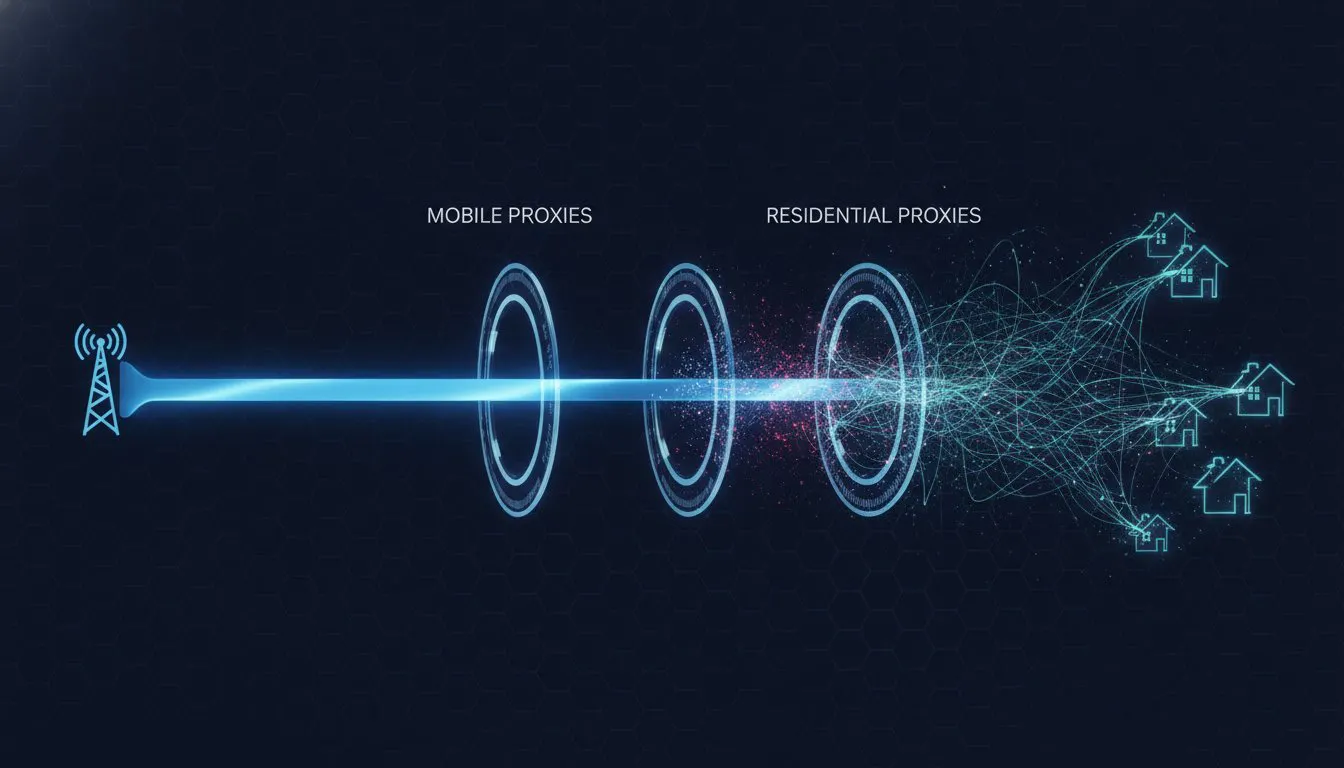
In 2026, the most effective way to bypass a strict anti-bot system isn't to hide your footprint, but to blend into the most trusted traffic on the web. You've likely experienced the frustration of frequent IP bans and low trust scores when using traditional tools for sensitive platforms. It's a common pain point for professionals who need stable, high-speed connections for automation and account management. 5g mobile proxies solve this by leveraging the inherent anonymity of carrier-grade NAT (CGNAT) architecture, making your traffic indistinguishable from that of millions of legitimate mobile users.
You'll learn how to master the technical mechanics of 5g mobile proxies to achieve maximum anonymity and bypass the world's strictest anti-bot systems. We'll explore the infrastructure behind these high-trust connections, including real-world 5G speeds that often exceed 300 Mbps and the role of low-latency standalone networks. This guide provides a comprehensive technical overview of how to achieve successful account creation and seamless API integration for your most demanding digital operations.
Key Takeaways
- Understand how CGNAT architecture provides a structural advantage for maintaining digital anonymity on sensitive platforms.
- Compare 4G and 5G benchmarks to select the appropriate speed and latency profiles for your specific automation needs.
- Master the technical implementation of 5g mobile proxies to achieve high trust scores and bypass advanced anti-bot detection.
- Streamline your infrastructure by pairing the mobile proxies of our partner proxied.com with the Anosim API (v1) for numbers and SMS.
- Learn to select carriers and ASNs that offer the highest reputation for social media management and ad verification.
Table of Contents
- What Are 5G Mobile Proxies and Why Do They Outperform Traditional IPs?
- 4G vs. 5G Mobile Proxies: Speed, Latency, and the Evolution of Mobile Networking
- Evaluating Proxy Quality: Trust Scores, Carrier Reputation, and Anti-Detection
- Strategic Use Cases: From Social Media Automation to Secure Account Verification
- High-Trust Proxy Infrastructure for Secure Digital Operations
What Are 5G Mobile Proxies and Why Do They Outperform Traditional IPs?
A 5G mobile proxy acts as a high-performance gateway between your local environment and the destination server. If you need a foundational technical definition, What is a Proxy Server? describes the core intermediary function that these tools perform. Specifically, 5g mobile proxies route your data through a physical mobile device or industrial modem connected to a cellular 5G network. This process ensures the IP address assigned to your session originates from a legitimate mobile carrier rather than a server farm.
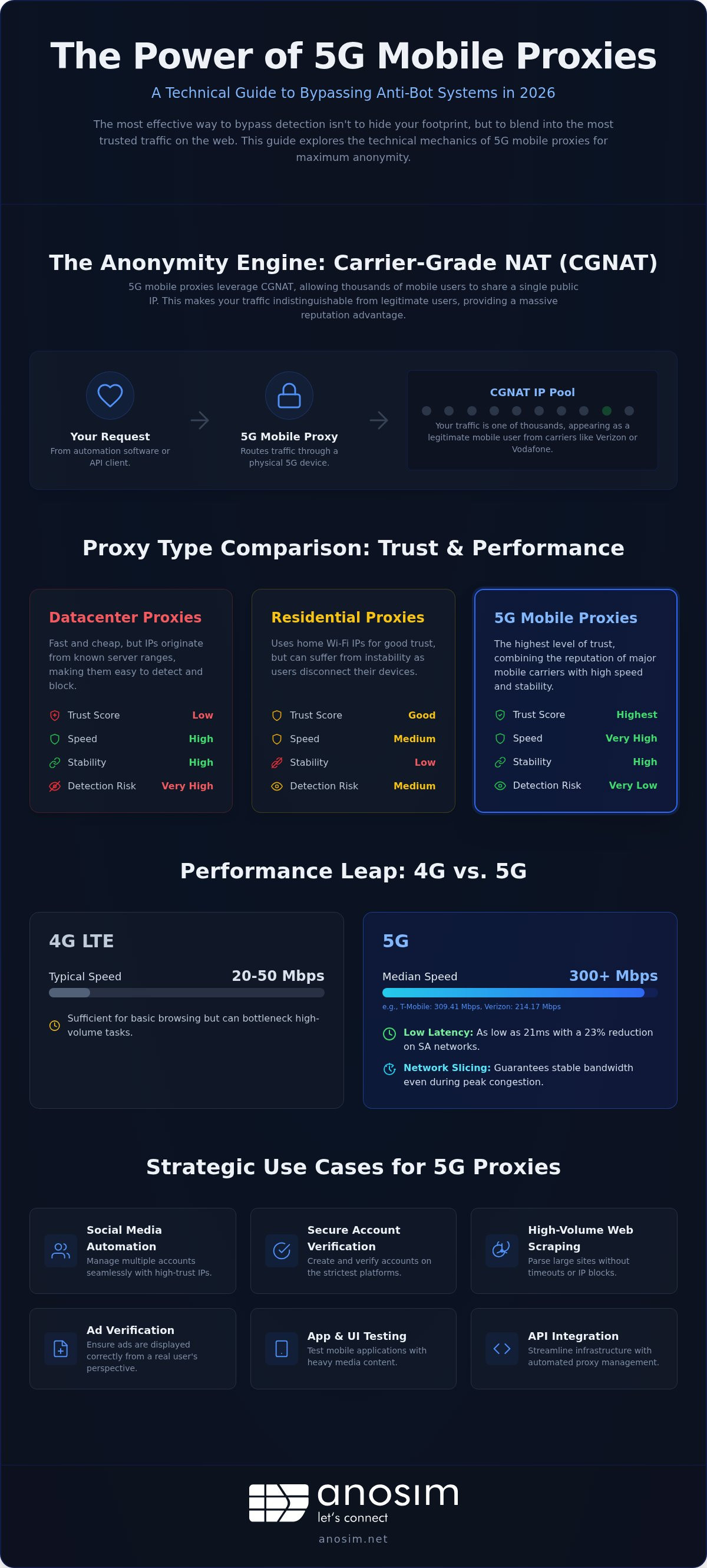
The primary technical advantage of this setup lies in Carrier-Grade Network Address Translation (CGNAT). CGNAT is the technology that allows thousands of mobile users to share a single public IP, making it impossible for websites to ban individual users without blocking legitimate customers. When you utilize a mobile proxy, you're effectively hiding in plain sight. Anti-bot systems see your traffic as part of a massive pool of real users on networks like Verizon or Vodafone. Blocking a single "bad actor" on these IPs risks collateral damage to thousands of paying carrier customers. Most platforms won't take that risk, giving mobile IPs a massive reputation advantage.
The Architecture of a 5G Proxy Connection
Traffic flows from your client software to a proxy gateway server. This gateway directs the request to a physical 5G modem or mobile device located in the target geographic area. The device then transmits the request to a local 5G tower. Because 5G architecture uses a more efficient packet-handling system and higher frequency bands, it offers significantly lower latency than 4G or LTE predecessors. Real-world tests on networks like T-Mobile show median download speeds exceeding 300 Mbps in 2026. This provides the throughput needed for high-volume automation without the bottleneck of older cellular standards. For organizations looking to deploy their own high-performance connectivity, you can learn more about Virtuser and their specialist consulting for private 5G, LTE, and MVNO infrastructure.
Selecting the right tool depends on your specific trust requirements. Datacenter proxies are fast and inexpensive but come from known server ranges. They're easy for platforms to flag and block instantly. Residential proxies use home Wi-Fi IPs; they offer good trust but often suffer from instability as home users disconnect or turn off their routers. Mobile proxies, particularly 5g mobile proxies, provide the highest level of trust available. They combine the reputation of major mobile carriers with the protective layer of IP rotation. This ensures your operations remain undetected by the most sophisticated security filters, even when performing high-frequency tasks.
4G vs. 5G Mobile Proxies: Speed, Latency, and the Evolution of Mobile Networking
While 4G LTE has been the workhorse of the industry for years, 2026 marks a definitive shift toward 5G as the standard for high-trust automation. The performance gap is significant. 4G LTE typically delivers real-world speeds between 20 and 50 Mbps, which is sufficient for basic browsing but struggles under the weight of modern data demands. In contrast, 5g mobile proxies leverage infrastructure that frequently exceeds 300 Mbps in major markets. T-Mobile, for instance, leads the US market with a median speed of 309.41 Mbps, followed by Verizon at 214.17 Mbps. This throughput is essential for maintaining efficiency in high-volume environments.
Latency is where the technical evolution becomes most apparent for automation. 5G Standalone (SA) networks have shown a 23% reduction in median latency compared to non-standalone networks, with some real-world tests recording figures as low as 21ms. Lower latency and reduced jitter are critical for tasks that require real-time interaction, such as live app testing or navigating sensitive anti-bot challenges that measure response timing. Additionally, 5G introduces network slicing. This allows carriers to allocate specific bandwidth for high-performance sessions, ensuring your proxy connection remains stable even during peak network congestion.
When Speed Actually Matters for Proxies
High-speed connections are no longer a luxury for enterprise-level tasks. If you're conducting high-volume web scraping or parsing large media files, 4G bandwidth often becomes a bottleneck that leads to timeouts. App testing with heavy media content, such as high-definition video ads or infinite-scroll social media feeds, requires the throughput that only 5G can provide. Multi-threaded automation also benefits; running several concurrent sessions on a single 4G connection often results in degraded performance across all threads. For these scenarios, upgrading to 5G is a functional requirement rather than a preference.
The 'Newness' Factor: Why 5G IPs are Less Flagged
Security algorithms on major platforms often assign higher trust scores to newer network ranges. Because 5G infrastructure is still expanding, 5G IPs often carry a 'cleaner' history because the 5G infrastructure is still expanding compared to the overused 4G ranges. These newer subnets haven't been subjected to years of automated abuse, making them less likely to appear on legacy blacklists. For users who need maximum discretion, utilizing 5g mobile proxies provides a psychological 'freshness' that platform algorithms associate with high-value, premium mobile users. If you need to scale your operations without triggering security flags, choosing a provider with robust mobile proxy infrastructure is essential for long-term stability.
While 5G is mandatory for high-performance needs, 4G remains a pragmatic choice for low-bandwidth tasks or in regions where 5G rollout is still in progress. However, for 2026 and beyond, the architectural benefits of 5G make it the superior choice for any operation where trust and speed are non-negotiable.
Evaluating Proxy Quality: Trust Scores, Carrier Reputation, and Anti-Detection
High-performance automation requires more than just a working connection; it demands an IP with a pristine reputation. Anti-bot systems use services like IPQualityScore and MaxMind to assign a risk level to every incoming request. These platforms analyze the Autonomous System Number (ASN) and the history of the IP range. Because 5g mobile proxies originate from legitimate cellular pools, they typically maintain much lower fraud scores than datacenter or even residential alternatives. This inherent trust is your primary defense against aggressive security filters.
Carrier reputation plays a decisive role in how platforms perceive your traffic. Tier-1 carriers such as AT&T, T-Mobile, and Vodafone carry significantly more weight than smaller Mobile Virtual Network Operators (MVNOs). Major platforms recognize that these giants serve millions of legitimate customers, making them hesitant to block their IP ranges. If you're using an IP from a lesser-known provider, you're more likely to face CAPTCHAs or shadowbans. Choosing a proxy backed by a major carrier ensures your traffic blends into the highest-volume, highest-trust segments of the internet.
You must also guard against technical leaks that expose your real identity. DNS and WebRTC leaks occur when your browser or application bypasses the proxy gateway to resolve addresses or establish peer-to-peer connections. Even the most expensive 5G connection is useless if your local IP is visible through a misconfigured browser. Rotation runs through the API of our partner proxied.com, while the Anosim API (v1) handles the number and SMS side of the same workflow.
IP Rotation Mechanics: Time-based vs. Link-based
Effective rotation prevents target websites from identifying the repetitive patterns typical of automated bots. Time-based rotation changes your IP at fixed intervals, such as every 5, 10, or 30 minutes, which is ideal for long-running scraping tasks. On-demand, or link-based, rotation allows you to trigger a new IP via an API endpoint exactly when a specific workflow step is completed. This level of control is essential for account creation or multi-step verification processes where you need a fresh identity for each new attempt.
Detecting and Preventing Fingerprint Leaks
A high-quality proxy is only one half of the anonymity equation. You must synchronize your proxy's location with your browser's digital fingerprint. If your 5g mobile proxies are based in Paris but your system clock is set to New York, anti-bot systems will instantly flag the discrepancy. Combining mobile proxies with anti-detect browsers like AdsPower or Dolphin{anty} allows you to align your timezone, WebRTC settings, and language headers. This total synchronization creates a cohesive user profile that is virtually impossible for platforms to distinguish from a real mobile device.
Strategic Use Cases: From Social Media Automation to Secure Account Verification
High-trust networking is the foundation for scaling digital operations in 2026. For social media marketing (SMM), 5g mobile proxies are essential for managing 50 or more accounts on platforms like Instagram or TikTok without triggering shadowbans. Traditional IPs are often flagged during bulk actions, but the carrier-grade reputation of 5G traffic allows for seamless automation. This trust level is equally vital for ad verification. It enables you to see exactly what users see in different geographic regions, ensuring your ads are displayed correctly without being detected as a monitoring bot.
Successful account management requires a complete infrastructure stack. Simply having a high-trust IP isn't enough for platforms with multi-factor requirements. You must pair your proxy setup with reliable SMS activation to pass mobile verification checks. This combination is particularly effective in competitive e-commerce environments, such as sneaker botting, where datacenter IPs are blacklisted instantly during high-demand drops. By mimicking a real mobile user from both a network and a telephony perspective, you significantly reduce the risk of account termination.
Case Study: Bypassing Strict Platform Verifications
Managing accounts on Tinder or Telegram requires a sophisticated approach to avoid 'suspicious activity' flags. These platforms prioritize mobile traffic; using anything else often leads to immediate verification loops or bans. Utilizing temporary phone numbers for verification alongside 5G proxies creates a cohesive mobile identity. To maintain long-term account longevity, use 'sticky' mobile sessions. This keeps your session tied to a specific IP or subnet during the login phase, reducing the security triggers that occur when an IP changes mid-process. It's a pragmatic solution for users who need to maintain stable, long-term access to sensitive accounts.
Web Scraping at Scale
Web scraping on protected targets like Cloudflare-shielded sites or highly localized SERPs requires the highest possible trust signals. 5g mobile proxies allow you to bypass CAPTCHAs and complex bot-detection scripts that would stop residential or datacenter traffic. By using city-level targeting, you can parse localized data for SEO analysis with extreme accuracy. This approach significantly reduces the cost of scraping by decreasing the rate of failed requests and recaptcha solve fees. If you're ready to secure your automation workflow, you can access a high-trust mobile proxy stack and start scaling your operations today.
High-Trust Proxy Infrastructure for Secure Digital Operations
Anosim functions as a silent partner for the telephony side of high-volume digital tasks. The 5g mobile proxies of our partner proxied.com are sourced from real carrier networks, ensuring that your traffic carries the highest possible trust signals. By utilizing authentic mobile IPs, you eliminate the risks associated with server-farm ranges that are easily flagged by sophisticated anti-bot systems. This infrastructure is built for reliability, offering a stable foundation for automation, account management, and privacy-conscious browsing.
The ultimate privacy stack involves more than just a masked IP. For total anonymity, you can combine the high-performance proxies of our partner proxied.com with rented mobile VoIP services. This creates a unified digital identity that platforms perceive as a legitimate mobile user. Because Anosim operates with a privacy-first mindset, there are no KYC requirements or physical SIM deliveries involved. You manage your entire digital footprint through a virtualized environment, maintaining maximum discretion without the logistical hurdles of physical hardware.
Developer-First Proxy Management
Efficiency in automation depends on how easily a tool integrates into your existing codebase. The Anosim API (v1) is designed for seamless implementation within Python, Node.js, or Go environments. If your workflow already utilizes the SMS-Activate Standard API, our infrastructure is fully compatible, allowing for cross-platform synchronization without extensive refactoring. IP rotation is automated through the API of our partner proxied.com, ensuring each request or account session uses a fresh, high-trust address. This programmatic control reduces manual overhead and allows your scripts to adapt to changing network conditions in real-time.
Getting Started with the Right Plan
Selecting the right proxy plan at our partner proxied.com depends on your specific volume and duration requirements. If you're conducting large-scale web scraping, a pay-per-GB model might offer the most cost-effective path. For social media management or long-term account maintenance, unlimited data plans provide the stability needed for sticky sessions. You can also choose specific geographic locations to match the requirements of your target platform, ensuring that your IP's location aligns perfectly with your account's regional settings.
Once you've selected your plan and GEO, integration is nearly instantaneous. You can secure your high-trust 5G mobile proxies at our partner proxied.com today and begin deploying your automation scripts with the confidence that your infrastructure is backed by professional-grade security and reliability.
Securing Your Infrastructure for the Next Era of Automation
The transition to 5G architecture isn't just about raw throughput; it's a fundamental shift in how digital trust is established. By leveraging 5g mobile proxies, you gain access to high-trust carrier IP pools that are structurally difficult for anti-bot systems to block. We've explored how CGNAT and modern 5G Standalone networks provide the low latency and high reputation required for sensitive automation and account management. These technical advantages ensure your requests blend into legitimate mobile traffic patterns.
Maintaining a secure digital footprint requires a cohesive stack of tools. Rotation of your connections is automated through the API of our partner proxied.com, while the Anosim API (v1) covers numbers and SMS. When you pair those proxies with Anosim's integrated SMS verification support, you create a robust environment for bypassing the most aggressive security filters. This utility-first approach ensures your operations remain efficient and undetected. Scale your secure operations with 5G mobile proxies from proxied.com and take control of your networking requirements. You're now equipped to navigate the evolving landscape of digital anonymity with confidence.
Frequently Asked Questions
What is the difference between a 5G mobile proxy and a 4G proxy?
The primary difference lies in throughput and network latency. While 4G proxies offer speeds of 20 to 50 Mbps, 5g mobile proxies frequently exceed 300 Mbps on networks like T-Mobile. 5G Standalone architecture also reduces median latency by approximately 23% compared to older standards. These performance improvements are critical for media-heavy automation. Additionally, 5G IP ranges are newer and less likely to appear on legacy blacklists than overused 4G subnets.
Are 5G mobile proxies legal to use for web scraping?
Using mobile proxies for web scraping is legal in most jurisdictions, provided you aren't accessing protected, non-public data or violating specific regional laws. Legality is determined by your actions rather than the tool itself. Professional users should adhere to robots.txt files and avoid overwhelming target servers. Resellers often maintain detailed connection logs to comply with data protection regulations like GDPR and to ensure the infrastructure isn't used for illicit activities.
How do 5G proxies help with social media account management?
These proxies are highly effective for social media because they utilize Carrier-Grade NAT (CGNAT). This technology allows thousands of real users to share a single public IP address. Platforms like Instagram or TikTok are hesitant to block these IPs because doing so would affect thousands of legitimate customers. By using 5g mobile proxies from major carriers like Verizon or AT&T, you can manage multiple accounts with a significantly lower risk of shadowbans or suspicious activity flags.
Can 5G mobile proxies bypass Cloudflare and CAPTCHA?
Yes, 5G proxies significantly increase your success rate against Cloudflare and CAPTCHA challenges. These security systems prioritize traffic from legitimate mobile carrier ASNs. Because mobile traffic is inherently trusted, you'll encounter fewer security hurdles than you would with datacenter or residential IPs. While they don't disable CAPTCHAs, they provide the high-trust signals necessary to blend in with human users, reducing the frequency of triggers and automated blocks.
Do I need a physical SIM card to use mobile proxies?
No, you don't need a physical SIM card to utilize our infrastructure. Anosim provides a fully virtualized service for virtual numbers, and our partner proxied.com delivers the mobile proxies the same way, both through secure cloud platforms. We don't offer physical SIM card delivery. This approach allows you to manage your digital footprint and automation workflows from anywhere in the world without the logistical complexity of managing hardware or local carrier contracts.
What is the best way to rotate my mobile IP address?
The most efficient method for IP rotation depends on your specific workflow. Time-based rotation is useful for continuous scraping, changing the IP every 5 to 30 minutes. However, for account creation, link-based rotation is superior. This allows you to trigger a fresh IP via the API of our partner proxied.com exactly when you need it. Programmatic rotation ensures that each new session or verification attempt starts with a clean identity, preventing pattern detection.
How do I check the trust score of my mobile proxy IP?
You can verify the reputation of your proxy using third-party services like IPQualityScore or MaxMind. These tools analyze factors such as the IP's ASN, its history of abuse, and whether it belongs to a known mobile carrier pool. A high-quality mobile IP should show a low fraud score and a mobile connection type. Maintaining a high trust score is essential for bypassing strict security filters on sensitive platforms and ensuring account longevity.
Can I use 5G mobile proxies for SMS verification services?
Yes, pairing mobile proxies with SMS verification is a standard practice for secure account creation. Anosim offers the SMS activation services and our partner proxied.com the mobile proxies, which together provide a complete infrastructure stack. By using a 5G proxy from the same geographic region as your virtual number, you create a cohesive mobile identity. This synchronization is critical for passing the multi-factor authentication requirements used by platforms like Telegram, Tinder, or various e-commerce sites.