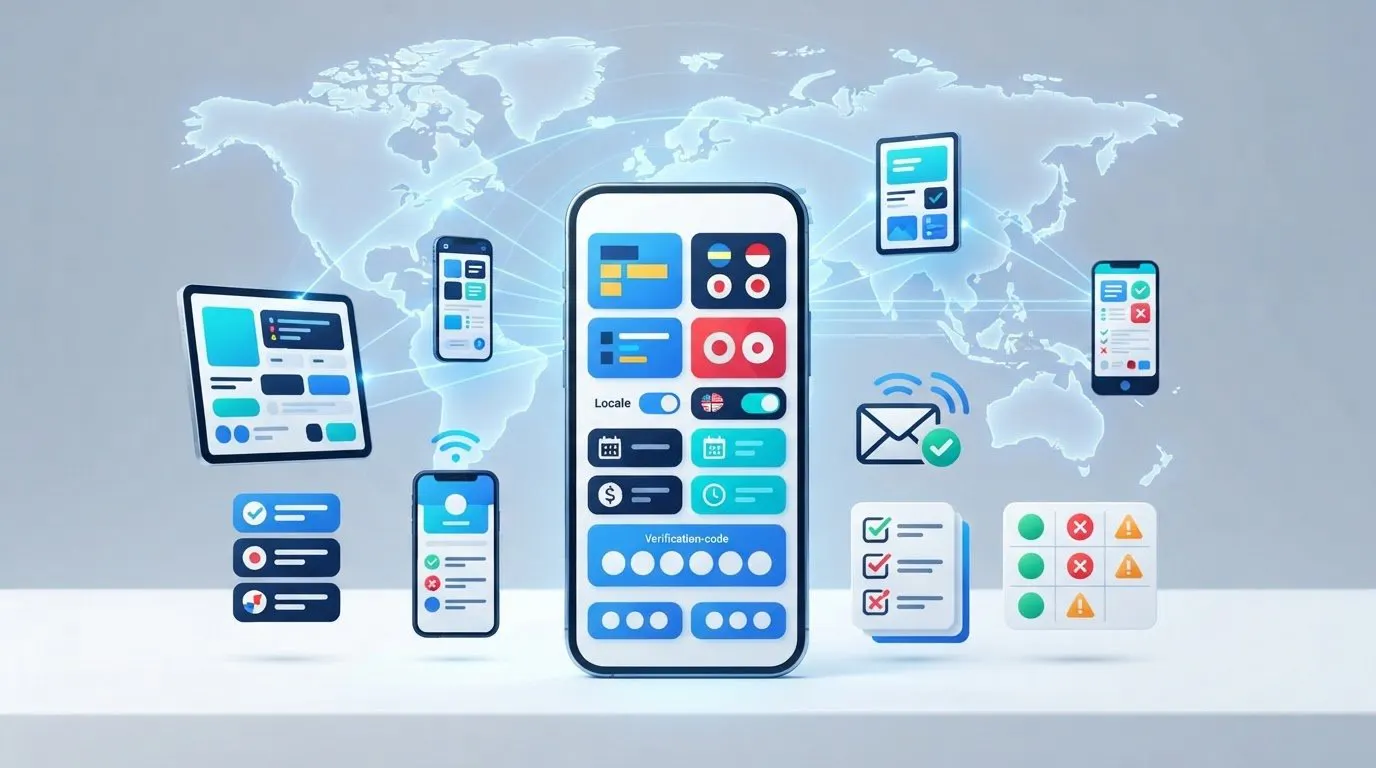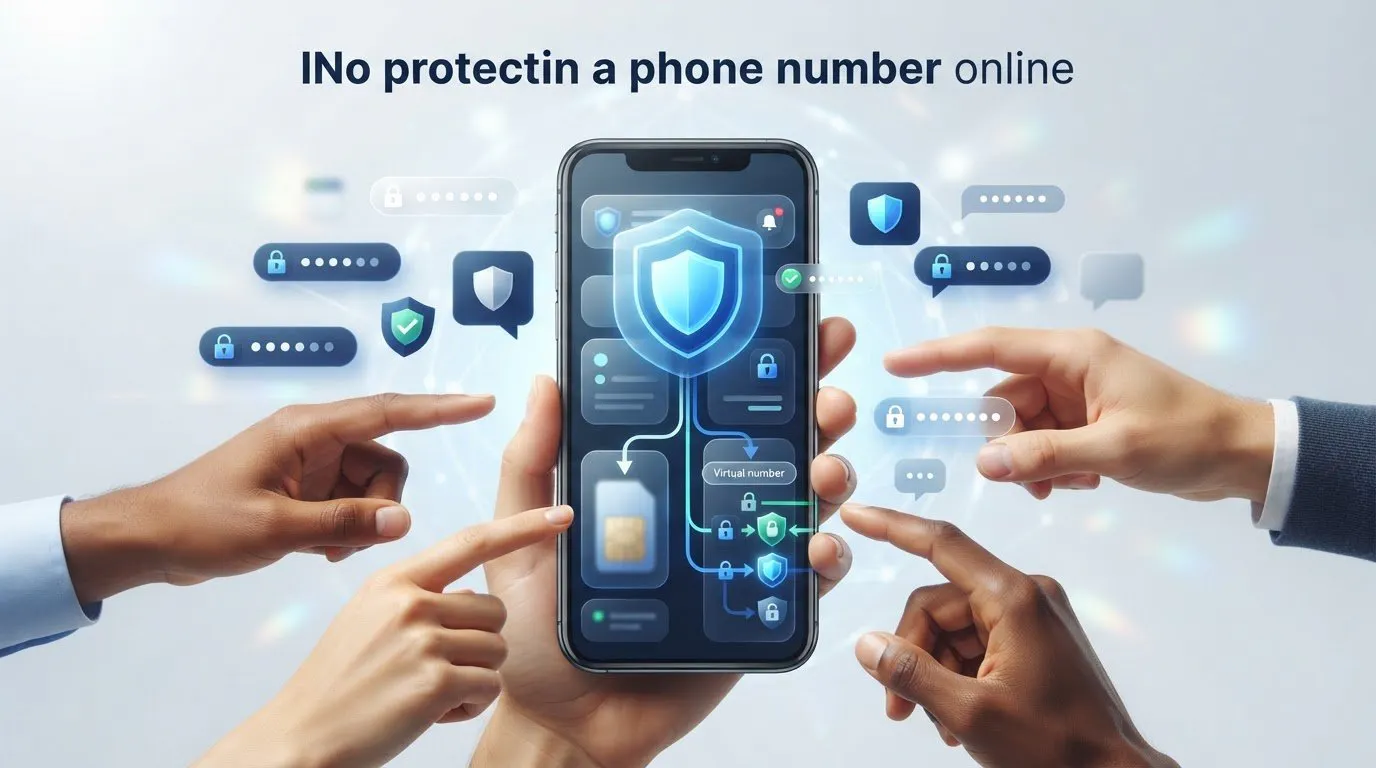
The 2024 AT&T and Comcast breaches exposed nearly 145 million accounts, proving that your primary mobile number is no longer a private identifier; it's a liability. Every time you submit your personal digits for a "quick verification," you're likely feeding a database that will eventually be sold, leaked, or exploited. If you're searching for an anonymous phone number online, you've likely already experienced the frustration of having generic numbers flagged as VoIP or tired of the logistical headache of juggling multiple physical SIM cards just to maintain basic digital boundaries.
It's clear that traditional privacy methods are failing. This guide provides a technical roadmap to securing high-trust virtual infrastructure that bypasses modern detection systems while keeping your primary contact data off the grid. You'll learn how to successfully navigate account verifications and achieve a total separation of your digital persona from your real-world identity. We will examine the transition from disposable apps to dedicated virtual services, the implications of the 2026 FCC "Know Your Customer" proposals, and the most cost-effective ways to manage multiple verifications without compromising your security.
Key Takeaways
- Understand how your primary number acts as a universal ID linking your financial and social data, making isolation the first step in digital security.
- Learn to differentiate between standard VoIP and high-trust Mobile VoIP options when securing an anonymous phone number online to avoid platform bans.
- Master the technical alignment of your digital environment by matching your proxy or VPN location to your virtual number's country for seamless verification.
- Discover how to maintain a zero-footprint identity by utilizing browser-based services and anonymous payment methods that bypass traditional banking logs.
- Explore professional-grade automation through specialized APIs to manage high-volume account activations without the logistical burden of physical SIM cards.
Table of Contents
- Why Your Primary Phone Number Is a Security Liability in 2026
- Virtual vs. Burner vs. Mobile VoIP: Understanding the Technology
- Selecting the Right Provider: A Comparison Framework
- Step-by-Step: How to Secure an Anonymous Number Securely
- Scaling Anonymity: API and Business-Grade Solutions
Why Your Primary Phone Number Is a Security Liability in 2026
An anonymous phone number online is a virtual line that operates independently of your legal identity or a physical SIM card. In 2026, your primary phone number functions as a "Universal ID," a single string of digits that cross-references your banking history, social media profiles, and retail habits across massive data broker networks. When you provide this number to a new service, you aren't just signing up; you're handing over a master key to your digital life. Virtual phone number technology allows you to sever this link by providing a functional communication layer that doesn't lead back to your home address or government ID.
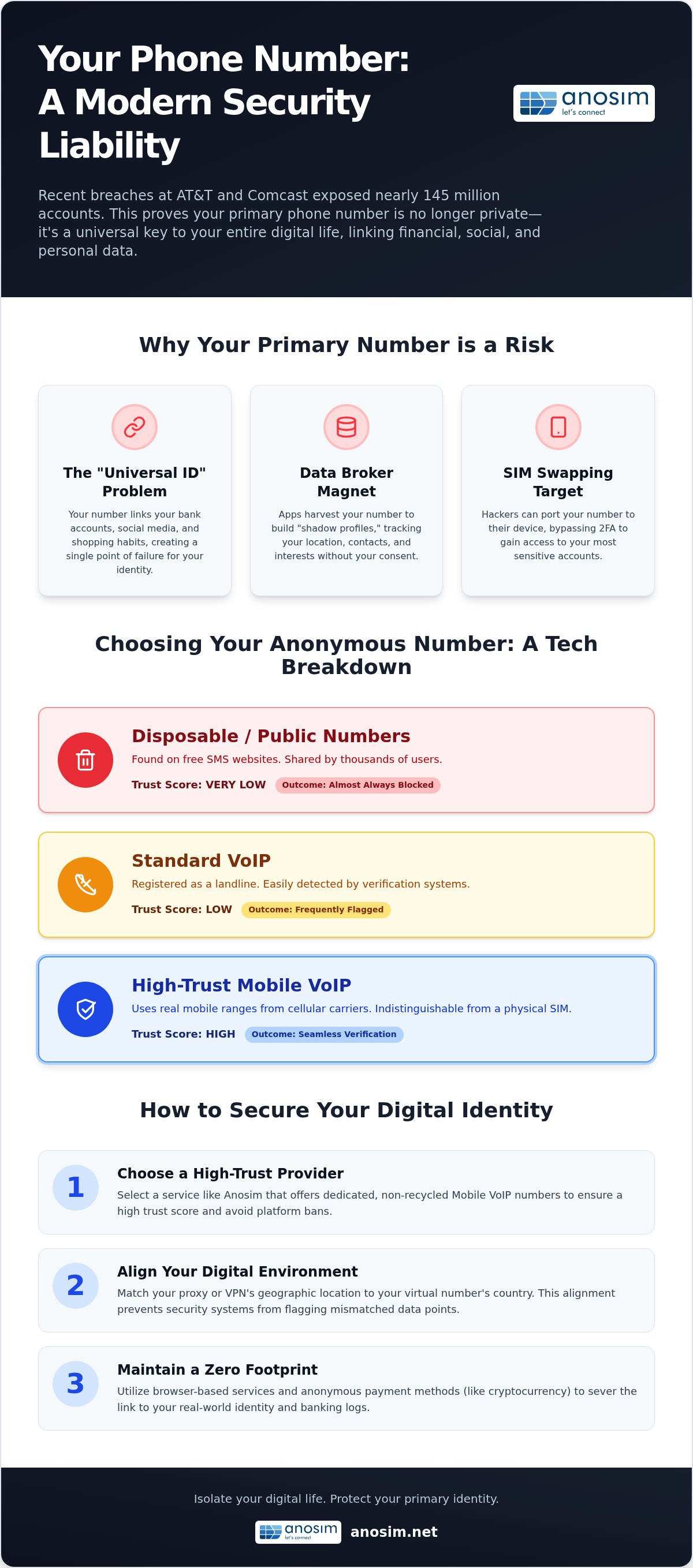
Protecting your primary number is a financial necessity. High-profile breaches, such as the 2024 incidents at AT&T and Comcast affecting over 140 million users, demonstrate that centralized databases are primary targets for hackers. A leaked number makes you a candidate for SIM swapping, where attackers convince carriers to port your number to their device, granting them access to your 2FA-secured bank accounts. It's vital to distinguish between "private" and "anonymous." A private number might hide your caller ID from the recipient, but an anonymous number ensures the service provider and third-party trackers cannot link the activity to your physical persona.
The Rise of Data Brokerage and Phone Number Tracking
Apps often request access to your contact list under the guise of "finding friends." This allows data brokers to build shadow profiles, mapping your social circle even if your friends never signed up for the app themselves. These profiles track your location, interests, and spending power by correlating your number with leaked databases. Using an anonymous phone number online prevents your primary device from being indexed in these relational databases. Phone numbers used for 2FA are often the weakest link in your security chain, as they can be intercepted through network vulnerabilities. Your digital footprint in telephony is the persistent trail of metadata, registration logs, and account associations generated by your phone number usage across the web.
Scenario: Why "Just One" Signup Can Compromise Your Privacy
Consider the "free" SMS verification sites found in search results. These services often serve as data harvesting traps. They collect the association between your IP address and the service you're verifying, then sell that intelligence to marketing firms. This leads to targeted spam and "warm" phishing attempts on your primary device. Utilizing a dedicated virtual infrastructure provides a "firewalled" identity, offering the psychological peace of mind that a single platform breach won't compromise your entire digital existence. By isolating each digital persona, you ensure that a compromise in one area doesn't grant an attacker a map to your entire life. This proactive approach turns privacy from a reactive struggle into a manageable, technical standard.
Virtual vs. Burner vs. Mobile VoIP: Understanding the Technology
Choosing an anonymous phone number online requires understanding the technical hierarchy of virtual infrastructure. Most users fail because they treat all virtual numbers as identical. Standard VoIP services are frequently flagged by major platforms like Google or WhatsApp because they are registered as landline or fixed-line ranges in global databases. When an app performs a lookup, it sees a non-mobile classification and triggers a block or an "unsupported number" error. This technical mismatch is the primary reason why cheap "burner" apps often fail during the signup process.
Disposable numbers found on public SMS receiver websites present an even higher risk. Since these numbers are shared across thousands of users, their reputation is permanently damaged. If a previous user triggered a fraud alert with that number, your new account will be linked to that history immediately. In contrast, Mobile VoIP infrastructure uses real mobile ranges assigned by cellular carriers. This setup provides the trust score of a physical SIM card without the hardware requirement. Anosim facilitates this by offering dedicated mobile-mapped lines, ensuring that your virtual presence is indistinguishable from a standard mobile user.
Why Platforms Block Certain Anonymous Numbers
Platforms use sophisticated verification systems to assign trust scores based on a number's origin. Documentation like the FCC guide to stopping unwanted calls highlights the regulatory pressure to combat spoofing, which has led tech companies to tighten their filters against virtual ranges. A landline-mapped virtual number is technically different from a mobile-mapped one; the latter appears to the network as a legitimate handset. High-tier providers ensure their infrastructure uses clean IPs that aren't associated with known botnets, which is a critical factor for successful account creation.
Long-Term Rental vs. One-Time SMS Activation
The choice between service types depends on your specific operational requirements. If you only require a single verification code for a low-stakes platform, a one-time SMS activation is the most efficient path. However, for services that require periodic re-verification or ongoing two-factor authentication, renting a number for 30 days or longer is the logical choice. This prevents the number from being recycled to another user, which could lead to your account being hijacked or locked.
- Activation: Ideal for one-off signups where you won't need to access the number again.
- Rent Service: Essential for banking, primary social media accounts, or business-critical tools.
Cost-benefit analysis shows that while one-time activations are cheaper, the risk of losing account access makes long-term rentals more economical for professional use. If you value sustained digital isolation, you should explore dedicated rent services to find the duration that matches your project's lifecycle. This infrastructure provides the reliability of a mobile line with the speed of a virtual tool, allowing you to manage your digital footprint without physical hardware limitations.
Selecting the Right Provider: A Comparison Framework
When choosing an anonymous phone number online, the delivery method is as critical as the number itself. Many popular "Burner Apps" require extensive device permissions, including access to your contacts, location, and storage, which fundamentally undermines the goal of anonymity. Browser-based platforms are often superior because they operate within a sandbox, preventing the provider from harvesting hardware identifiers or IMEI data. This "no-install" approach ensures your interaction remains at the network level rather than the device level, keeping your primary hardware isolated from your virtual activities.
Payment methods represent another potential leak in your security chain. If you pay with a traditional credit card, your bank statement creates a permanent link between your legal identity and the virtual service. Providers that prioritize privacy accept cryptocurrency or anonymous credits to maintain financial isolation. This is particularly important when you require a US virtual mobile number from an international location, as it prevents cross-border payment flags while giving you access to region-locked platforms. For power users and developers, API accessibility allows these services to be integrated directly into automated workflows, removing the manual overhead of managing individual accounts.
Evaluating Provider Privacy Policies
You must scrutinize whether a provider logs your real IP address during the connection. Many "free" services exist solely to collect user data, effectively turning your search for privacy into a marketing asset for third parties. A true "No-Logs" policy in virtual telephony means the infrastructure does not store incoming SMS content or connection metadata once the verification session is terminated. If the provider's business model relies on selling "insights," your anonymity is already compromised.
Compatibility Check: Will It Work for Your Target App?
High-security platforms use advanced fingerprinting to detect and block virtual lines. For example, successful Tinder phone verification often requires more than just a working number; it requires a clean digital environment. When you secure an anonymous phone number online, matching it with Mobile Proxies ensures your IP address matches the geographic origin of your virtual number. This prevents the location mismatch flags that lead to instant account bans on social and dating platforms. For more tactical advice on specific use cases, see our guide on Temporary Phone Numbers for Verification.
Step-by-Step: How to Secure an Anonymous Number Securely
Securing an anonymous phone number online is a technical process that requires precise environmental alignment. Most failed verifications occur not because the number is faulty, but because the user's digital footprint contradicts the number's origin. To achieve a high trust score, you must treat your virtual identity as a cohesive unit where your network data and telephony data match perfectly. Following a methodical setup prevents platform bans and ensures your primary identity remains completely isolated.
The execution follows a logical five-step framework designed for maximum reliability:
- Step 1: Choose your service type. Determine if you need a one-time SMS activation for a quick signup or a long-term rental for an account you intend to keep.
- Step 2: Match your digital environment. Use a VPN or proxy to ensure your IP address matches the country of the number you've selected.
- Step 3: Secure your activation. Access your browser-based dashboard to select a clean mobile line, avoiding apps that require invasive device permissions.
- Step 4: Execute the verification. Enter the number into your target app and monitor your dashboard for the incoming One-Time Password (OTP).
- Step 5: Finalize and protect. Complete the account setup and consider transitioning to a long-term rental if the account requires periodic re-verification.
Matching Your IP to Your Anonymous Number
Platforms analyze the geographic distance between your IP address and your phone number. A UK number paired with a US IP address creates a technical discrepancy that triggers immediate "suspicious activity" flags. To bypass this, you should use Mobile Proxies to mimic the cellular connection of a local user. There is a direct synergy between the mobile proxies of Anosim's partner proxied.com and Anosim's virtual numbers. When you align these two layers, you present a consistent digital persona that looks identical to a standard mobile handset on the network.
Maintaining Your New Anonymous Identity
Isolation doesn't end at the first verification. When you set up Two-Factor Authentication (2FA), use an app-based authenticator rather than your primary number to avoid linking your identities. You can manage multiple active lines through the Anosim dashboard, which allows you to track expiration dates and renew rentals before they lapse. If a number stops receiving codes, check your proxy connection first. Often, the platform has flagged the IP range rather than the anonymous phone number online itself. Rotating your proxy or clearing browser cache usually resolves these verification delays.
For those ready to establish a secure, firewalled digital presence, you can start your first SMS activation here to bypass invasive tracking immediately.
Scaling Anonymity: API and Business-Grade Solutions
For organizations and developers, managing an anonymous phone number online through a manual dashboard is often inefficient. Large-scale operations, such as privacy-tech startups or marketing researchers, require programmatic control over their virtual infrastructure to maintain speed and reliability. By moving from a browser-based interface to direct software integration, users can automate the entire lifecycle of virtual lines. This transition allows for the seamless management of hundreds of accounts while ensuring that each digital persona remains technically isolated from the others.
Positioning your project on professional-grade infrastructure turns privacy from a manual task into a scalable asset. Whether you're building a verification-as-a-service platform or managing a high-volume social media operation, the underlying technology must be robust enough to handle simultaneous requests without triggering platform-wide fraud filters. This level of operational efficiency is only possible when you treat virtual numbers as a utility rather than a temporary workaround.
Automating Privacy with the Anosim API
The Anosim API (v1) provides the technical foundation for developers to integrate virtual communication directly into their own applications. This allows teams to programmatically rent mobile VoIP lines based on specific geographic or platform requirements without human intervention. Utilizing the SMS-Activate Standard API further enhances this capability by ensuring cross-platform compatibility across diverse software environments. This technical flexibility supports bulk SMS activation, which is essential for high-volume tasks like automated account stress testing or large-scale digital footprint management. Implementing API-driven SMS activation reduces manual error by removing the need for physical device management and repetitive data entry.
Why Professionals Choose Anosim for Digital Anonymity
Professional users prioritize dedicated inbound lines over shared public numbers to ensure verification success and data integrity. Unlike public "burner" sites where numbers are cycled rapidly among thousands of users, dedicated infrastructure provides the stability needed for long-term account maintenance. Anosim functions as a silent facilitator, providing the backbone for privacy-centric business models that require reliable, mobile-mapped identifiers. High-volume users can leverage reseller and partner programs to scale their own services, turning virtual infrastructure into a reliable growth engine. This professional-grade approach ensures that as your requirements expand, your anonymous phone number online strategy remains secure and cost-effective.
Protect your privacy today with Anosim's professional virtual numbers.
Establishing a Persistent Privacy Firewall
In 2026, maintaining digital boundaries requires more than just avoiding "burner" apps; it demands a shift to dedicated virtual infrastructure. You've learned that your primary number is a universal identifier that links your banking and social data, making isolation a technical necessity. By choosing high-trust Mobile VoIP options and matching your digital environment with mobile proxies, you effectively bypass platform filters that block standard virtual lines. Whether you're a privacy advocate or a developer using the Anosim API (v1) for automation, the goal remains the same: total separation of your real-world identity from your digital persona.
Obtaining an anonymous phone number online shouldn't be a logistical hurdle. Anosim provides global coverage with specialized inbound lines that require no physical SIM card, ensuring your verifications are 100% digital and instant. This infrastructure allows you to secure accounts without leaving a trail of metadata for brokers to exploit. Secure your first anonymous number on Anosim now to reclaim control over your personal data. Taking these technical steps today ensures your digital footprint remains under your own management.
Frequently Asked Questions
Is it legal to use an anonymous phone number online for verification?
Yes, using an anonymous phone number online for personal privacy is legal in most jurisdictions. While the 2026 FCC 26-27 proposal seeks to enforce "Know Your Customer" rules for traditional carriers, virtual lines used for account isolation remain a legitimate privacy tool. These services allow you to bypass invasive tracking without violating telecommunications laws. It's essential to use these tools for data protection rather than fraudulent activities to stay within legal boundaries.
Can apps like WhatsApp or Telegram detect if I'm using a virtual number?
Platforms use Home Location Register (HLR) lookups to identify the origin of a number. Standard VoIP ranges are often flagged as landlines, leading to immediate rejection by high-security apps. However, high-trust Mobile VoIP infrastructure mimics the database profile of a physical handset. This makes the number indistinguishable from a standard mobile line, significantly increasing your success rate during the verification process for platforms that strictly filter out virtual providers.
What is the difference between an SMS activation and a number rental?
SMS activation is a one-time service designed for a single verification code. Once the code is received, the session ends and you lose access to the number. A Rent Number service provides continuous access to a line for a set duration, such as 30 days. Rentals are necessary for accounts that require periodic re-verification or ongoing two-factor authentication (2FA), ensuring you don't lose account access when the number is recycled.
Do I need a VPN to use an anonymous phone number effectively?
A VPN or proxy is essential for maintaining a consistent digital persona. Platforms monitor for geographical discrepancies between your IP address and the phone number's country of origin. If you attempt to verify a UK-based anonymous phone number online using a US IP address, the system will likely trigger a fraud alert. Matching your network data to your telephony data is the most effective way to ensure account stability during signup.
Can I use an anonymous number to receive codes from banks?
Success with financial institutions depends on the specific bank's security protocols. Most banks block standard virtual numbers to prevent fraud. However, specialized Mobile VoIP lines that carry mobile trust scores are often accepted because they appear as legitimate cellular devices. If you need to secure a banking account, a dedicated mobile-mapped rental is the only reliable option, as disposable or landline-based numbers will almost certainly be flagged and rejected.
What happens if I lose access to my rented anonymous number?
Losing access to a rented number means you cannot receive future verification codes or recover the account if you're locked out. Once a rental period expires and the grace period passes, the number returns to the provider's pool and may be assigned to another user. To prevent this, you should monitor your dashboard for expiration alerts and renew your rental before it lapses, especially for business-critical accounts or primary social media profiles.
Are there any free anonymous phone numbers that actually work in 2026?
Free numbers are almost universally ineffective for high-security verifications in 2026. These public-facing SMS receivers are shared by thousands of users, leading to them being blacklisted by every major platform. Additionally, free services often monetize your data by tracking your IP and the services you're verifying. For reliable anonymity, you must use dedicated, private infrastructure that hasn't been compromised by high-volume public use or previous fraud reports.
How does Anosim protect my personal data when I use their service?
Anosim protects your data by minimizing the information required to operate. The service focuses exclusively on inbound SMS, which eliminates the need for outgoing call logs or invasive device permissions. By offering a browser-based dashboard, the platform avoids harvesting IMEI or hardware identifiers from your device. This technical isolation ensures that your anonymous phone number online usage remains a private interaction that doesn't leak your real-world identity to third-party trackers.