The most dependable sms activate alternative may be the number you can keep, not the one you can access fastest. SMS-Activate ceased operations on December 29, 2025, but replacing it isn’t just a matter of finding another temporary number. The right choice depends on how important the account is and whether you’ll need that number again.
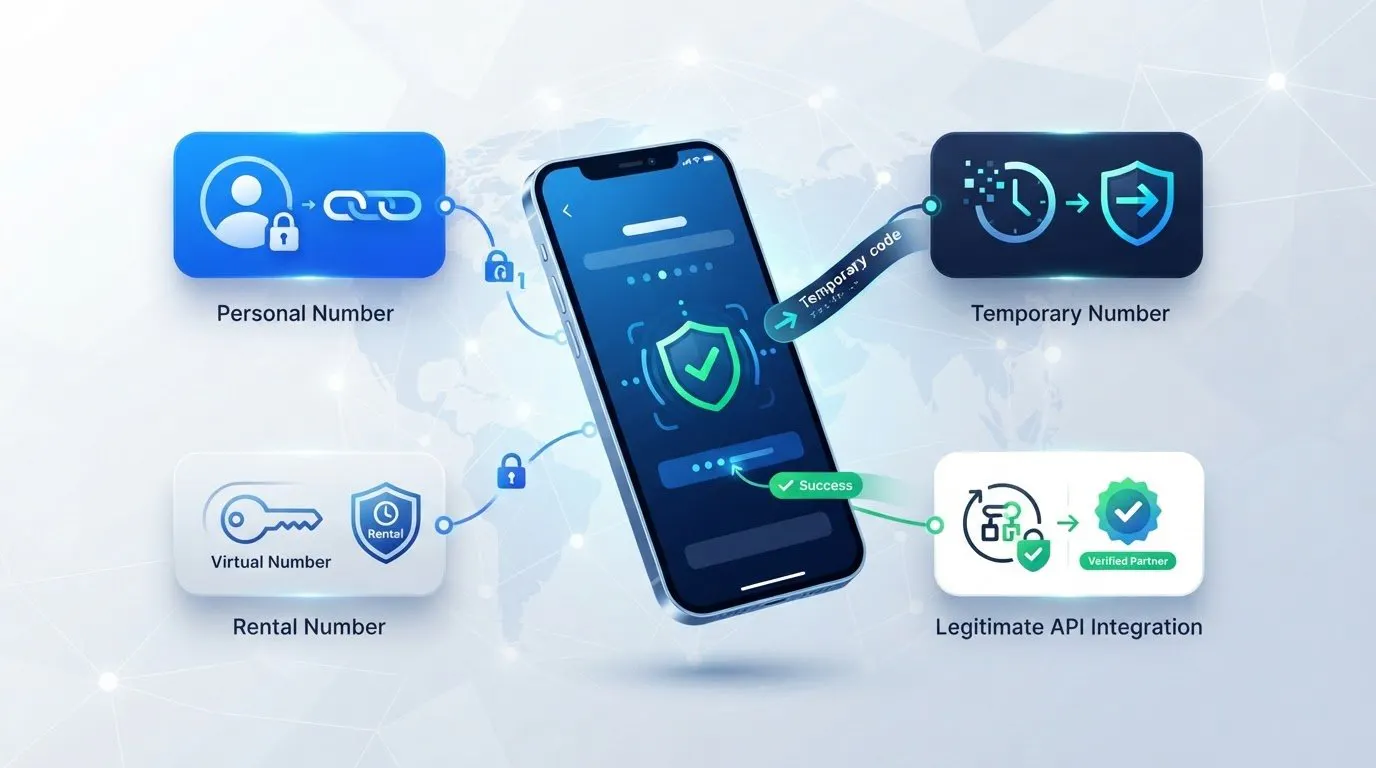
It’s reasonable to prioritize privacy and quick verification, but a one-time code and ongoing account access are different needs. A disposable number may suit a single verification; a rental can make more sense when you expect repeat codes or need continuity. Your personal number may be the practical option for an important account, while an API is intended for legitimate workflows that need integration or automation. No option guarantees that a particular platform will accept the number or deliver its message.
This guide compares personal, temporary, and rented numbers, along with API access, so you can match the option to your verification pattern. It also covers the trade-offs around privacy, number continuity, message delivery, and platform rules, helping you choose based on control and account importance rather than availability alone.
Key Takeaways
- Match your sms activate alternative to the account’s importance and how often you may need verification, not just the first code.
- Compare personal numbers, secondary SIMs, temporary activation, and virtual rentals by privacy exposure, control, and number continuity.
- Check the platform’s rules and supported number types before choosing; acceptance and code delivery can vary.
- Consider API access only if you’re building or automating a legitimate inbound verification workflow.
- Learn how Anosim’s activation, rental, and API options differ so you can assess whether they fit your requirements.
Table of Contents
- What Is an SMS Activation Alternative, and When Do You Need One?
- How SMS Activation Alternatives Differ in Privacy and Number Continuity
- Which SMS Activation Alternative Fits Your Specific Use Case?
- How to Evaluate an SMS Activation Alternative Before Using It
- Using Anosim as an SMS Activation Alternative
What Is an SMS Activation Alternative, and When Do You Need One?
An SMS activation alternative is another method or number option for receiving a text-message verification code when signing up for or accessing an account. It might mean using a different provider, a personal or secondary number, a temporary number for one verification, or a longer-term rental. The available options vary, and a third-party platform decides which number types it accepts.
Choose based on more than convenience. Privacy concerns may lead you to avoid sharing your personal number, while continuity matters if you expect to need future codes or account recovery. Account importance is another factor: a low-stakes, one-time signup has different recovery needs from an account you rely on. These choices concern receiving inbound SMS codes only; that does not imply the ability to send messages or make calls.
What users usually mean by an SMS activation alternative
The phrase can describe a replacement service or a different kind of number. It can also be confused with alternatives to SMS as an authentication method, such as an authenticator app. For context, Multi-factor authentication uses multiple types of evidence to verify identity, and SMS is one possible factor. Decide whether you need another way to receive a text or a different verification method altogether.
For a one-time signup, temporary access may fit if the account doesn’t require that number later. If you’ll need repeat verification, consider whether you can retain access to the number. Neither option removes the need to check the platform’s rules.
When a temporary number may not be the right fit
A temporary number can create a recovery problem if the account later asks for another code and you no longer control the number. Before using one, check whether the platform permits non-personal, temporary, or virtual numbers, and review its recovery options. If you can’t regain access without the original number, a number you control over time may be a better fit.
There’s no universal acceptance guarantee. A platform may reject a number based on its own verification requirements, and successful delivery can depend on the number and service involved. Use alternatives for legitimate account access, follow the platform’s terms, and don’t treat a verification number as a substitute for a recovery plan. Before choosing, ask: do I need a single code, ongoing access, or a non-SMS authentication method?
How SMS Activation Alternatives Differ in Privacy and Number Continuity
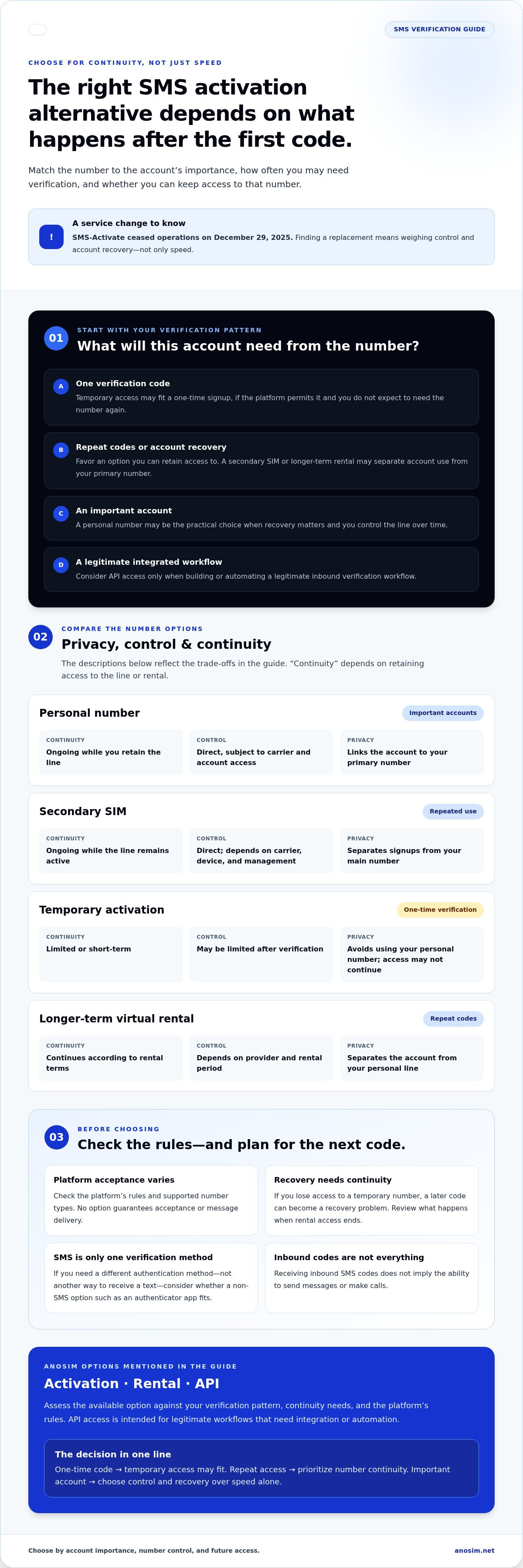
Number choice affects more than who sees your phone number. It also determines how much control you retain if a service requests another code later. A personal number is generally under your direct control, while a temporary activation is designed for a short verification task. Secondary SIMs and longer-term virtual rentals can separate account use from your primary number, but each has different retention and recovery considerations.
The best option depends on how long the account needs that number.
- Personal number: continuity is ongoing while you retain the line, and control is direct, subject to carrier and account access. It links the account to your primary number. Suitable for important accounts where recovery matters.
- Secondary SIM: continuity is ongoing while the line remains active, and control is direct, but depends on your carrier, device, and account management. It separates signups from your main number. Suitable for repeated use with a separately managed line.
- Temporary activation: continuity is limited or short-term, and control may be limited after the verification. It avoids using your personal number, but control may not continue. Suitable for a one-time inbound verification, if permitted.
- Longer-term virtual rental: continuity follows the rental terms, and control depends on the provider and rental period. It separates the account from your personal line. Suitable for repeat codes when continued number access is needed.
Temporary SMS activation versus a longer-term number rental
Temporary activation can fit a one-time inbound verification when you don’t expect to use the number again. A rental may be more appropriate if you need repeat codes or want to preserve access during a defined period. Before choosing, review how long access lasts and what happens when it ends. Readers considering continued access can compare longer-term virtual number options.
Shared or reassigned numbers add uncertainty: a later code could be unavailable to you, or the number’s history may affect how a platform treats it. Don’t assume that receiving one code means you’ll retain access for recovery.
Personal number or secondary SIM versus virtual number
A personal number offers direct continuity but connects the account to your primary line. A secondary SIM can create separation, though you remain responsible for the carrier plan, device, and account needed to keep it accessible. A virtual number may reduce exposure of your personal number, but control depends on the rental arrangement and platform acceptance. No option provides complete anonymity or guarantees acceptance.
If the platform offers alternatives to SMS, consider them for sensitive accounts. CISA explains stronger options, including phishing-resistant MFA. Match the method to both the account’s recovery needs and the platform’s terms.
Which SMS Activation Alternative Fits Your Specific Use Case?
The right sms activate alternative depends on what the number must do after the first code arrives. A routine signup, a business account with recurring verification, and a software test have different continuity and control requirements. Start with the account’s recovery needs, then check whether the platform permits your chosen number type.
- One-time signup: the priority is to receive one inbound code without using a primary number. Suitable option: temporary SMS activation, if permitted. Key limitation: it may not be available for later verification or recovery.
- Ongoing personal account: the priority is to retain access for repeat codes and recovery. Suitable option: a personal number, secondary SIM, or longer-term number rental. Key limitation: each option requires continued control and platform acceptance.
- Business operations: the priority is to maintain a number associated with recurring account access. Suitable option: a number the organization can manage over time. Key limitation: confirm ownership, access management, rental terms, and platform rules.
- Development: the priority is to integrate inbound verification into a legitimate workflow. Suitable option: an API, after reviewing its documentation and permitted use. Key limitation: integration does not ensure third-party acceptance or code delivery.
For one-time verification and routine signups
A temporary inbound SMS activation service may fit a low-stakes signup when you need a code once and won’t depend on the number again. For an important account, weigh that convenience against recovery: the platform may ask for another code later. Compare the available SMS activation options, and check the platform’s terms before selecting one.
For ongoing accounts, teams, and development
Recurring access calls for a continuity plan. A personal number or secondary SIM may offer direct control; a longer-term rental may separate work accounts from an employee’s personal line. For teams, decide who is responsible for retaining access and managing recovery before choosing a number. A rental doesn’t bypass verification controls, and the platform may restrict certain number types.
Developers should assess API documentation, expected responses, error handling, and permitted use before integrating a service. Keep the workflow limited to legitimate inbound verification, and account for failures without repeatedly requesting codes. API access supports integration; it doesn’t override the platform’s own rules.
Before deciding, verify the country, service, number type, and current availability for the option you’re considering. Availability can change, and no provider can promise acceptance by every third-party platform.
How to Evaluate an SMS Activation Alternative Before Using It
A short review before signup can prevent a mismatch between your verification need and the access a number actually provides. Use this checklist to assess an sms activate alternative without assuming that a listed number will suit every account or remain available indefinitely.
A five-step checklist for selecting a provider
- Define the use. Decide whether you need one inbound code, recurring access, or an API for a legitimate verification workflow. This determines whether a temporary option is sufficient or continuity needs closer review.
- Check the platform’s rules. Confirm that the account permits the selected number type and verification method. If the rules are unclear, consult the platform’s own guidance before proceeding.
- Verify current availability. Check the required country, service, and number type in the provider’s current information. Availability can change, so don’t rely on old listings or assume a number is offered for your specific case.
- Understand access and privacy. Review how long you can access the number and what happens when that period ends. Read the privacy information to understand how verification data is handled, retained, or shared.
- Review support and terms. Look for service-specific support information, usage limits, and the provider’s terms. Make sure you understand what to do if a code doesn’t arrive or you need access again.
For questions about Anosim’s services, consult its verification service FAQs and verify current details before choosing.
Security and account-recovery checks
Verify the recovery method before relying on a temporary number. If a critical account requires the same number to regain access, temporary access alone may leave you without a practical recovery route. Check whether the platform offers other recovery methods and set them up before you need them.
Treat verification codes as sensitive credentials. Don’t share them with another person or enter them on a page you haven’t confirmed belongs to the service you’re accessing. A provider’s privacy information and terms can help you understand its process, but they don’t replace the platform’s own security guidance.
After checking the platform’s rules, current number availability, access terms, and recovery path, choose the option that fits your actual use. If inbound SMS activation matches your requirements, review Anosim’s SMS activation options and confirm the relevant details before use.
Using Anosim as an SMS Activation Alternative
Once you’ve decided whether you need a single inbound code, continued access to a number, or a programmatic workflow, compare services against that requirement. Anosim offers inbound SMS activation, number rental, mobile VoIP rental, and API access. These options serve different workflows, so confirm current country and service availability, number type, terms, and third-party platform rules before use. No option guarantees that a particular platform will accept a number or deliver a code.
Choose between activation, rental, and API access
For a suitable one-time verification workflow, inbound SMS activation is the most direct fit. If you expect repeat codes or need to retain access, consider whether a number rental better matches the account’s continuity requirements. The rental terms and access period matter, especially if the number may be needed for recovery later.
For development, API access is relevant when you’re building or automating a legitimate inbound verification workflow. Review the documentation before integrating, including the current API behavior and any requirements that affect error handling. Anosim offers the Anosim API (v1) and SMS-Activate Standard API compatibility; check the Anosim API documentation to assess the integration for your use case.
Mobile VoIP rental is another listed service, but verify its suitability against the number type permitted by the platform you intend to use. Service availability and third-party acceptance can vary. An API or rental does not bypass a platform’s verification controls or terms.
What Anosim does and does not provide
Anosim’s SMS-related services are for receiving inbound text messages. The service does not deliver physical SIM cards and does not provide outgoing SMS or outgoing calls; only numbers from the Rent Mobile VoIP service can also receive calls. Choose it only if inbound verification meets your need; if you require outgoing calls, outbound messaging, or a physical SIM, this offering will not meet that requirement.
Before proceeding, confirm the relevant service, country, number availability, rental terms, and compatibility expectations. For a one-time need, compare available activation options after checking that the platform permits your chosen number type. If your workflow requires continued access or API integration, review the corresponding terms and documentation first. The best sms activate alternative is the one that fits the account’s verification pattern without creating an avoidable access or recovery problem.
Choose Verification Access That Fits the Account
The right sms activate alternative is the one that matches your need for privacy, continuity, and control. For a one-time code, temporary activation may be sufficient if the platform allows it. For accounts you may need to recover, prioritize continued access to the number and confirm the platform’s rules before signing up.
Also distinguish receiving a single inbound message from managing repeat verification or an automated workflow. Anosim offers inbound SMS activation and longer-term virtual number rental; developers can review Anosim API (v1) and SMS-Activate Standard API compatibility for legitimate integrations. Availability, terms, and third-party acceptance should be checked for your specific use.
Choose your use case first, then compare the available options against it. Compare Anosim SMS activation options to see whether they suit your verification needs. A little planning around number access and account recovery can help you move forward with greater confidence.
Frequently Asked Questions
What is the best alternative to an SMS activation service?
The best option depends on whether you need one code, ongoing number access, or a different authentication method. For a one-time verification, a temporary inbound SMS service may fit if the platform permits it. For accounts that need repeat codes, consider a number you can retain. If the platform offers an authenticator app or security key, that may be an alternative to SMS itself.
Are SMS activation alternatives safe to use?
They can be appropriate for some uses, but safety depends on the service, number access, privacy practices, and account’s importance. Review how the provider handles verification data and whether access to a number is shared, temporary, or retained. Follow the platform’s terms, and never disclose a verification code to another person or enter it on an untrusted page. No option removes the need for account-recovery planning.
Can I use a virtual number for account verification?
Sometimes, but acceptance depends on the platform’s rules and the number type. Before selecting a virtual number, check whether the account permits it and confirm that the relevant country and service are currently supported by the provider. A number that can receive SMS isn’t automatically accepted for every verification flow. Keep a recovery method available if the account may request another code later.
What is the difference between SMS activation and renting a number?
SMS activation is generally intended to receive an inbound verification code for a specific, limited need. Renting a number is intended for access over a longer period, which may be useful if you expect repeat verification. The exact access period and conditions depend on the rental terms. Before choosing, consider whether you’ll need the number for account recovery, not only the initial signup.
Can an SMS activation alternative guarantee that a verification code will arrive?
No. A provider can’t guarantee that every third-party platform will accept a number or send a code to it. Delivery can depend on the platform’s verification rules, the number type, current availability, and the service involved. Check compatibility information before use, but treat it as guidance rather than a promise. If a code doesn’t arrive, follow the platform’s approved verification or recovery process.
Should I use a temporary number for an important account?
Usually, avoid relying on a temporary number as the only way to access or recover an important account. If you lose access to that number, a later verification request could become a barrier to recovery. First review the platform’s rules and available recovery methods. For an account you depend on, choose a verification method and number you can continue to control.